iPhone Duo: screens crack at the fold and Apple acknowledges it, what to do if you have one?
An Australian buys his iPhone Duo on launch day. He opens it, closes it, plays with it, like everyone else. Six hours later, with fewer than twenty openings on the counter, he feels a small hard spot in the hinge, hears a snap, and a line of white pixels runs across the large screen. For a phone priced from 2,339 euros on Apple's French store, that stings. The price of a good laptop, cracked in one afternoon!
He's not the only one. Since the October 23 launch, photos of screens cracked in the same spot have been circulating on Reddit and on the forums of MacRumors, which quickly came up with a nickname for the affair: “Crackgate”. And on Monday, October 26, Apple responded.
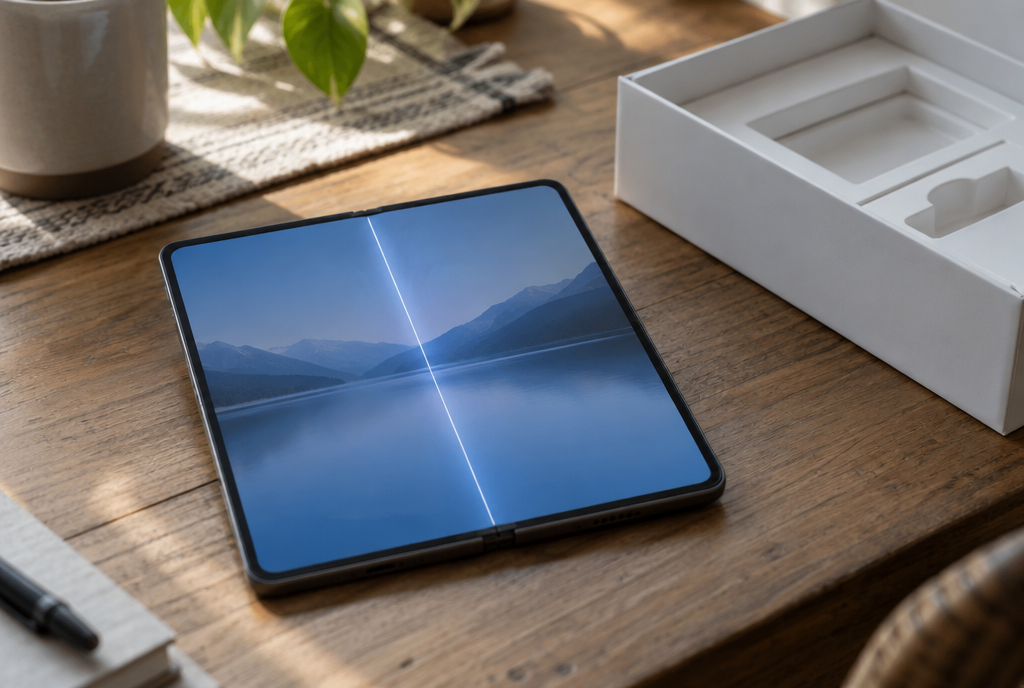
The white line along the fold: that's the symptom described by almost all affected owners
Apple isn't playing dead, and that's already something
Here's the sentence sent to MacRumors: “We are aware of an issue affecting the inner display of a small number of iPhone Duo devices.” And the rest: if your screen has a problem, contact AppleCare, Apple's after-sales service, for a replacement.
Three days between the first photos and the official acknowledgment. At Apple, that's almost the speed of light! Remember the iPhone 4 in 2010: its antenna would drop out when you held it a certain way, and the first response basically amounted to saying that you were holding it wrong. This time, no lecture on the right way to fold your phone. The Australian got a new device straight away, in store. Others are waiting a little, due to a lack of stock.
What Apple doesn't say, though: the cause, how many devices are affected, and whether there will be a fix. “A small number”, that's all.
What happens inside the hinge
The testimonies all sound alike. The crack appears in the lower half of the inner screen, right along the fold, shortly after purchase. And just before that, people describe the same thing: a feeling of blockage when closing it, sometimes a little “pop”.
To understand, you need to know what's under the screen. When the Duo is open flat, a support bar in the middle of the hinge holds the screen perfectly straight. When you close it, this bar has to disappear downward, so the screen can curve into a teardrop shape instead of folding sharply like a sheet of paper.
iFixit, the site specializing in repairs, took the Duo apart on October 25 and reconstructed the hinge in 3D, based on its teardown images, Apple's patents and a scanner. Their hypothesis: on some units, this bar might not descend far enough. As the screen curves, it would then press against an edge just a little below where the cable connecting the two halves of the phone runs. That's exactly where the cracks are concentrated. iFixit stresses that this is a lead, not a certainty.

A screen closing onto a part that should have disappeared: that's, basically, iFixit's hypothesis
32,000 folds without breaking, then broken on the twentieth?
Five days ago, I told you that the first tests all praised the hinge. Joanna Stern, a tech journalist, had built a robot called “Hingey” to fold her unit day and night: more than 32,000 folds in four nights, or almost two years of openings at a rate of fifty per day, and in the end, a hinge… just a tiny bit firmer than at the start. Others went even further, up to 75,000 folds by hand for a Polish YouTuber, and the phone still works.
So, who's lying? Nobody. These tests measure wear. The Duo's cracks look like early defects. In manufacturing, you draw this as a bathtub-shaped curve: lots of failures right at the start, on a few badly assembled units or ones slightly outside the tolerances, then a long quiet period, then wear failures, years later. A robot that folds a phone 32,000 times tests the straight section of the bathtub. It says nothing about the left section, because it tested only one unit, and apparently a good one.
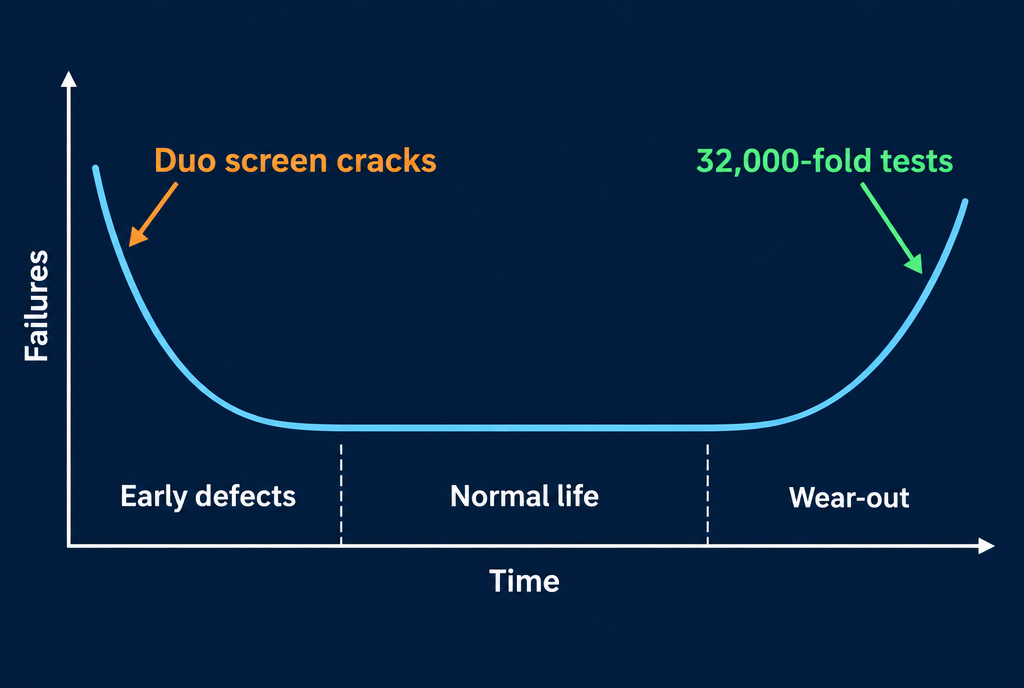
Folding tests measure wear, on the right. The Duo's cracks appear right at the beginning, on the left
For comparison, Samsung says its Galaxy Z Fold7 passed a 500,000-folding test. That's a Samsung figure, measured by Samsung. Apple, for its part, has published no such figure.
Watch out for the photos going around
One tasty little detail: MacRumors points out that some of the photos of cracks going around were made by an AI. Yes, even broken screens are being generated now. So, it's impossible to measure the actual scale of the problem from social media. A few very real cases, from Australia, the United States, Canada and China, and noise all around them.
Got one? Here's what I'd do
First, don't panic: according to MacRumors, most owners will never see this problem. But if you feel a hard spot or some strange resistance when closing it, don't force it. Don't close it again « to see if it works ». Go straight to a store or call AppleCare.
As for your rights, in Europe, you're better protected than an American. Alongside Apple's one-year warranty, the law gives you two years of legal warranty from the seller, everywhere in the European Union. And a failure that appears during the first year is presumed to have existed from the time of purchase: it's not up to you to prove that you didn't break anything. If you bought it less than fourteen days ago, you can also simply return it.
Why am I insisting? Because outside any warranty, iFixit recorded the price of replacing the inner screen in the United States: $999. For a single screen! To be fair, iFixit still gives the Duo the best repairability score ever awarded to a foldable, 5 out of 10, especially because its two batteries can be cleanly detached with a simple electrical current.

For now, Apple's answer comes down to one gesture: a new device, in a store
And if you were still hesitating about buying it? Me, I'd wait a few weeks. Not because the Duo is a dud, the tests remain excellent, but because the first units of a brand-new product are always the ones that take the knocks. By the time Apple finds the cause and fixes it at the factory, your wallet and your screen will thank you.
As for Hingey, Joanna Stern's robot: next time, Apple, lend it the first thousand units off the production line, not just the journalists' one!
Sources
- MacRumors, October 26, 2026: Apple's response to the cracked screens
- MacRumors, October 23, 2026: the first screens split along the hinge
- iFixit, October 25, 2026: the iPhone Duo teardown and the support bar hypothesis
- MacRumors, October 21, 2026: what 32,000 folds did to the hinge
- Digital Trends: the countries the reports come from
Article written with the help of Claude Code, proofread and corrected by me.
Join the conversation
You need an account to comment on this article. Creating one is free and takes under a minute.
No comments yet.