AI: OpenAI slashes its prices to poach Claude's clients, good news for developers?
In May, at Rippling, an American payroll and human resources software company, 57% of the coding work entrusted to AI went through Anthropic's models, those of Claude. OpenAI accounted for 16%. Five months later, it's the other way around: OpenAI 52%, Anthropic 18%. It's not that Claude suddenly became bad overnight. It's that OpenAI brought out the calculator.
According to The Information, reported on October 25 by The Decoder, OpenAI is handing out huge discounts to poach its competitor's biggest customers. The figures come from the customers themselves and a source close to the contracts: neither OpenAI nor Anthropic has confirmed them. But judging by what they say, it looks like it's working.

Two stalls, the same product, and only one seller who put things on sale
The discounts, case by case
The biggest case is Replit, a site that lets you create applications by chatting with an AI. It shifted most of its AI spending to OpenAI, in a contract worth more than $100 million a year, with a discount of more than 30%. Still according to The Information, Anthropic had refused to extend the discount Replit had with it, unless Replit agreed to spend even more.
At DataCamp, an online school of around 200 people, boss Jonathan Cornelissen says that OpenAI's rates brought his bill down by 80 to 90%. And an American bank saw its ChatGPT licenses double, to 500 employees, without paying a cent more: less than $7 per person per month, instead of the usual $20 or more.
A little amusing reminder: at the beginning of September, I was wondering whether GPT-6 Astra was really worth 2.5 times the price of its predecessor. Seven weeks later, OpenAI is holding a sale. The more economical models in its Sol and Luna ranges explain part of the drop. For the rest, according to The Decoder, OpenAI is buying market share by trimming its own margins.
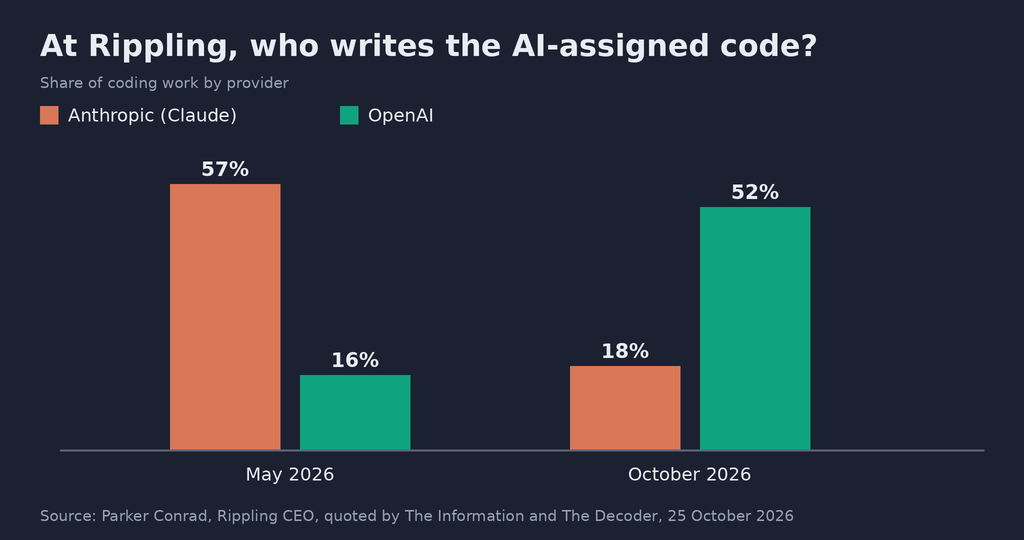
In five months, the two curves crossed at Rippling
The discount with a string attached
Here's the detail that made me stop and think. According to several accounts of The Information's article, the 40% discount given to DataCamp came with a condition: use Codex, OpenAI's programming tool, and not competitors such as OpenCode or Claude Code.
You see the principle? It's the low-cost airline. The ticket costs next to nothing, and then you discover that the suitcase costs extra, the seat does too, and that you can only travel with them. Once your whole team has got used to Codex, its scripts, its shortcuts, its settings, you don't just leave when the price goes back up.

The ticket is dirt cheap, it's the suitcase you pay for
Why Anthropic isn't following
Because Anthropic is preparing to go public, expected in November, and before selling shares to the public, it's better to show margins that hold up. The Wall Street Journal read the draft prospectus, the document that presents the company to future shareholders. For the first half of 2026, it shows $16.3 billion in revenue, compared with $1.1 billion a year earlier. Nearly $9 billion in computing expenses. And a loss of $80.7 billion.
This last figure is scary, but you have to read it all the way through: around $72 billion comes from an accounting entry linked to the way Anthropic raised money, not from actual cash that was spent. Don't worry, nobody left $72 billion in a taxi. That still leaves a hole of just under $9 billion in six months, which is already quite a lot. In this context, handing out 30% discounts to its biggest customers is complicated.
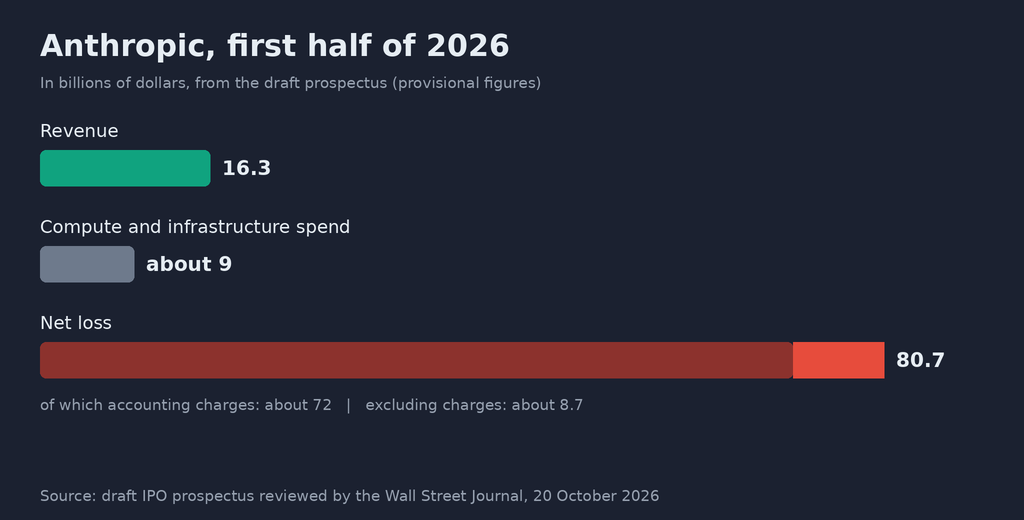
Of the 80.7 billion loss, around 72 is an accounting entry, not money actually spent
And for you who code with these tools?
First, the good news, and it's real: a price war between the two biggest providers means cheaper AI, first for big customers, and one day for everyone else. Discounts like these often make their way down into public pricing grids. And if you work for a company that pays for AI by volume, your boss will soon be wondering why he's paying full price.
And it's not just about developers. The ChatGPT or Claude subscription you pay around twenty euros a month for, a bank already gets for less than $7 per employee. The day those two also start fighting over individuals, your monthly bill will be the first to benefit.
I've already been doing a bit of this calculation myself. I keep Claude for thinking and making decisions, and I have some of the code written by much cheaper Chinese models. For those tasks, it costs me a fraction of the price. The day a tool offers me a discount on the condition that I can no longer switch, I already know my answer.
My advice, if your team is choosing its tool right now: never sign up for a price, sign up for an exit. Check that your settings, instructions and scripts can move from one tool to another without rewriting everything. Tools like Claude Code and Codex both read plain-text instruction files: keep them generic, and you'll be able to switch providers in an afternoon.
And to OpenAI, slashing its prices while Anthropic prepares for the stock market: nice timing, gentlemen. We'll see if the prices stay this gentle once the customers are properly settled in.
Sources
- The Decoder, October 25, 2026: OpenAI offers up to 90% discounts to attract Anthropic's customers
- Techpresso: Replit, Rippling, DataCamp and the Codex condition
- Angel Investors Network: Anthropic's draft prospectus according to the Wall Street Journal
Article written with the help of Claude Code, proofread and corrected by me.
Join the conversation
You need an account to comment on this article. Creating one is free and takes under a minute.
No comments yet.