Bitcoin: why is Bitcoin Core now publishing some vulnerabilities immediately?
For years, Bitcoin Core handled its vulnerabilities like a notary handles a will: in silence. Bitcoin Core is the reference software for the Bitcoin network, the one that verifies transactions on tens of thousands of computers around the world. When someone found a hole in it, the developers quietly plugged it, and only told the story months later, sometimes a year later. On October 22, they changed the rule. The reason can be summed up in one sentence: AI can now find certain vulnerabilities with a single question.

Hiding the key under the doormat is pointless when everyone knows to look underneath
Why vulnerabilities were hidden
The principle is called an embargo, and it makes sense. You find a vulnerability, you fix it, but you say nothing. Why? Because an update takes months to spread to all the computers on the network. If you announce the hole on the day of the fix, you give attackers the instructions while half the world is still running the old version. It's a bit like not shouting to the whole neighborhood that your back door doesn't close properly until the locksmith has been to everyone's place.
At Bitcoin Core, it worked like this: a low-severity vulnerability was disclosed two weeks after the version that fixed it. A medium or serious vulnerability waited until the last affected version was no longer maintained, roughly a year. A year of silence, to give everyone time to update.
The problem: AI reads fixes too
Antoine Poinsot, a Bitcoin Core developer at Chaincode Labs, explained it on October 22 on the Bitcoin developers' mailing list. They are receiving more and more reports of vulnerabilities that are “easy to (re)discover”, and that is, I quote, “largely because LLMs radically lower the bar” for finding certain types of bugs, or for spotting a fix slipped in quietly. LLMs are language models like ChatGPT or Claude.
And that's where the embargo falls apart. An AI can read your discreet fix, understand what it repairs and deduce the vulnerability. The secret protects no one anymore, it just delays the moment when honest users know they need to update. Poinsot says it bluntly: for these vulnerabilities, the embargo “doesn't accomplish much, but delays the release of a fixed version”. I actually talked about it last month: one of the two holes plugged in Bitcoin Core 32.0 had in fact been found with an AI model.
The new rule, in plain English
From now on, when a report comes in, the developers can put it in a new category: “easily discoverable”. The criterion is not that an AI found it, it's that an AI could find it without breaking a sweat. And for these vulnerabilities, no more hiding things: the fix immediately goes out to all versions that are still maintained, not just the next major version, a fixed version is released as quickly as possible, and the public security advisory, with the details, is published the same day. The locksmith shows up, and tells the whole neighborhood at the same time.
For all other vulnerabilities, nothing changes: two weeks for the minor ones, roughly a year for the medium and serious ones. And critical vulnerabilities, the ones that could create bitcoins out of thin air or split the network in two, keep their separate treatment. The change was proposed on October 16 and accepted on the 22nd. As I write this, no vulnerability has yet been put in the new category.
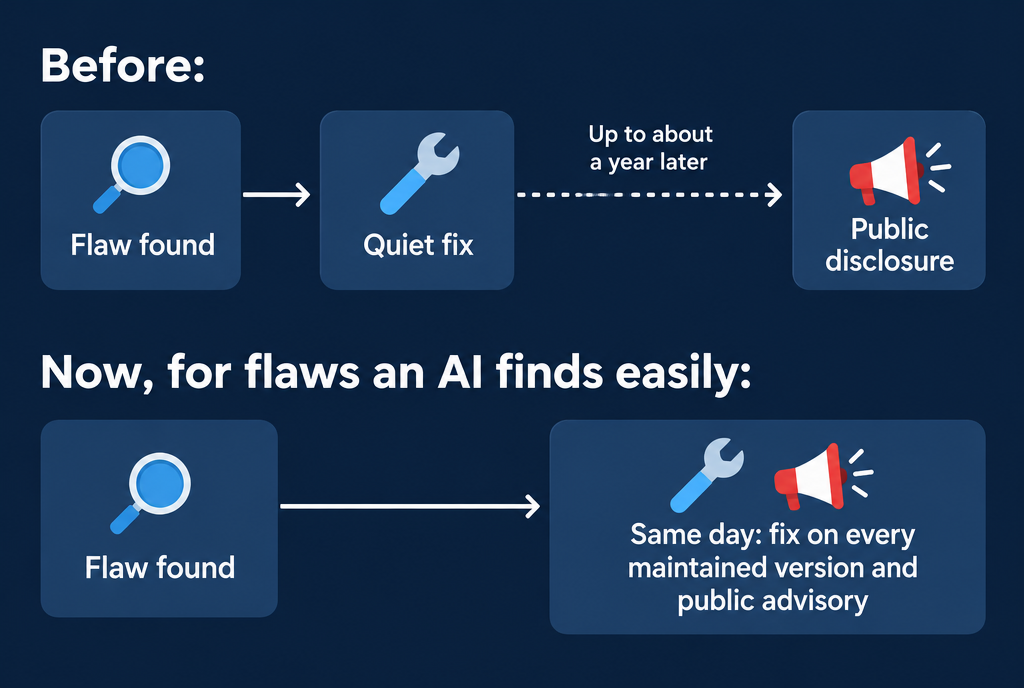
For vulnerabilities that an AI finds without effort, the fix and the announcement come out together
Where this comes from: 4,962 alerts in 27 and a half hours
This change doesn't come out of nowhere. This summer, after the massive theft linked to Coldcard wallets, whose keys were guessable (I told you about the case in August), a group of volunteers called itself the “Bitcoin Red Team”. Sixteen people, led by Rob Hamilton and the developer known as calle, unleashed AI agents on 390 Bitcoin-related projects: wallets, encryption libraries, tools for merchants. Bitcoin Core itself was not on the list.
Result, according to their August 4 report: 4,962 alerts in 27 and a half hours, including 85 deemed critical and 635 serious. All for more than $40,000 in computing, paid for by OpenSats, a foundation that funds free software developers around Bitcoin.
But watch out, an alert isn't a vulnerability. At the time of the report, barely more than one alert in five had been confirmed by a test that reproduces it. The rest is "maybe". AI finds things quickly, it finds a lot, and it also gets a lot wrong. That's precisely why developers are drowning in reports.
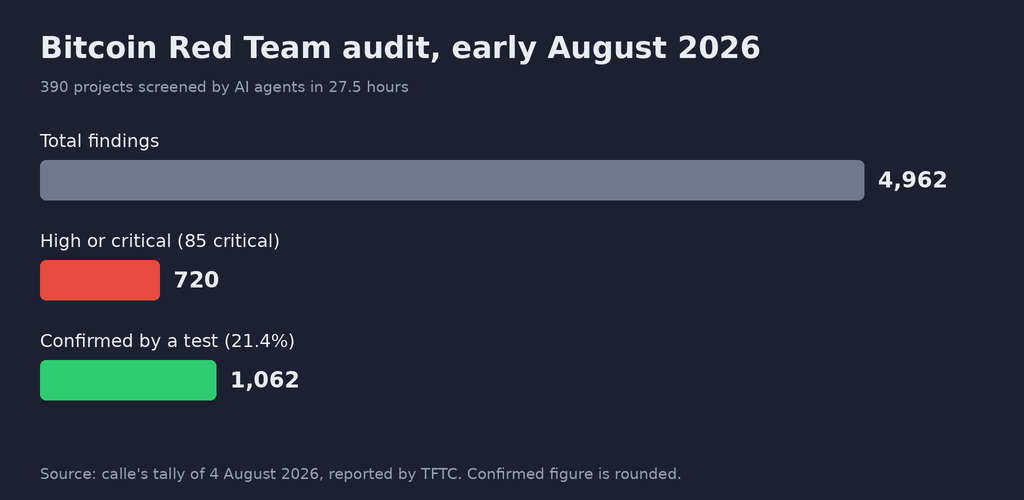
A lot of alerts, and only one in five confirmed at the time of the report
Okay, and what do you do?
If your bitcoins are sitting on an exchange or in your bank's app, nothing. They're the ones running this software, and they're the ones who need to update it.
If you're running your own Bitcoin Core node (a computer that checks all the transactions itself, instead of trusting someone), the good news is that you no longer need to jump to the very latest major version to be protected: versions that are still maintained will also receive the fixes. The bad news is that a vulnerability announced the very same day is a vulnerability that attackers also know about that very same day. Subscribe to security announcements on the Bitcoin Core website, and update in the following days, not months later.
And if you keep your bitcoins on a hardware wallet, that little device that keeps your key offline, it's the same reflex for its internal software. Manufacturers are also going to receive an avalanche of reports produced by AIs.
The update you keep putting off until later is the one you must stop putting off
My opinion
There is a real price to pay, and Poinsot doesn't hide it: a fix released quickly is a fix that has been tested less. On software that protects millions of people's money, that's not nothing. Other developers would have wanted to warn users even before the fix was ready; the rule they settled on publishes the notice at the same time as the corrected version, not before.
But frankly, I prefer this rule. Secrecy was protection designed for a world where it took an expert weeks to understand a fix. That world no longer exists. An AI does it in a minute, for the good guy as well as the bad guy. Might as well have the good guy warned at the same time as the bad guy.
And to everyone who has a Bitcoin node running at the back of a closet since 2022 without a single update: maybe it's time to go say hello to it.
Sources
- Bitcoin.com News: Bitcoin Core changes its security policy, quotes from Antoine Poinsot
- Decrypt via Yahoo Tech, October 23, 2026: Bitcoin Core rewrites its policy for a world where AI finds bugs
- Crypto Briefing, October 23, 2026: the new "easily discoverable" category
- TFTC: the Bitcoin Red Team audit, 4,962 alerts on 390 projects
- Bitcoin Core: the security advisories page
Article written with the help of Claude Code, proofread and corrected by me.
Join the conversation
You need an account to comment on this article. Creating one is free and takes under a minute.
No comments yet.