Crypto: 50 million Germans can buy bitcoin in their bank's app, what about Belgium?
Since Monday October 19, a customer of a German savings bank can open their bank's app, the one where they check their current account and pay their rent, and buy bitcoin in three screens. No account to open on an exchange platform, no extra password to remember, no little device to plug in. The Sparkassen network, these savings banks found in every town in Germany, has around 50 million customers, according to figures picked up by the German press at the launch. That's no small thing!
And in Belgium, you ask? It turns out we had that before them, in February. Except that in both cases, the bitcoin you buy isn't quite bitcoin like the others.
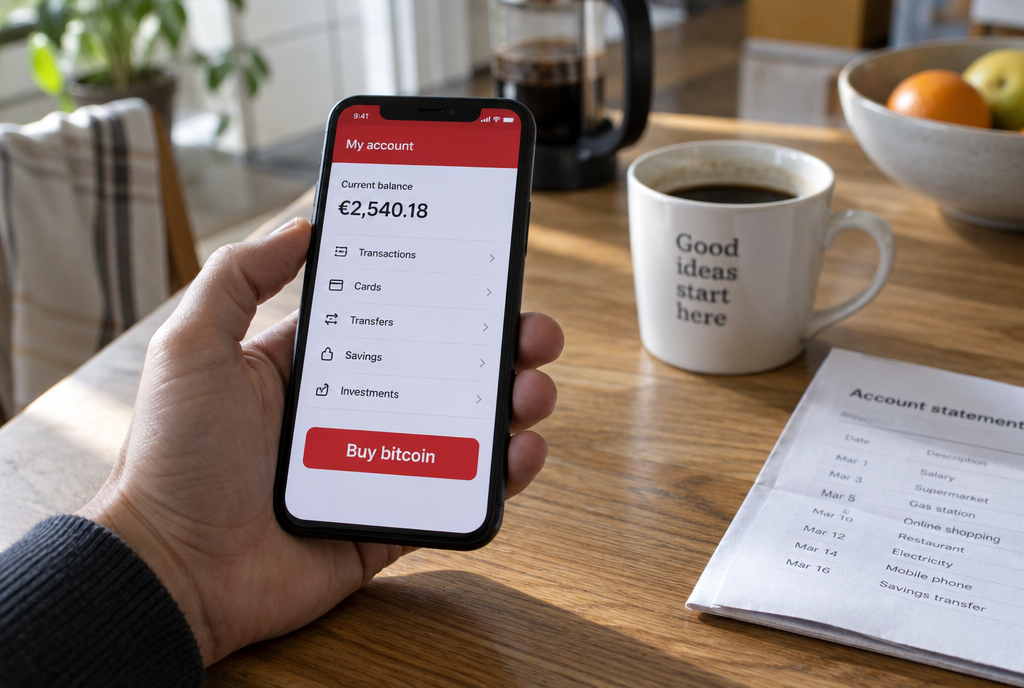
Between the rent and the groceries, one more button
What the Germans can buy
The service is called "Krypto, powered by Deka". Deka is DekaBank, the outfit that already manages the savings banks' investments, and it set up the system with the Stuttgart Stock Exchange. On the menu, five cryptos and not one more: bitcoin, ether (the currency of the Ethereum network), XRP, Solana and Polygon's POL. No "memecoins", those tokens born from a joke on the Internet, and no stablecoins either (tokens whose value is pegged to the dollar or the euro).
As for the price, Deka's fee schedule published in September announces €0.99 per order, for both buying and selling, up to €250,000 per transaction. Added to that is a gap between the buying price and the selling price, what is called the "spread": the bank guarantees you a price for a few seconds and pays itself from the difference with the market price. How much? Mystery, no Deka document puts a figure on it.
For now, only five savings banks switched on the button at launch, including the one in Frankfurt and the one in Karlsruhe. Each Sparkasse is independent and decides for itself when it gets involved. More than 230 have expressed interest according to the specialist press, and the federation of savings banks expects another 30 to 40 each month, with the aim of connecting a good part of them in the first half of 2027. And it warns, word for word: these are "highly speculative" investments. It won't advertise the product either.
The detail that changes everything: these aren't your keys
A bitcoin isn't a file you put away in a drawer. It's a line in a big public ledger, and to move it you need a secret key, a long string of characters. Whoever has the key has the bitcoin. Period!
At Deka, you never see this key. All the customers are kept in one single shared wallet, what the bank calls an "omnibus" wallet. Your share exists only in Deka's accounting records. It's the difference between a gold bar sitting in your safe and a line saying "10 grams of gold" on your statement: in both cases you own gold, but not in the same way.
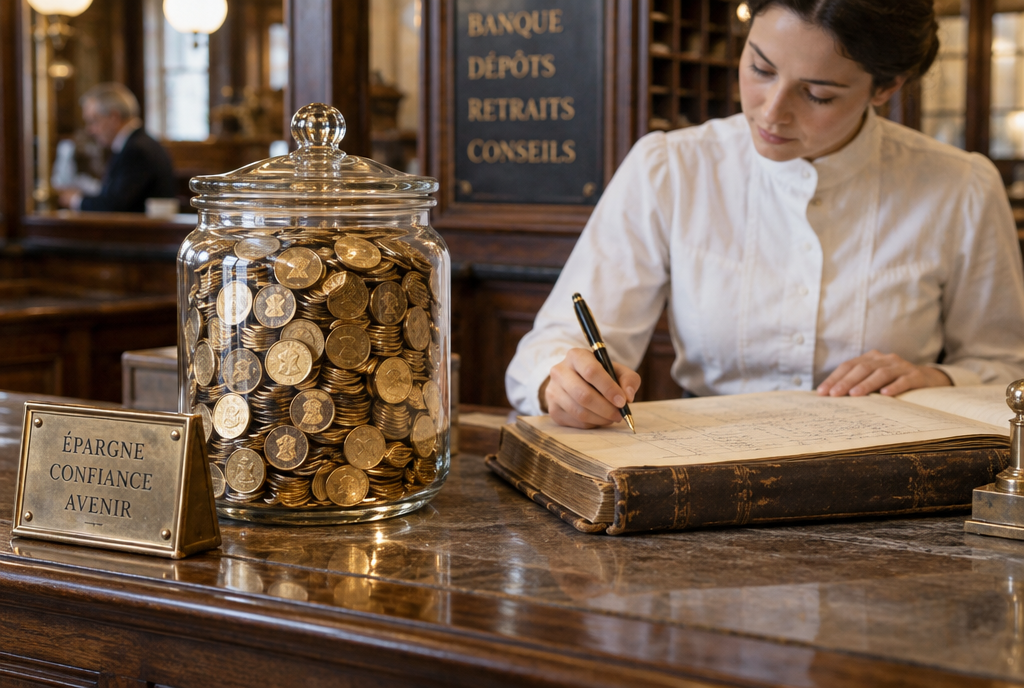
One jar for everyone, and your share in the banker's notebook
And there's something even more surprising. If you want to take your bitcoins out of Deka, you can only send them to other approved providers, a small list of companies approved by the bank. To your own wallet, that little device where you keep your key offline yourself, that's a no. (The device isn't foolproof either, I talked about it in August with the Coldcard affair and its guessable keys.) You have to take a detour through a platform that accepts sending them further on.
Why? The European anti-money-laundering rules require extra checks when you send crypto to an address that doesn't belong to any company, and Deka chose not to bother with that. You can understand it. But as a result, you own bitcoin more or less like you own shares in a fund: on paper, with someone else.
And what about here?
In Belgium, KBC opened the same kind of service on February 16, 2026, on Bolero, its online investment platform. It was the first major Belgian bank to do so. Here, just two cryptos, bitcoin and ether, and a short test to take before the first purchase to check that you understand the risks. And at launch, KBC presented its service as a closed circuit: you buy and sell in Bolero, without transferring anything outside.
The fees, on the other hand, are not alike at all. According to its crypto page, Bolero charges €5 per order up to €1,000, then €5 per €1,000 tranche beyond that (0.5%). On a small €50 purchase, a tenth of your stake goes on fees before you've even started, ouch. At Deka, €0.99, but with a spread whose size we don't know. Comparing the two down to the cent is therefore impossible, and those who tell you otherwise haven't read the small print.
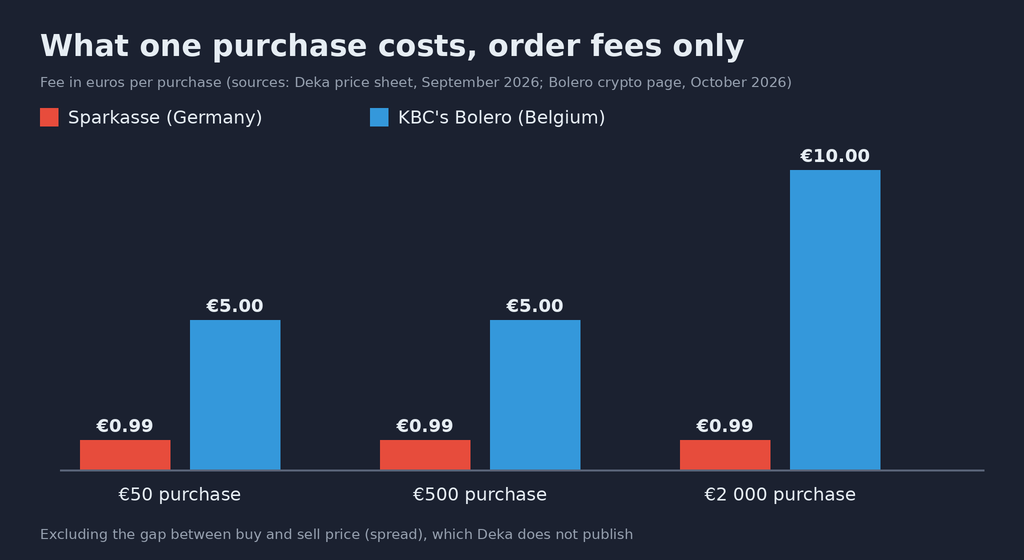
On paper, Germany wins. On the spread, we don't know
Can a Belgian use a Sparkasse? In practice, no: you need a current account at a participating savings bank, which means being a customer of a German bank.
Why banks are getting into it now
Behind both of them, there's the same text: MiCA, the European regulation that governs cryptos throughout the Union. It provides a fast track for banks. A bank that already has its licence doesn't need to apply for a new one, it simply tells its watchdog that it is adding cryptos to its offering. Deka did so with BaFin, the German financial watchdog. KBC did so with FSMA, its Belgian equivalent, after the Belgian law implementing MiCA came into force on January 3, 2026.
What this changes for you, concretely, is who you deal with. In case of a problem, you no longer look for a customer service department lost on another continent, you have your bank, its ombudsman and the law of your country. On the other hand, watch out, the deposit guarantee, the one that protects your savings account up to €100,000 if the bank goes bankrupt, does NOT cover cryptos. What protects you is the rule requiring the bank to keep your cryptos separate from its own money.
In short, 50 million people are going to see bitcoin appear between their current account and their savings account, without ever touching a key. I won't tell you whether it's the right time to buy, it's not my role and nobody knows. But I wonder how many of these customers will know that bitcoin, at its core, was invented precisely to do without banks!
Sources
- DekaBank: the page for the “Krypto, powered by Deka” offering
- crypto.news, October 20, 2026: Sparkassen launch trading in five cryptos
- Cryptoticker: October 19 launch, key custody and withdrawals
- Cryptoticker, October 10, 2026: fees and withdrawal limits at Deka
- Bolero: the crypto page and its rates
- Test-Achats Invest: Bolero opens up bitcoin and ether
Article written with the help of Claude Code, proofread and corrected by me.
Join the conversation
You need an account to comment on this article. Creating one is free and takes under a minute.
No comments yet.