Microsoft and Meta ration Claude Code: is the AI that codes too expensive?
Twenty-eight thousand dollars. In twenty-eight days. That's what a single Microsoft employee spent on AI, according to an internal table that employees fill in among themselves and that Yahoo Finance reported at the end of August. A thousand dollars a day, weekends included! I would've been fired on the spot if it had been me! And on Monday, October 5, The Information, a paid American website that investigates tech, published this news: Microsoft and Meta are tightening the screws on Claude Code, Anthropic's assistant that writes code directly on the developer's computer.
The figures first. At Meta, the number of employees using Claude Code dropped from around 60,000 at the start of the year to 30,000. At Microsoft, the internal bill from Anthropic was expected to exceed one billion dollars this year, and it was cut by more than a third. A Microsoft spokesperson confirms that the company is pushing its teams toward GitHub Copilot, its own coding assistant, even if engineers can still choose another model.

The AI receipt, when you use Claude's API
An AI that charges by the piece of a word
To understand how you get to 28,000 dollars, you need to know how a company pays for AI. Not by the month, like your Netflix subscription: by the token. A token is a small piece of a word, about four letters: a page of a novel is roughly four hundred. And the AI charges for every piece it reads and every piece it writes. When Claude Code works on a project, it rereads entire files, over and over again, it thinks, it corrects itself, it rereads, and every rereading goes through the checkout.
Do you remember the text messages that were paid for individually, before unlimited plans? The son who made his parents' phone bill explode by a few cents per message, and the father who discovered the statement at the end of the month? That was exactly my case at the end of the 2000s: my boss received a €3,000 bill for 10 KB with my brand-new iPhone, at a time when we paid for Internet data not only by usage, but by the time the connection stayed open.
But the record of 28,000 dollars needs to be taken with a pinch of salt. The table is filled in by the employees themselves, if they feel like it: around 350 people noted their AI spending there, out of more than 223,000 employees. And the middle figure, the one where half spend less and the other half more, is around 300 dollars a month. Even the CoreAI team, which makes Microsoft's AI tools and is the most voracious, stays below 1,000 dollars. The record is either an extreme case, or a typo.
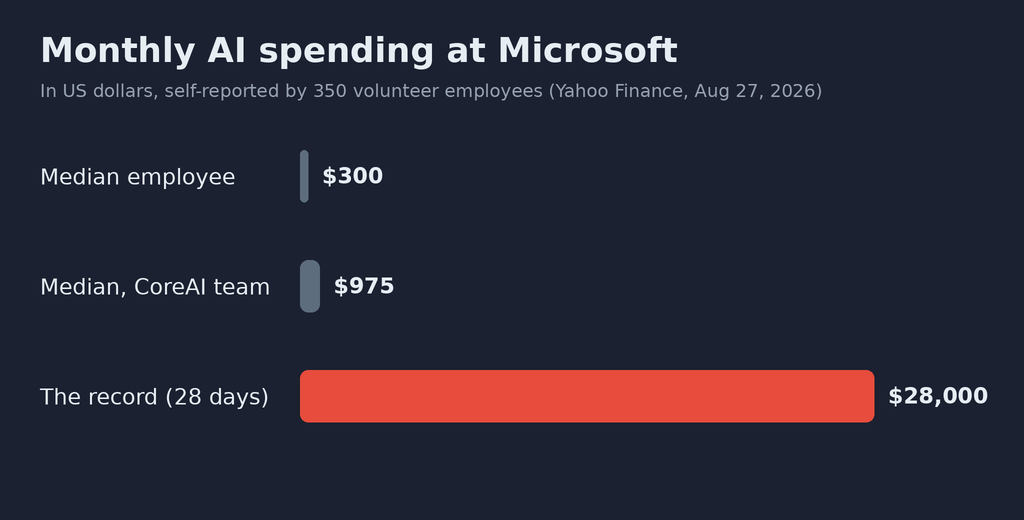
Half of the volunteers spend less than 300 dollars. The record is 28,000
"Tokenmaxxing", or burning through AI to look productive
This is where it gets downright funny. At Microsoft, dashboards displayed who was using AI the most. And when you measure people on one figure, some people make the figure go up! According to the Israeli website Ynetnews, employees allegedly inflated their consumption to climb these rankings, to the point that the phenomenon was given a name: "tokenmaxxing", Internet jargon for saying "push your tokens to the maximum".
In August, Jay Parikh, the boss of CoreAI, had to write it down in black and white in an internal memo: "tokenmaxxing isn't what we're trying to optimize." Translation: stop burning AI just to look good! It's the old trick of the intern who leaves his office light on until 9 p.m. so the boss sees it when he leaves, 2026 version.

Number 1 in the AI leaderboard this month. While he sleeps
Meta, for its part, is making its own Claude Code
At Meta, the story is a little different. Part of the drop comes from the layoffs in the spring, which affected about one employee in ten. But according to The Information, the real reason is that Meta built its own tools: MetaCode, reserved for its employees, already has more than 30,000 users, and Muse Code, a direct competitor to Claude Code, more than 6,000. Muse Code has even been tested by outside customers since August. Clever! Why pay the neighbor's tool by the bit of word when you have thousands of engineers on hand to make your own?
And at Anthropic, nothing is collapsing. What Microsoft saves internally, its customers spend on Claude through Microsoft's online services, so Microsoft's total bill at Anthropic remains more or less stable. The big customers are just starting to do their sums, like everyone else at the end of the month.
I'm on a flat-rate plan
Personally, I pay for Claude Code by the month, with a fixed-price subscription and a quota that resets every five hours. When I have three sessions open and I'm down to 12% before the reset, I do my sums like everyone else, and I explained a month ago why this quota melts so fast. But when I read that a Microsoft engineer managed to blow through more in a single month than what I pay over several years of subscriptions, I tell myself that the flat-rate plan is actually a hell of a good deal!
And that's where the good news in this story is: the giants are starting to ask themselves how much each AI dollar brings them in. When Microsoft and Meta make the competition work, AI companies have to lower their prices or do better for the same price, which ends up benefiting everyone, including the developer all on his own in his corner. You can already see it: Sonnet 5.5, Anthropic's mid-range model, does almost as well as Opus, the big model, for half the price.
If you're a developer at a company that pays for your AI, get ready to be asked the question anyway: "What did those hundreds of dollars in tokens bring you this month?" Three simple reflexes before your boss asks it:
- Choose the model according to the task: the big one for thinking about a project's architecture, the small one for chores, renaming files, writing tests or documentation. That's how I work, and my quota is doing much better for it.
- Don't make it reread the whole project for every question. Give it the two or three files that matter, it'll go faster and read fewer tokens.
- Keep track of what the AI saved you: a feature delivered in one day instead of three is much easier to justify than a token counter.

The biggest model for a chore: it works, but it costs
And the guy with the $28,000 bill?
As far as I'm concerned, Microsoft is right to blow the whistle on the end of recess. Measuring developers by the number of tokens they burn is like judging a carpenter by the number of nails he drives in: you end up with furniture full of nails. What matters is what comes out at the end, a program that works without bugs, and no counter measures that.
And to the $28,000 employee, if you really exist: I hope your code was really worth it, and that you still work at Microsoft.
Sources
- PYMNTS, October 5, 2026: Microsoft and Meta push their employees toward their own tools, according to The Information
- Yahoo Finance, October 5, 2026: Meta and Microsoft cut back on internal use of Claude (MetaCode, Muse Code, layoffs)
- Dealroom, October 6, 2026: Microsoft's total spending with Anthropic remains stable
- Yahoo Finance, August 27, 2026: Microsoft's internal spreadsheet, $28,000 in 28 days and Jay Parikh's note
- Ynetnews: "tokenmaxxing" and AI usage dashboards at Microsoft
Article written with the help of Claude Code, proofread and corrected by me.
Join the conversation
You need an account to comment on this article. Creating one is free and takes under a minute.
No comments yet.