A radio antenna made of air and laser: what can it be used for?
American researchers have made a radio antenna out of air and a laser. No metal rod, no mast, nothing: a beam that makes a wire of air glow in the void, and this wire sends out radio waves. They themselves say it looks like a laser sword. As a geek, it's a subject I like.
The work comes from North Carolina State University, with researchers from Texas A&M and Princeton. Their university announced it on October 5, and the study appeared in a scientific journal for radio engineers, the IEEE Journal of Microwaves.

Still no humming when you wave it around. Maybe that will come in version 2
An antenna, normally, is made of metal
A quick reminder to understand the feat. An antenna is a piece of metal in which electrons are made to move back and forth, very quickly. This back-and-forth sends radio waves through the air. And the length of the piece of metal determines the waves it sends best: that's why the antenna on your car's FM radio isn't the same size as a ham radio antenna, or the one hidden in your phone. One antenna, one frequency range, and if you want to change it, well, you change the antenna, that's why the roofs of buildings and the masts look like metal Christmas trees, with one antenna for radio, one for television, one for phones, and yet another one for who knows what.
Their idea: replace the metal with plasma. Plasma is air shaken up so violently that electrons are torn away from their atoms. It glows, and above all, it conducts electricity like a copper wire! You've already seen some: lightning is plasma, and so are old neon signs.
To make their plasma, the researchers fire a very powerful laser through the air. Set to the right power and the right diameter, the beam tears the electrons out of the air along a very thin wire. This glowing wire is the antenna. And since you can't solder a cable to air, they slid the beam through a metal ring that transmits the radio signal to the plasma without touching it. Nice!
An antenna that changes size in the blink of an eye
Here's where it becomes really interesting. The length of the plasma wire is decided by the laser's settings. Change the settings, and the antenna gets longer or shorter. In theory, a single antenna could therefore cover a whole range of frequencies, where several are needed today. And by moving the beam, you could also point it, without a motor and without a mast that pivots.
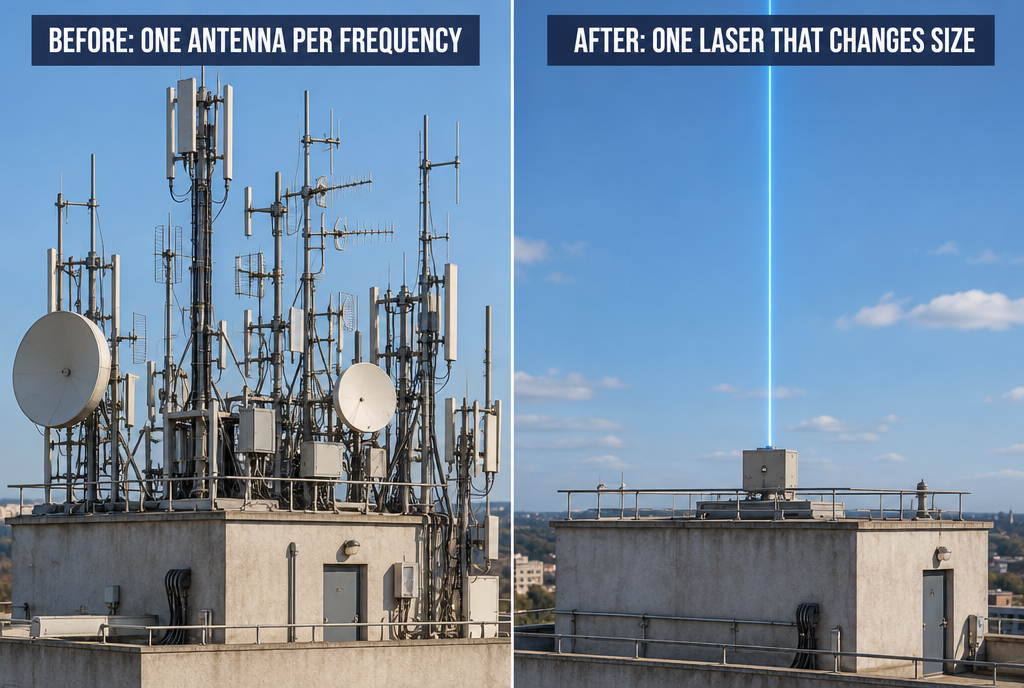
On the left, today's roof. On the right, the researchers' dream
Paul Franzon, one of the authors, sums up the appeal: you would get a custom antenna without a complicated mechanism to deploy. The researchers are thinking first of satellites and airplanes, where every kilo counts and where a folding antenna that gets stuck means a failed mission.
Well, the laser sword reaches 5 centimeters
You still have to look at the numbers, and they are modest. The antenna transmitted on a single frequency, 30 megahertz, very close to the one used by CB radio enthusiasts and their CB radios. The antenna receiving the signal was placed about 5 centimeters away. And the signal received was two and a half times stronger with the plasma wire than without it. This is proof that it works, not an antenna that covers a neighborhood. And nobody has yet shown that it can also receive, even though the lead author, Prya Darshni, sees no reason why it wouldn't work.
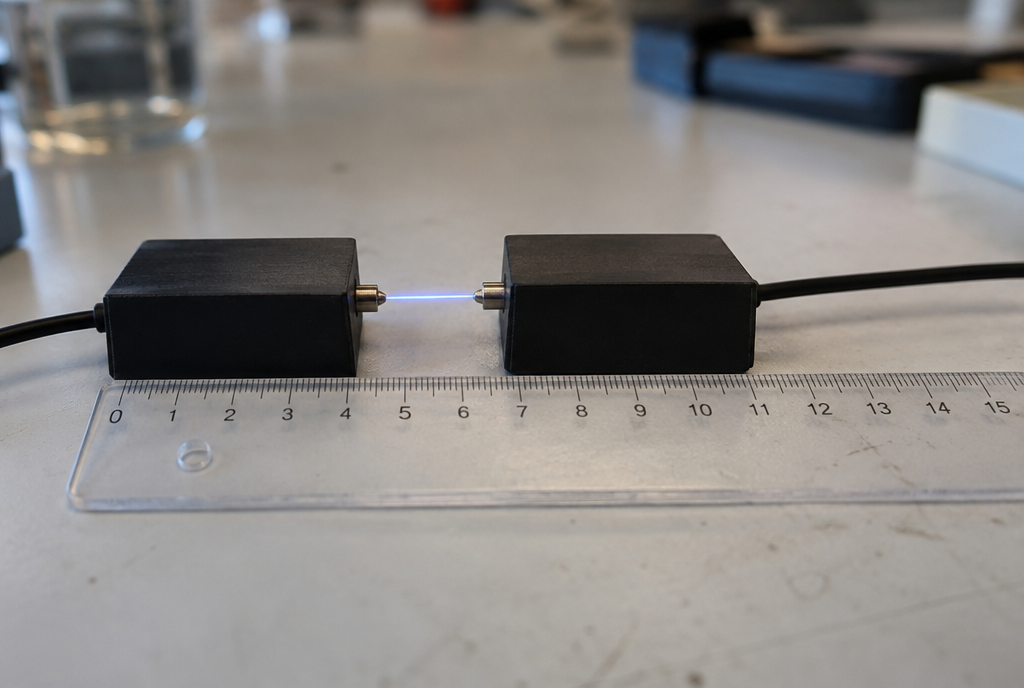
For now, the transmitter and receiver could almost kiss each other on the cheek
Prya Darshni says it herself: it's a first step, but a big step, because it's the first time anyone has shown that a plasma-wire antenna can work. And for once, no “telecom revolution” in the press release. Just an experiment that works!
And what does it change for you?
Today? Nothing. Your internet box, your phone and your car radio won't see any sign of it for a long time, maybe ten years, maybe twenty, maybe never.
But imagine where it could lead. Satellites that bring internet to rural areas without fiber need antennas, and every gram launched into orbit costs a fortune. An antenna made of light, weighing nothing, that doesn't fold and that changes frequency on demand, could one day make these satellites lighter, and therefore cheaper to launch. And what costs less to launch often ends up costing less on your subscription bill.
And we've seen this kind of story before. In 1960, when Theodore Maiman got the very first laser working, it was nicknamed “a solution looking for a problem”. Nobody knew what it could be used for. Fourteen years later, in 1974, a laser reader beeped the first barcode in a supermarket in Ohio, on a pack of chewing gum. Today, there's a laser in every supermarket checkout, and it's still the light from a laser that carries the internet through fiber to your home.

It took the laser fourteen years to find its first customer. A pack of chewing gum
I'm not saying that the plasma antenna will follow the same path. I'm saying you should never judge a lab invention by what it can do on its first day.
My opinion
For me, this is the most beautiful way to do science: no billions, no promise to change the world by Christmas, just three researchers wondering whether you can make an antenna out of air, and discovering that yes, you can, a little, over 5 centimeters. That's how the things we use without thinking about them start, thirty years later.
Sources
- NC State University, October 5, 2026: first demonstration of a plasma-beam antenna
- The Debrief: a laser sword that emits radio waves
Article written with the help of Claude Code, proofread and corrected by me.
Join the conversation
You need an account to comment on this article. Creating one is free and takes under a minute.
No comments yet.