Crypto: Glamsterdam, Ethereum's big upgrade, is being tested. What does it change for you?
Tuesday, October 6, at exactly 13 h 53 min 36 s (Universal Time, so 15 h 53 in Brussels), Ethereum switched to Glamsterdam. Not the real Ethereum, the one where the real ETH sleep: Sepolia, its test network, an exact copy where everything works the same way but with Monopoly money. And the developers aren't talking about a small update: for them, it's the biggest change since 2022, when Ethereum stopped mining. And according to specialist media outlet The Defiant, the first verification rounds on the test network went off without a hitch. Nice name, by the way: it's a contraction of Amsterdam and Gloas, the two halves of the update. Ethereum's developers have a sense of humor, or a serious problem with postcards.

The train is new, the track is a test track. The passengers will have to wait
First: you have nothing to do
I'll start there, because it's the most useful information in the whole article. If you have ETH on an exchange or in your wallet, your address, your keys, your balance and your app all stay exactly the same. There's no new token, no exchange to make, no gift to claim. Nothing.
So if you receive an email, an SMS or a message on Telegram along the lines of « Glamsterdam is coming, migrate your ETH before midnight or they'll be lost », it's a scam. One hundred percent. MoonPay, a crypto buying platform, sums it up very well in its explanation of the update : it's the deadline that gives the scammer away, a real update doesn't need anything from you. Every major Ethereum update brings its wave of fake messages, and this one won't be an exception, trust me.
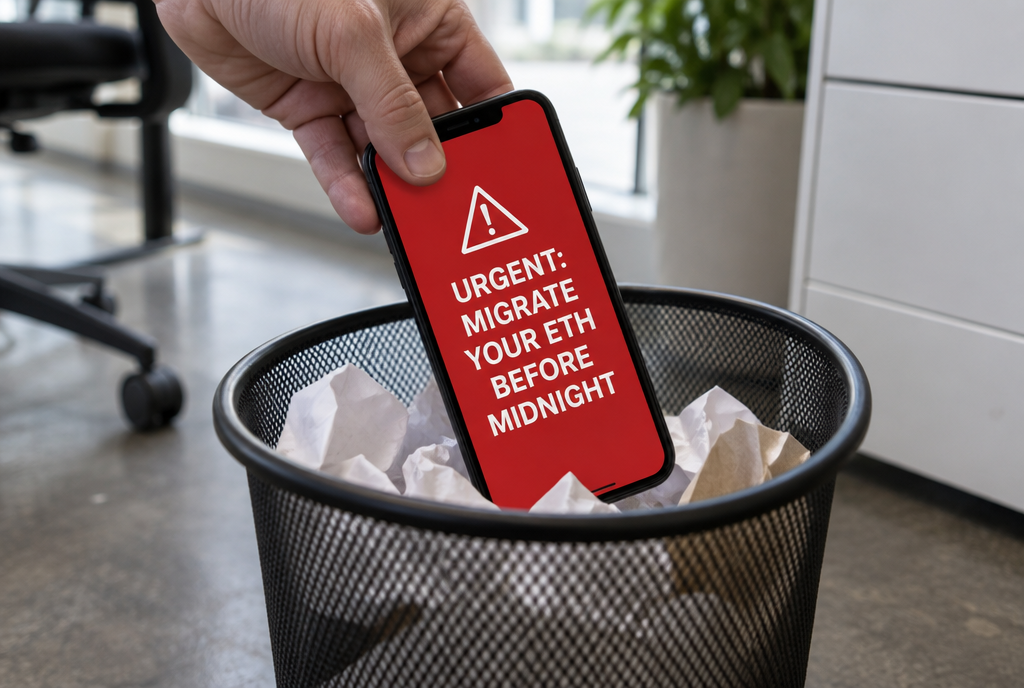
The only technical action Glamsterdam asks you to take. And even then, it's optional for the phone
More transactions at once, like at supermarket checkouts
To understand what comes next, two words. Ethereum records transactions in batches, « blocks », one every twelve seconds, like the pages of a big ledger. And each block has a maximum size, measured in « gas », the unit that counts the work transactions require. Today, a block can contain around 60 million gas. On the test network, with Glamsterdam, the developers are testing 200 million. More than three times as much room per page!
Why wasn't this possible before ? Because the computers that run Ethereum currently process a block's transactions one by one, in order. Glamsterdam adds to each block a list of everything it's going to touch, which accounts, which data. With this list in hand, the computers know in advance which transactions don't get in each other's way, and they can process them at the same time.

Ethereum's Saturday afternoon, before and after versions
And what does that mean for your wallet? The fees aren’t going away: they still depend on the crowd trying to get through at the same time. But more space means less jostling during peak hours. Glamsterdam is also revising the price of each operation: according to MoonPay, a simple transfer of ETH from one account to another will consume up to 71% less gas, in other words more than three times less. On the other hand, creating a new account or installing a new program on the chain will cost more. It makes sense: we are finally paying for what really clogs up the network.
The block builder goes to the notary
The other big piece is more discreet, but it matters. When you send a transaction, you are not the one writing it into the chain: they are block builders, a few specialised players, who assemble the batches and choose the order. The problem is that around 88% of blocks currently go through intermediaries who are subject to no official Ethereum rules. It works because everyone trusts them. That’s a handshake.
Glamsterdam is writing this relationship into the network’s rules themselves. A group of validators, the computers that verify the chain, now checks that the selected builder actually delivers its block on time. Trust no longer rests on the reputation of an intermediary, but on code that everyone can read.

Same deal, same people. Except that on the right, someone kept a copy
When is it happening?
Good question, and nobody has the answer. There is still no official date. The second test network, Hoodi, is provisionally scheduled for October 27, and the real Ethereum will only have its date once both tests have gone smoothly. The stated goal is the end of 2026. But I’ll remind you that Glamsterdam was initially expected in the first half of the year, then this summer, and that the move to Sepolia itself had been pushed back from August 3 because of bugs on the test networks.
My opinion
These delays annoy the impatient, and I understand them. But I would much rather have an update that slips by six months than a network holding billions that crashes on a Tuesday morning because we wanted to stick to a date. Testing in front of everyone, on a copy, before touching the real thing, is exactly what you expect from people who manage other people’s money. And for someone who holds a little ETH in Belgium, the message fits in one line: do nothing, and click on nothing.
Sources
- 99Bitcoins via TradingView: Sepolia prepares the ground for Glamsterdam
- crypto.news: Glamsterdam on Sepolia, a test of a 200 million gas limit
- investingLive, October 7, 2026: Glamsterdam in plain English (88% of blocks through intermediaries)
- MoonPay, September 15, 2026: what Glamsterdam changes for you (fees, scams)
Article written with the help of Claude Code, proofread and corrected by me.
Join the conversation
You need an account to comment on this article. Creating one is free and takes under a minute.
No comments yet.