Crypto: Ethereum has reviewed 62 proposals for its 2027 update. Two were accepted.
Crypto: Ethereum reviewed 62 proposals for its 2027 update. Two were accepted.
Imagine a company publishing the internal memo where its engineers rank their own projects, including the rejected ones, the hesitations and the disagreements. It never happens.
That's what the Ethereum Foundation's research team did on September 7. Sixty-two proposals put through the sieve, a note for each one, and the list made public.

Of the sixty-two cards spread across the table, only two came back with the note “this one, we’re shipping”.
A word of vocabulary before anything else. At Ethereum, every change goes through a public form called an EIP, for improvement proposal. Anyone can submit one. It has a number, it is discussed, it is accepted or rejected. It's the mandatory counter, and there's a line.
How sixty-two proposals are scored
The method is simple enough to be pleasing. Sixteen contributors scored each proposal separately, without consulting one another. S is worth 4 points, A is worth 3, B is worth 2, C is worth 1, and rejection is worth zero. In total, 397 scores, or a little more than six opinions per proposal. Only then did they discuss them together.
This is the first time this team has published a single opinion. Before, each group gave its own separately, and go figure what was going to come out.
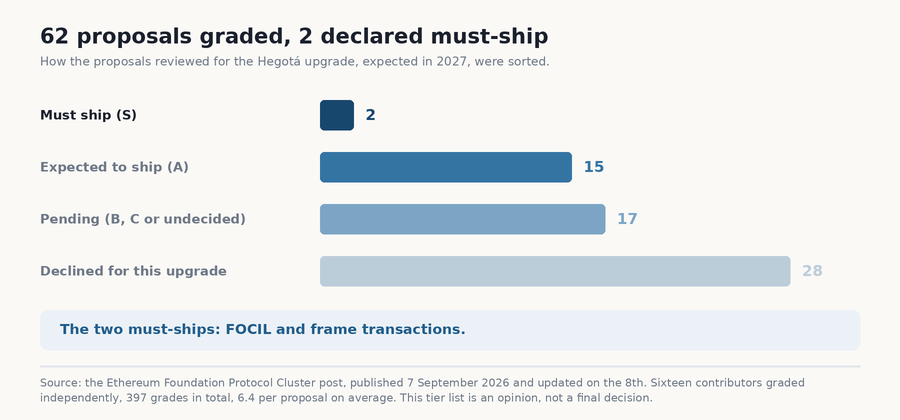
Twenty-eight proposals rejected all at once. It's not a purge, it's what a shopping list is for: choosing.
Two proposals got an S. They have nothing to do with each other, and taken together they tell you quite well where this chain is headed.
The first: so nobody can refuse your transaction
It's number 7805 and its little name is FOCIL, for “forced inclusion lists imposed by the chain choice rule”. In plain English: lists of transactions that have to be included. It got an S unanimously, the only one in the bunch, and it's been in the pipeline since November 2024.
To understand what it's for, you need to know what happens when you send a transaction today. You don't write it directly into the chain. It goes into a waiting room, and an actor called a block builder puts together the package of transactions that will be recorded. It chooses which ones get in and in what order.
There aren't many of these builders. Very few. And an actor who isn't one of many deciding what gets in, that's called a gatekeeper.

Today, if the gatekeeper doesn't want your transaction, it waits. FOCIL is meant to take that power away from him.
FOCIL adds a parallel path, and the mechanism is clever. Each round, a committee of sixteen validators is chosen at random. Each one looks at the pending transactions and puts together their list of the ones that have to be included. The builder is then forced to take them, because the other validators refuse to validate a block that ignored them. He doesn't lose his job, he loses his veto.
Is this a real problem or a theoretician's worry? Both, honestly. Mass blocking hasn't happened. But the possibility exists, and today it rests on the goodwill of a few actors. Unanimity among sixteen engineers who didn't consult one another means they all think it's necessary.
The second: change the lock before the key can be copied
The second one is called EIP-8141, frame transactions, and it's the stranger of the two. Among its authors is Vitalik Buterin, Ethereum's cofounder.
Today, what proves that an account belongs to you is a mathematical signature of a unique type, the same for everyone since day one. It relies on elliptic curves, a method that today's computers cannot crack. With a sufficiently large quantum computer, it becomes readable. We're not talking about guessing your password: we're talking about recovering your private key from information that is already public.
The proposal breaks a transaction down into a series of programmable pieces, up to sixty-four, each taking care of one thing: checking that you have the right, paying the fees, executing the operation. It looks like a plumbing detail. Except that if verification becomes a little program that your account carries itself, then the signature is no longer imposed by the protocol. You can change it.
The proposal's official text says it plainly: it provides “a native path out of the elliptic-curve cryptographic system used today to authenticate transactions, toward quantum-safe systems”.

The door hasn't been forced, the burglar doesn't exist yet, and we're changing the lock anyway. This is exactly the right time to do it.
Because we need to be honest about the timeline: the quantum computer capable of breaking these signatures doesn't exist. We're still at the stage of connecting two refrigerators together to fit more qubits into the same machine, and that was less than three weeks ago. Nobody knows whether the deadline is eight years away or thirty.
But changing the signature method of a chain that carries millions of accounts isn't something you do in a weekend once the fire has started. You prepare for it years in advance, calmly, while everything is going well. Another proposal in the batch, 8365, is starting to remove old vulnerable identifiers, by the way: the post describes it as the only truly post-quantum element that belongs in this update.
What this ranking is not
I'm going to slow down a bit here, because half the write-ups I read this week are mixing everything up.
This isn't a decision. It's an opinion, that of a research team, published to be discussed and challenged. The authors say so themselves and they have scheduled a public question-and-answer session for September 16. They even produced a list of ongoing disagreements alongside it, something I'd like to see more often elsewhere.
This isn't for tomorrow either. The Hegotá update is expected in 2027, and it comes after another one, Glamsterdam, planned for late 2026. Proposal 8141 is still at the official draft stage.
What this ranking does say, though, is the direction. The S rank commits us: if the schedule slips, we cut the As before touching the top two.
Concretely, if you hold crypto
Nothing to do today. No button to click, nothing to prepare, and above all no urgency to invent.
What changes will show up in two or three years, and this is what it will look like.
Your transactions will go through without depending on the goodwill of a few players. Concretely, no intermediary will be able to decide that your transfer, specifically, will have to wait. That probably never happens to you, and that's precisely the point of a guarantee: it serves you on the day it happens.
Your wallet will be able to change its signature method without you moving your funds. That's the point that matters most on the day quantum computing becomes a real threat: the difference between updating your application and panickedly moving all your assets to a new address, at the same time as the whole world.
And your account will be able to do simple things that are complicated today: pay fees in something other than the chain's currency, chain two operations together in one, change keys without changing addresses. This is the kind of improvement nobody ever talks about and that nevertheless determines whether your grandmother can use it.
One last remark, and this is the one I remember. While we're tearing each other apart over prices and promises, a few dozen engineers are scoring proposals at four points, publishing their disagreements and arranging to meet on Reddit to get yelled at. The boring work, the kind you never see going by. It's this work, though, that decides whether all this will still be standing in ten years.
Sources
- Ethereum Foundation : The Hegotá EIP Opinion Post and Tier List, published on September 7, 2026 and updated on the 8th, the original post with the scoring method, the sixteen contributors, the 397 scores, the complete ranking and the question session on September 16
- EIP-8141 : Frame Transaction, the official text of the proposal, its authors including Vitalik Buterin, its filing date of January 29, 2026, the division into sixty-four frames and the sentence about moving toward quantum-safe signatures
- EIP-7805 : FOCIL, the official text of the proposal on including transactions without depending on block builders
- Blockchain.News : Ethereum Foundation grades 62 EIPs for Hegotá upgrade, September 7, 2026, the breakdown by rank and the schedule for the upgrade
Join the conversation
You need an account to comment on this article. Creating one is free and takes under a minute.
No comments yet.