Mistral Large 4: can the big French model stand up to Claude and ChatGPT?
Mistral, the French company that makes AI from Paris, released its biggest model on October 6: Mistral Large 4. One trillion parameters. And its official little nickname, I'll give you one guess: “Le Chonk”. On the internet, a “chonk” is a very chunky cat, the kind that no longer fits through the cat flap. When you know that Mistral's assistant is called Le Chat, the joke is carried right through to the tips of its whiskers!
I've only got one question: is it as good as Claude and ChatGPT, or is it just a very big number in a press release?
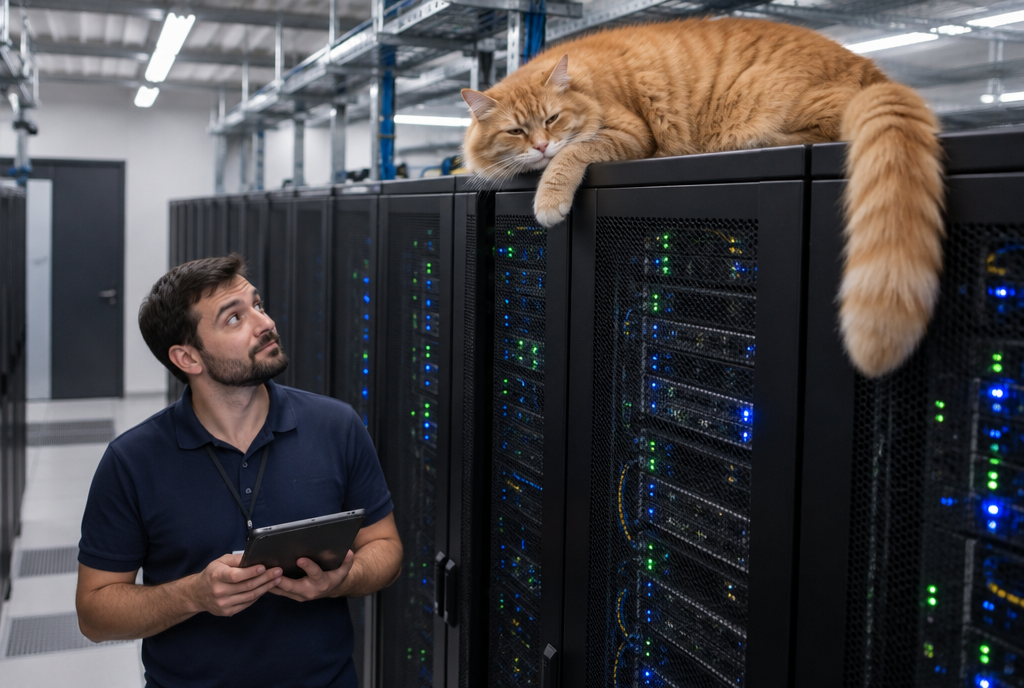
One trillion parameters, and it still found the only warm spot in the room
One trillion what, exactly?
A parameter is one of the little settings the model learned during its training, a bit like the connections in a brain, and the more of them there are, the more things it can remember, so one trillion, yes, that's huge, we're playing in the same league as the biggest American and Chinese models. When I read the number, I first thought it was a typo.
But there's a trick, and it matters for the price! For every word it writes, Le Chonk only makes 49 billion of them work, barely one twentieth. Specialists call this a “mixture of experts”: imagine a hospital with a thousand doctors, but you only see two or three of them, the ones who know your problem. The others don't move, and they don't cost you anything. That's why such a huge model can be sold so cheaply.
You can show it an image, it replies in text, and according to Mistral it speaks more than 160 languages, including the European Union's 24 official languages, Maltese and Irish included. It was trained on 3,800 Nvidia chips, in Mistral's server rooms, in Europe. For now it's a preview, a trial version still being fine-tuned, open to developers. The complete model, available to download, is announced for the end of the month, October 27 according to VentureBeat.
Up against Claude and ChatGPT: price first
This is where it hurts. AI companies charge developers per million “tokens”, pieces of words, roughly 700,000 words, several novels. Here's what a million response tokens cost, according to the prices published by each company on October 7:
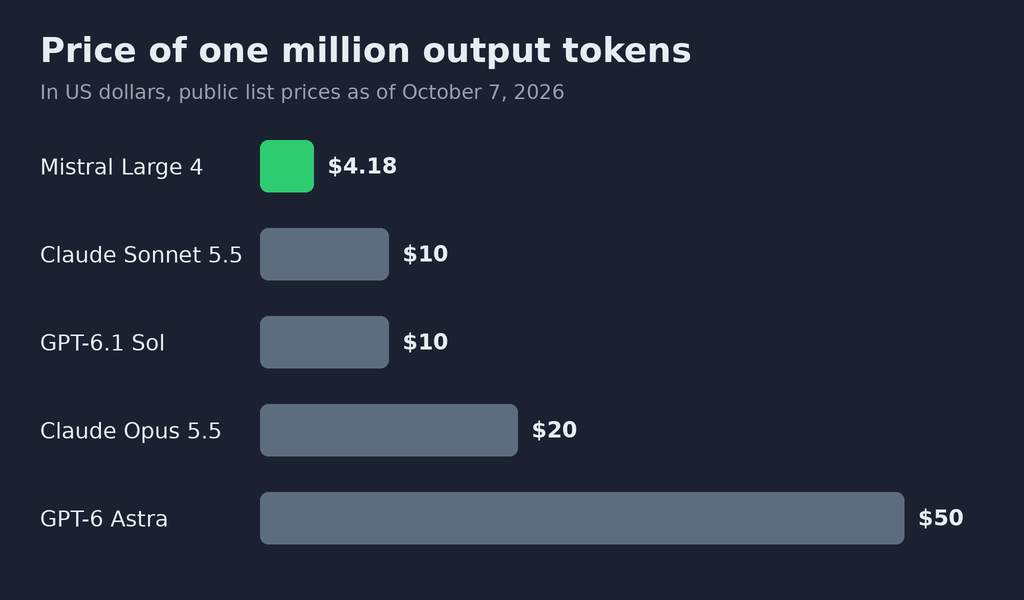
For a one trillion parameter chat, the smallest bar is still his
Less than half the price of Claude Sonnet 5.5 or GPT-6.1 Sol. Almost five times less than Claude Opus 5.5. And twelve times less than GPT-6 Astra, OpenAI's biggest model. Twelve times! You don't pay per token when you chat with ChatGPT, but the apps you use every day do pay. And an app that pays twelve times less for its AI is a subscription that can get cheaper, or a free version that can exist.
And the quality? Here, you have to be honest
Okay, let's be serious for two minutes. All the figures that follow come from Mistral itself, and this is a preview. They're company figures, they should be read as such.
In programming, on a test where the AI has to fix real bugs in real projects, Le Chonk succeeds 62% of the time. It beats the best freely downloadable Chinese models, DeepSeek V4 Pro (57%) and Qwen 3.8 Max (51%). But VentureBeat did the work the press release doesn't do: on the public ranking for the same test, Claude, GPT-6 and Gemini hover around 74%. A twelve-point gap is something you feel every day.
Same thing in a blind test, where human graders rate the answers without knowing which model wrote them. Le Chonk finishes second out of five with 3.74 out of 5. The first? Claude Opus 5, Anthropic's previous generation, at 4.22. Not bad at all, but not first.
There is one area where it crushes everyone, cybersecurity: 82% on a test where you have to reproduce and fix real vulnerabilities, the best score ever published according to Mistral. But Mistral itself points out that Claude Opus 5.5 and GPT-6 Astra score almost zero on this test… because they refuse to take it. They are set up to say no to hacking questions.

World champion in the 100 meters. The other two refused to run
Winning a race where the others do not run still gets you a medal, but it is not quite the same. And it raises a real question: a model that agrees to talk about vulnerabilities, and that anyone will be able to download at the end of October, is a godsend for those defending a network… and for those attacking it. Mistral says it resists 93% of manipulation attempts on a test by the Lakera company. We will see how it works in practice.
What it changes for you, even if you do not code
The real appeal of Chonk is not being the best. It is being downloadable and European. When the hospital in your area, your health insurer or your municipality wants to use AI to sort files, today it often sends those files to an American company's servers. With a model you download, it can install it in its own server room, in the basement, and your data never leaves the building. Mistral says it in black and white, the model will be able to run “on site”.

The kind of trip your medical data can very well do without
But do not dream of running it on your PC. A little back-of-the-envelope calculation: even compressed as much as possible, a model with one trillion parameters requires more than 500 gigabytes of memory. Your graphics card may have 16. For that, you need a model like Meta's that I talked about in August, which runs on a graphics card. Chonk, on the other hand, is for a company with a server cabinet, or for you through Le Chat or an app that uses it.
One last reservation, and not a minor one: the license has not been published yet. Mistral promises “open weights”, meaning the complete model available for download, but we do not yet know what we will be allowed to do with it. See you on the 27th.
My opinion
I code all day with Claude Code, and I am not going to change tomorrow morning: a twelve-point gap in programming is the difference between a colleague who understands on the first try and a colleague you have to repeat everything to. But I find it genuinely delightful that a European company is releasing a model this size, trained here, sold at half the price of the Americans, and that we will be able to install at home. Two weeks ago, I was wondering which model to choose between Grok and MiMo. Well, there is one more candidate, and this one speaks French!
And to the Mistral team: well done on the chat, but for Large 5, a diet would not hurt. We want a model that fits in a computer, not in a warehouse!
Sources
- Mistral AI, October 6, 2026: announcement of Mistral Large 4, figures and pricing
- VentureBeat, October 6, 2026: Mistral Large 4, the figures compared with the public ranking
- OpenAI: GPT-6.1 Sol, pricing (and that of GPT-6 Astra)
- Anthropic: pricing for Claude Opus 5.5 and Sonnet 5.5
Article written with the help of Claude Code, proofread and corrected by me.
Join the conversation
You need an account to comment on this article. Creating one is free and takes under a minute.
No comments yet.