Hackers and AI: a vulnerability exploited in less than a day, what Microsoft's report says
Less than 24 hours. That's how long it takes today, in half of all cases, between the moment a vulnerability is spotted in the wild and the moment hackers have the tool to exploit it. And on the other side, a company takes an average of 30 to 60 days to patch a critical vulnerability. Do the math, it hurts.
These figures come from Microsoft's annual security report, published on October 1. Microsoft sees a huge number of attacks on Windows, Outlook and its online servers, and once a year it spills the beans. This year, the message can be summed up in one sentence: with AI, attackers have pulled ahead. Microsoft even puts it like this: "AI is changing the physics of cybersecurity." That's quite something!

The burglar has 24 hours, the owner has two months. Guess who wins
A vulnerability exploited in one day, patched in two months
A "vulnerability" is an error in software that lets someone get in where they shouldn't. When one is discovered, it gets a public number, a "CVE", so everyone is talking about the same one. In the first half of 2026, nearly 40,000 were published. Microsoft expects around 72,000 for the year, a record, almost twice as many as in 2025.
Why so many? Because finding a vulnerability used to be expert work that took weeks. Today, Microsoft writes in black and white that in many cases, it amounts to "writing an instruction" for an AI. And turning the vulnerability into a weapon, same thing. Hence the time it takes collapsing to under 24 hours.
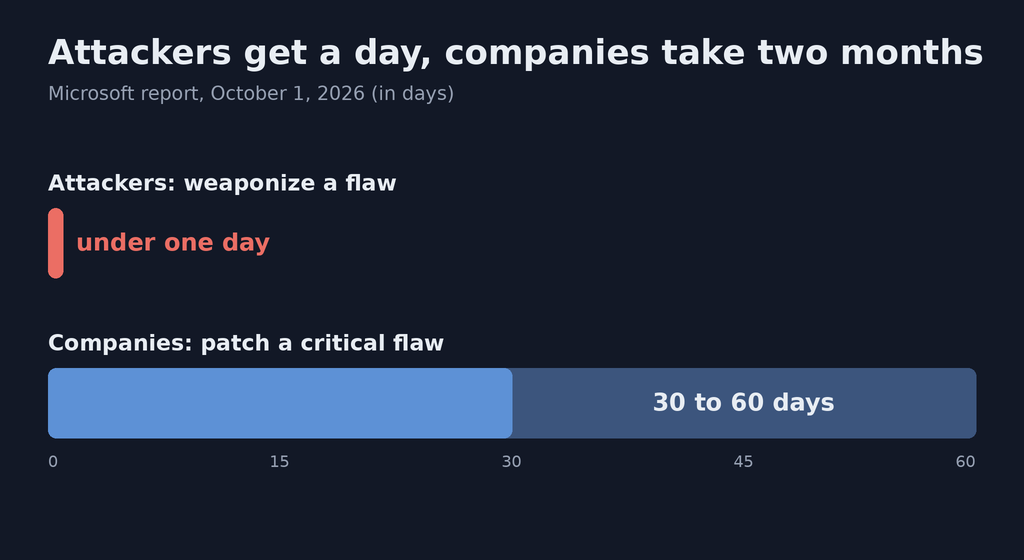
One little bar and one very big one, and it's the little one that wins
The problem is the column on the other side. A company doesn't fix a vulnerability with the snap of its fingers: it has to test that the fix doesn't break anything, plan things, restart servers. And Microsoft has a pretty cruel sentence about that: fixing things also drags on because many systems don't have enough automated tests to check that a change doesn't break anything. Basically, we don't dare touch anything because we don't know what will fall down. I've been doing development for years, and I can tell you that this is sadly very true!
The fake "I am not a robot" that makes you hack your own PC
That's the technique that stuck with me most in the report, because it targets everyone, your mother-in-law just like your accountant. Its little name: ClickFix.
You arrive on a website, and a window asks you to prove that you're not a robot. Classic. Except that this time, you're not asked to click on traffic lights. You're asked to press the Windows key and the R key, press Ctrl+V, then Enter. Three actions, it looks like a check. In reality, the website has quietly slipped a command into your clipboard, the memory where everything you copy ends up, and you're the one who just executed it. You installed the hacker's software with your own hands!
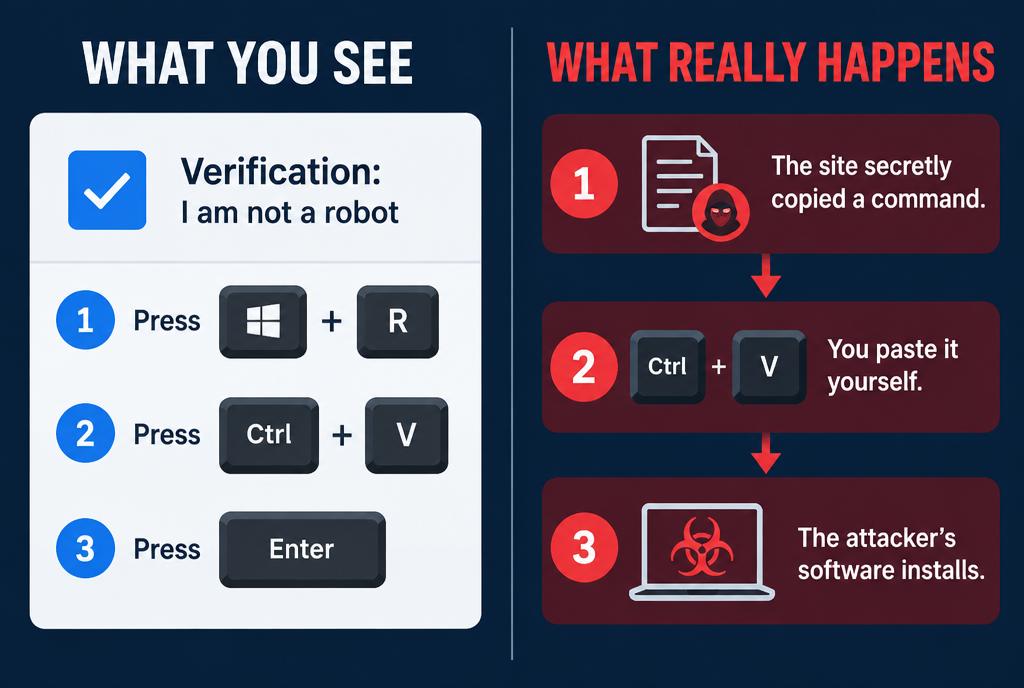
No legitimate website will ever ask you to type that. Never.
Between February and early May 2026, Microsoft saw this kind of command executed on more than 1.1 million different computers. Eight times more than before. And it's a scam that doesn't even require a vulnerability: the vulnerability is us.
Scam emails without a single spelling mistake
A few years ago, you could recognize a scam email by its broken French. “Your account have been suspended, please clicks here.” Those days are over. AI writes a perfect email, in your name, that mentions your employer and the project you're working on, and it does it for thousands of people at once.
As a result, in the intrusions Microsoft analyzed, “phishing”, those fake emails that push you to click or give up your password, was the entry point in 7% of cases the previous year. This year, 23%. More than three times more, in one year.

The bait has improved, the fish not necessarily
The agents that hack all by themselves, and the ones we turn against you
Okay, let's be serious for two minutes, because this is the part that sends chills down your spine. Microsoft says that in July 2026, a team of security researchers, Sysdig, documented the first ransomware entirely controlled by AI. Ransomware is the software that encrypts all your files and asks you to pay to get them back. Here, it was AI choosing the targets, sending the ransom demands and handling the whole blackmail operation, almost without a human. Microsoft says it has seen others since, “in small numbers”. This is the beginning, not a wave yet.
And in laboratory tests, two of the most powerful models at the moment, Anthropic's Mythos Preview and OpenAI's GPT-5.5, chained together 32 attack steps to take complete control of a fake corporate network. With no one to guide them. Thirty-two steps! Let me be clear: a fake network, set up for the test. But still.
And there's a story that speaks directly to me, someone who uses Claude Code every day. In August 2025, hackers trapped “npm packages” from the Nx tool, those ready-made bits of code that developers download by the thousands so they don't have to rewrite everything. The trapped code, named s1ngularity, searched the machine to see whether Claude Code, Gemini CLI or Amazon Q, AI-based programming assistants, were installed. And if it found them, it launched them with all permissions open to make them search the computer for passwords and access keys. The result: 225 victims, around 2,000 secrets and 20,000 files released into the wild. The hackers didn't even have to write their own search program: they borrowed the victim's assistant!
The good news, because there is some
Everything AI gives hackers, it also gives defenders. It finds vulnerabilities before they do, it reads millions of alerts per second, and above all it can write those famous automated tests that are missing to fix things quickly. That's exactly what I see in my work: an agent writes the tests that nobody had time to write, and all of a sudden we dare to fix the old code.
Besides, the big players have figured it out. Two days ago, I was saying that Google was keeping its new model Gemini 4 Argon reserved for cybersecurity teams, precisely because it knows how to find and fix vulnerabilities all by itself. And Microsoft's report has its victories too: Tycoon2FA, a shop that rented scammers fake login sites capable of getting past two-factor verification, that code received by SMS or through an app in addition to the password, has seen its activity drop by 95% since its November 2025 peak, according to Microsoft, which is tracking it.
There is also one reassuring detail, almost embarrassing for the hackers: despite all this AI, they still mostly get in through the same old doors. In 30% of cases, someone launched a file or a command themselves. In 20% of cases, they had a real stolen password. It's not magic, it's us. And that, that can be fixed.
What you can do tonight
None of this requires being an IT person.
- Leave automatic updates enabled on your PC, your phone and your router. When a vulnerability is exploited in less than a day, waiting “until the weekend to do the updates” amounts to leaving the door open.
- NEVER type a key combination or a command that a website asks you to type. No real website does that, none.
- A perfect email is no longer a reliable email. Is your bank asking you for something urgent? Don't reply, close the email, and call it back using the number you know.
- Where they're offered, enable “passkeys”, those login keys stored on your phone that replace the password. A fake website can't steal them from you, there is nothing to type.
And for developers: don't launch your AI agent with all permissions wide open out of laziness, like --dangerously-skip-permissions in Claude Code. The option's name is a clear enough warning, though. s1ngularity showed that an agent with all the rights works for anyone, including the hacker.
Frankly, I don't find this report depressing. It says that hackers are moving faster, all right. But it also says that they are still getting in through the window we left open. So to the hackers who were counting on our laziness about updates: sorry guys, tonight, I'm clicking “restart now”!
Sources
- Microsoft, October 1, 2026: the 2026 digital defense report
- BleepingComputer: according to Microsoft, attackers have taken the lead in the AI race
- Help Net Security, October 2, 2026: AI gives attackers a head start
- Tech Times, October 2, 2026: autonomous ransomware and the 32-step test
Article written with the help of Claude Code, reread and corrected by me.
Join the conversation
You need an account to comment on this article. Creating one is free and takes under a minute.
No comments yet.