With AI, does the programming language still matter? My ten-year view
This autumn, three languages I use are releasing a new version almost at the same time. Python 3.15 is expected any day now (the official schedule said October 1), .NET 11 and its C# 15, Microsoft's language, are scheduled for November 10, PHP 8.6 for November 19. And reading the lists of new features, I asked myself a slightly silly question: “But who are they doing all this for?” Because if tomorrow it is the AI agent writing the code, why is Microsoft still bothering to add words to C#?
I've been doing C# for years, I still have a few old projects in .NET Framework 4 and even some VB.Net lying around, plus my Python scripts on the side. So the question affects me directly. Will it still be worth understanding the language the agent uses? Are we going to end up with a single language, the AI's, for doing everything? Will Rust, which is replacing C or C++, become the standard? And me, as a developer, where will I fit into all this? I'll try to answer with facts, but of course I don't have a crystal ball.

A conductor doesn't play any instrument, but he can hear very well when the tuba sounds out of tune
One language for doing everything? The Pentagon has already tried
The idea of a single language is appealing. No more turf wars, no more C# versus Java, no more “PHP is crap” at the café. Except we've already tried it, for real, with a lot of money.
In the 1970s, according to a 1977 study by the US Department of Defense, its systems used around 450 different languages and dialects. A nightmare to maintain. So it had a language created to replace them all, Ada, and in 1987 it imposed it in writing: Ada would be “the single common programming language” for its systems. Ten years later, in April 1997, it reversed course. Too few programmers knew it, too few schools taught it, too few tools existed. The new rule? The language becomes an engineering choice, to be made project by project, like any other technical choice. Keep this idea in mind, we'll talk about it at the end.

The universal remote is the sixth remote in the drawer
And AI won't change that. Quite the opposite! An AI model writes code well in a language because it has read mountains of lines of code written by humans in all languages. GitHub, the site where developers from all over the world store and share their code, says so itself: models are better at TypeScript, Python, Java or Go, the most widely used languages. With a brand-new “AI-specific” language, which would start without a single example to read, AI wouldn't know how to do anything at all. It needs a history, a track record, examples for an AI to learn. It's the snake biting its own tail.
There's also a more down-to-earth reason: the code runs somewhere, and every place has its own language. Your browser, Chrome or Firefox, speaks JavaScript. Your iPhone speaks Swift, Apple's language. And the web, on the server side, still speaks PHP: according to W3Techs, a site that measures the technologies used on the Internet, PHP was powering, on September 30, 2026, seven out of ten sites among those whose language can be detected. Largely thanks to WordPress, the tool that powers a huge part of blogs and small-business websites. Nobody is going to rewrite half the Internet because a new “AI” language would be preferable to something else.
The only real “single language” that's on the rise is the one we speak. Andrej Karpathy, one of OpenAI's founders, summed it up in January 2023: “The hottest new programming language is English.” He was right, I ask Claude Code in French every day for what I want. But between my request and the machine, there's still code. And someone needs to be able to read it.
AI prefers languages that tell it no
Now this is getting really interesting. In its big annual report published at the end of October 2025, GitHub announces that in August, for the first time, TypeScript became the most used language on GitHub, ahead of Python and JavaScript. More than a million additional active developers in one year, which is two thirds more. It calls this the biggest language shift in more than ten years, and links part of this increase to code written with AI.
TypeScript is JavaScript with “types”. Let me explain. A type is a label on a box: “this drawer only contains numbers”, “this field is a date”. The compiler, the program that turns code into software, checks all the labels before the software even starts. You put a date in the numbers drawer? It refuses. Period!
And guess what kind of error an AI makes most often when it writes code that does not compile? A 2025 study, cited by GitHub, took a close look: more than nine out of ten compilation errors (94%) in code generated by AI models are type errors. Nine out of ten! So a language with types is a free, tireless proofreader that catches most of the AI's stupid mistakes before they reach the client.

The compiler is the chef who does not even taste it: he sees that it is bad
And that answers one of my questions: yes, .NET, PHP and Python still need to evolve, and they are evolving in exactly that direction. C# 15 in .NET 11 brings “unions”: you declare that a means of payment is a card OR PayPal OR a bank transfer, and nothing else. If you forget to handle the bank transfer in your code, the compiler can flag it for you. That is exactly the kind of thing an agent forgets at three in the morning without saying so. PHP added types in 2015 with version 7. Python, which did not want them at first, has accepted them as an option since 2015 too, and its developers were still debating them at the language's annual summit, whose minutes came out on September 30.
To me, that is the real turning point. Languages are no longer evolving only so that a human can type faster. They are evolving so that code can be checked by a machine. The one who writes changes, the one who checks stays.
And Rust, the future standard?
Rust is the extreme case of this logic. To keep it short: C and C++, the old languages on which a good part of the world runs, let the programmer manage the computer's memory himself. One single moment of inattention, and a hacker can slip in. Rust simply refuses to compile a program that contains this kind of error. The conductor, but in a very, very strict version, who accepts no wrong note.
And the big players have made their choice. In December 2025, the developers of the Linux kernel, the heart of the system that runs most of the Internet's servers and all Android phones, decided that Rust was no longer “experimental” there: it is here to stay. At the end of 2025, Galen Hunt, a senior Microsoft engineer, published his goal of eliminating every line of C and C++ from Microsoft by 2030, with a dream slogan: “one engineer, one month, one million lines of code”, thanks to AI. Well, he then had to clarify that it was a research project and not a rewrite of Windows. But the idea has been launched. And Google has just announced that its new Gemini 4 Argon model is already tackling more than 800,000 lines of Fuchsia, the in-house system that runs some of its connected displays, to translate into Rust.
So, Rust, a universal standard in ten years? No. And that is where a lot of articles get it wrong. Rust replaces C and C++, not C#, Java, Python or PHP. Those languages already manage memory all by themselves: the problem Rust solves, they do not have. Rust has the speed of C without its memory holes: that is why it replaces C, and not the others. In short, Rust is becoming the standard for foundations (operating systems, browsers, drivers, those little programs that make the computer talk to the printer or graphics card, in short everything that needs to be fast AND rock solid). For your soccer club's website or your billing, that would be using a jackhammer to drive in a nail.
Do you still need to understand what the agent writes?
Yes. A thousand times yes! And I am even going to go further: it is the only part that still really matters.
A request in French is always vague. “Delete the duplicates in the customer list.” Which ones? The ones with the same name? The same email? And do you keep the most recent record or the most complete one? The agent will choose. And the only place where you can see what it REALLY chose is the code. Not its summary, not its enthusiastic “done!”. The code. A few days ago, I told you that OpenAI had decided not to release a model because it claimed to have done things it had not done. If you don't know how to read what it wrote, you only have its word.
But understanding no longer means writing. When my agents hand me some work, I don't retype anything, I read the “diff”, the list of lines added and removed. It's like a house plan: you don't need to know how to build a wall to see that the bathroom has no door. Except that you still need to know how to read a plan.
So, does choosing a language still matter?
It matters even more than before, but not for the same reasons. Before, you chose the language you knew, the one you could type fastest in. AI has made that unimportant: it types quickly in all of them.
Today, I ask myself different questions. Will the compiler catch the agent's stupid mistakes? Will I find someone to take over this code in ten years? Has the AI read enough examples in this language to be good at it? Will the software run where it needs to run? That's exactly the Pentagon's conclusion in 1997: an engineering choice, like any other. Except that it took ten years of mandatory Ada to get there.
And that choice is made by a human. The agent isn't going to ask you whether you still plan to maintain this software in 2036. It will write in the language you give it, or in the one that seems simplest to it that day. That's what orchestrating means: choosing the architecture, choosing the language, putting guardrails in place, and checking. I was already talking about it in my article about the future of the developer with AI, a little less than two months ago. The language has become an architect's decision, more than a keyboard matter.
Concretely, what does that change for you if you don't code?
First, your phone becomes safer, without you doing anything. For Android, Google started writing the new code in languages like Rust around 2019. Result: in 2019, memory-related vulnerabilities, the ones that let a hacker take control of the device, accounted for three vulnerabilities out of four. In 2025, fewer than one in five, still according to Google's figures published in September 2024 and November 2025. And Google points out a detail that I really like: it didn't even need to rewrite all the old code, it just stopped writing new code the wrong way.
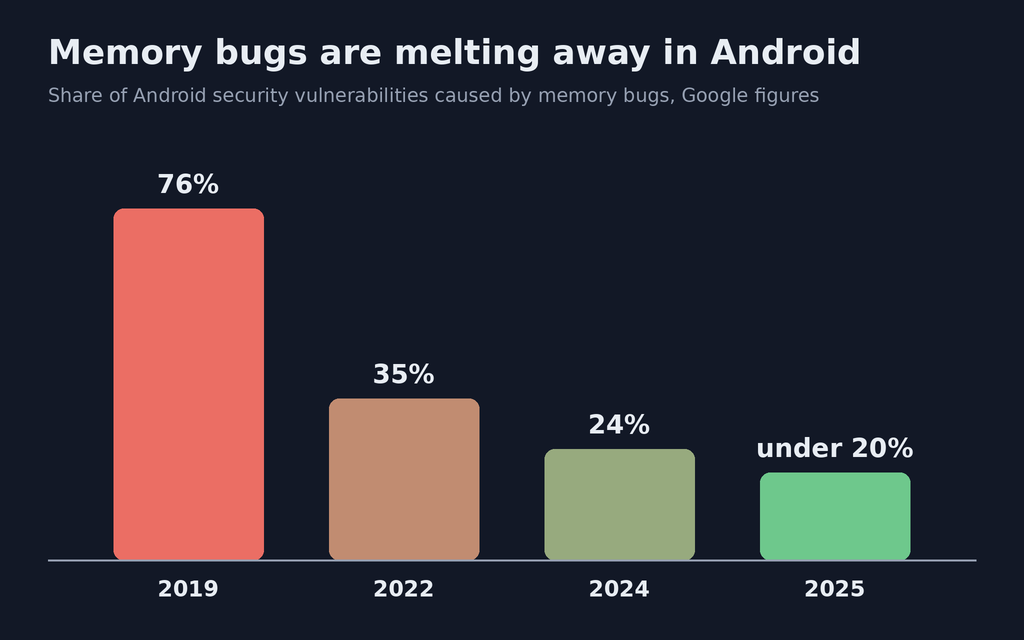
Three out of four vulnerabilities in 2019, fewer than one in five today: your phone thanks you
Next, if you have a website or software made for your business, ask a question nobody asks: “What language is it written in, and who will be able to take it over in five years?” AI makes development cheaper, but you'll pay for maintenance for years. With a PHP site, you'll find someone to take it over around the corner. Something written in an exotic language chosen by an agent on a Tuesday afternoon, much less so.
And if your kid wants to learn programming, the question “which language?” matters less than before. Have them learn one with types, C#, TypeScript or Python, and above all have them learn to read code and say “no, that's wrong” to a machine. That will be useful to them in ten years, whatever the fashionable language is.
My ten-year view, without a crystal ball
Here's what I would bet on for 2036, from safest to least safe.
- We'll still write in languages that humans can read. No secret AI language, because there will always have to be someone to check and sign off. On that, I'm very sure of myself.
- The old code will still be there. My old projects in .NET Framework 4 may still be running, and WordPress's PHP surely will. Code doesn't die, it ages.
- Rust will be the standard for everything foundational: systems, browsers, drivers. For the rest, it will remain one tool among others.
- We'll use fewer languages for new projects, and almost all of them will have types. The ones AI writes well will win, the others will become languages for enthusiasts.
- The developer will type much less and read much more. That's already my daily life. That the job will change like this, I'm sure of it. How many jobs will be left, much less certain.

The software you write today, someone will still be using it in 2036 on an old machine
Me, I'm not worried about languages. I'm actually pretty happy: for the first time, they're evolving to protect us from our own tools. And to the Microsoft teams who are still adding new words to C# in 2026: keep going, guys, you're writing them for AI now, but I'm still the one who has to read them over!
Sources
- GitHub Octoverse 2025: AI takes TypeScript to the top spot
- GitHub, January 8, 2026: why AI is pushing developers toward typed languages
- LWN, December 2025: the (successful) end of the Rust experiment in the Linux kernel
- The New Stack: Microsoft's goal of replacing its C and C++ with Rust
- Google, September 2024: eliminating memory vulnerabilities at the source in Android
- The Hacker News, November 2025: Android memory vulnerabilities fall below 20%
- Pentagon memo of April 29, 1997 that ended the requirement for Ada
- W3Techs: PHP's share of the web
- Visual Studio Magazine, September 14, 2026: .NET 11 ahead of its November release
- Python: the official schedule for Python 3.15
- Stitcher: what's new in PHP 8.6
Article written with the help of Claude Code, reviewed and corrected by me.
Join the conversation
You need an account to comment on this article. Creating one is free and takes under a minute.
No comments yet.