On February 5, 2025, at 9:51 in the morning, a British developer notices that his Mac's update has just turned on a feature at home that sends data at regular intervals, every fifteen minutes. He says no. Apple gives him a switch, he sets it to no, and forgets about it. Nineteen months later, he gives in to the reminders, installs macOS 27, and discovers that the switch no longer exists. The title of his post on dbushell.com sums it all up: “I said no and Apple said yes”, I said no, Apple said yes.
I'm not telling you this for the storyline, I'm telling you because the same thing happened on iOS 27, released nine days ago with a Siri that still hasn't arrived in Europe, and on macOS 27. So on machines that you may have updated this weekend without thinking about it, and without noticing anything.
Because that's the heart of the story. The setting that let you turn off Apple Intelligence, the company's AI, with a single gesture has been removed. Not moved, not hidden behind a scary warning, removed. And the no you said in the previous version does not survive the update.
Your no was still worth something the day before yesterday
We need to put the versions back in order, because that's where everything happens. Under iOS 26 and macOS 26, you had a switch, a real one, at the top of the Apple Intelligence page. You set it to no, the system says goodbye, and that's that. Under iOS 27, iPadOS 27 and macOS 27 Golden Gate, the switch is gone, and the features turned themselves back on for those who had said no.
Golden Gate is the name of the system I was telling you about last week, at the time I was mainly explaining that it was the end of Intel Macs. I hadn't seen that detail. And to be honest, nobody sees it: a line disappearing from a settings screen makes no noise. It took someone who had noted the exact date of his refusal, a year and a half earlier, for us to notice.
He got out the calculator. 22.28 GB taken up by Apple Intelligence on his disk, for an SSD charged at £500 per terabyte, which means around ten pounds gone up in smoke without anyone asking his opinion. I don't know of a better way to say that a commercial gift can be taken back.
What remains to be done, and what it doesn't free up
The path that remains, and it's a long one: Settings, then Screen Time, then Content & Privacy. Six pieces to turn off one by one, and not a byte of rendering
Don't throw away your phone just yet, there are still things you can do. In Settings, then Screen Time (the menu normally used to limit children's TikTok intake), then Content & Privacy, you come across a list of features that you can still turn off one by one: image creation, realistic images, the writing assistant, the math assistant, extensions and general knowledge.
What no longer works is the intended effect. Turning off those six does not free up a single byte: the model files remain nice and warm on your disk, and you have only prevented the features from launching. That's the whole difference between refusing and putting away.
The real button still exists under iOS 26 and macOS 26, and it works. Watch out for a trap, even there: the space does not come back the same day. Apple erases what it downloaded over several days, so you can turn it off, restart, go check your storage and see the same number. That's not a reason not to do it, it's a reason not to get worked up for nothing on the first evening.
What it costs in GB
Apple announces at least 7 GB of extra free space at the time of the switch. That's the cautious figure from the company, the one they put in a release note so they don't scare people. In the field, everyone who has checked their own machine is above that.
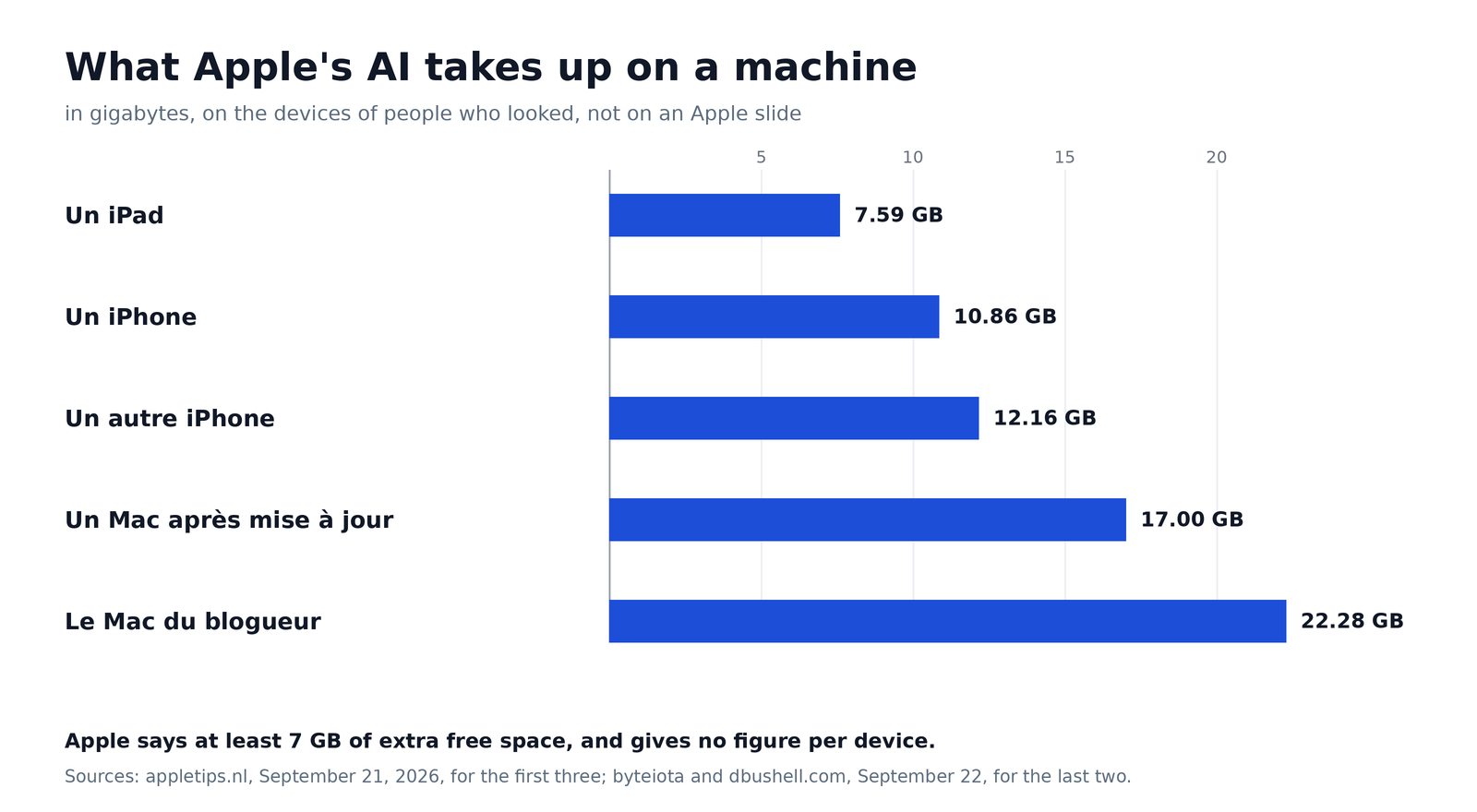
Five devices, five measurements, and not a single figure from Apple. The official minimum, 7 GB, is the one in the top bar
On a 128 GB phone already filled with vacation photos and a game that eats half the disk, 11 GB is a whole folder that disappears, or two thousand photos you won't take. And there is no way to tell Apple to put its model somewhere else, on a memory card or on the living room NAS. It's your disk, but you no longer have the key.
The only emergency exit is at your employer's place

Identical machines, one setting for all of them, and an IT service that must first have registered them with Apple. It's the only clean exit, and it's not for you
There is one clean way left to say no, and it's not meant for you. Apple documents deactivation through fleet management: a settings file pushed remotely by the IT service, which switches off the feature on all the machines at once. The problem is the condition. The device must be supervised, meaning registered by the company in Apple's system, like the work phone nobody chose. On a company Mac sleeping in an IT cupboard, it works perfectly well. On a developer's laptop, never: their IT service isn't going to register their machine in Apple's directory just to make them happy.
Below that, there are the community hacks, and I don't recommend them. The most common one consists of setting Siri to a language the system doesn't support, which prevents the models from being downloaded. It works more or less, until the next update, and it turns your mother tongue into an experiment. It's not a setting, it's a gamble.
So what do you decide now
One thing only, and it's a date: the date of your next update.
If you're still on iOS 26 or macOS 26 and this button matters to you, you still have it. Turn it off today, and take your time before installing what's next. That won't stop anything if Apple doesn't change its mind, but it gives you control for one more month, and in computing one more month is often one month too many for sellers.
If you've already installed it, you live with it. You'll go through Screen Time to turn off what bothers you, feature by feature, and you won't get the gigabytes back. It's infuriating, and there is nothing else to do.
A Dutch site, appletips.nl, went over the whole question when it was released and lists what is still possible, feature by feature. It's the page to keep handy if you want to clean house on your devices. And if you want to know exactly what you're losing, I told you about the launch of Golden Gate when it arrived, including the end of Intel Macs.
There is one last thing I don't like writing, but it's true. This isn't just an Apple story. Google, Microsoft and the others are pushing in the same direction, with the same argument: an AI that is supposed to serve everyone has to be turned on by default, otherwise nobody turns it on. It's defensible. It's also your hard drive and your peace of mind, and nobody asked you.
The February 2025 gentleman, for his part, checked no, slept well for nineteen months, and paid 22 GB to learn that a no has an expiration date. If you still have the button at home, make the most of it. It won't wait for you.
Join the conversation
You need an account to comment on this article. Creating one is free and takes under a minute.
No comments yet.