It happens to me more and more often, and I can't be the only one. I'm sitting at a table somewhere, I look up, and I see someone with slightly thick glasses. And then I wonder. Are they filming, or is it just a fashionable frame?
There's an app to answer that. It's called ZuckOff, it's free, and its author is a 30-year-old Polish developer, Pawel Szydlowski. He bought several models of smart glasses, turned them on one by one, and noted what each one says out into the air. About 5,000 people open his app every month. This Monday, it reached the top of Hacker News, 589 points.
I'm not going to sell you a dream: it doesn't turn your phone into a lie detector, and the author is the first to say so. But the mechanism behind it is more interesting than the app itself.
How an app can see glasses
The starting point is something you carry in your pocket without thinking about it. Bluetooth isn't only for connecting your phone to your headphones. All the time, devices around you broadcast little announcements to anyone willing to hear them: I'm here, I'm this model, here's who made me. Your phone receives them all day and throws them away.
ZuckOff collects them. It doesn't break anything, connect to anything, or intercept anything. It listens, compares what it hears to a catalog, and when it matches, it lets you know. Its author sums up the trick in one sentence: if the device's unique code matches and the manufacturer's code matches too, then you've got the perfect combo.
Neither of the two is secret, by the way. The second is an identifier that Bluetooth officially assigns to each manufacturer, and the register is public. So the best-selling glasses on the market give themselves away:
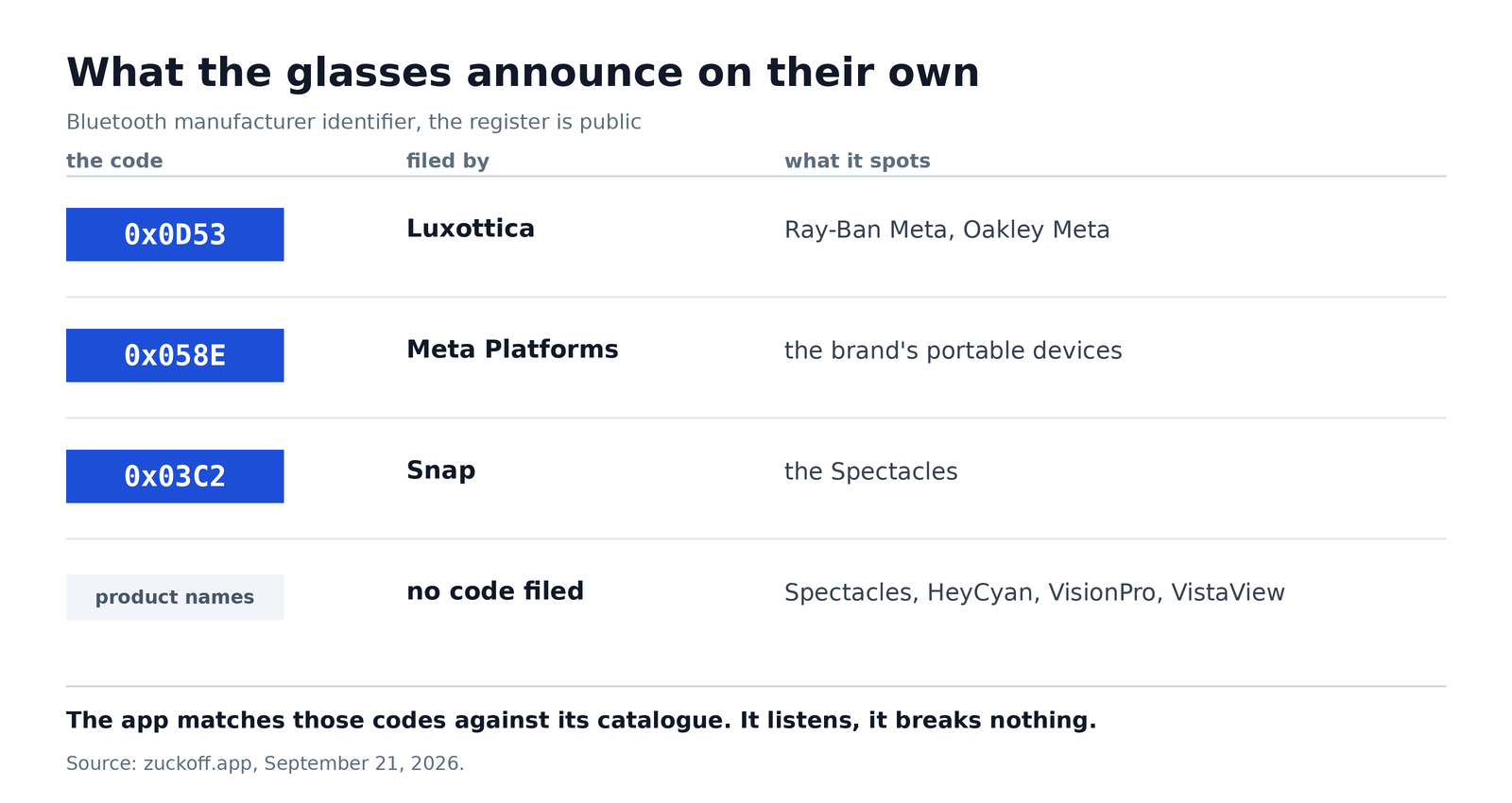
Four public codes, and camera glasses introduce themselves
The tastiest part is the first one on the list. Luxottica is the Italian giant of frames, the one that makes Ray-Ban and Oakley. And since it's the one that makes the piece of plastic, its code comes out of the chip, not Meta's. The most visible brand of the lot is contained in a discreet signature at the bottom of a register nobody reads.
Another detail that makes the app usable: it records everything it hears, glasses or not. It's this log that makes the difference, because you can check what it heard and when, instead of taking an alert at its word.
What ZuckOff can't tell you
Now for the part the other articles skimmed over, even though it's the one the author himself highlights on his page. A detection tells you that a device from this family is within range. It doesn't tell you who's wearing it, or what direction it's in. At best, the signal strength gives you a very rough distance.
Then, these glasses don't chat continuously in the same way. They mostly announce themselves when they turn on, when they pair, or when they come out of their case. Most keep making themselves heard once they're being worn, a few standalone models stay silent.
And then there's the sentence I like, because it works both ways: silence doesn't prove that nobody is recording, and a detection doesn't prove that anyone is recording. In other words, the app never gives you an answer, it gives you information. If you spend your evening suspecting the table next to you because your phone vibrated, you missed the instructions.
One last thing, and it's honest: 5,000 people a month isn't a mass movement. It's an app that provides a specific service to people looking for it, and nothing more.
What it's really useful for
Three moments in the day, and none of them needs a technical dictionary.
At a restaurant. You're sitting outside, and the table next to you is wearing black glasses on a rainy day. You open the app, let it listen for thirty seconds, and you know. You don't know whether you're being filmed, you know that a camera-equipped device is nearby. It's not much. It's already more than you knew five minutes ago.

The screen tells you that a device from the family is there. It doesn't tell you who's wearing it
At the gym or daycare. Two places where you leave your things and get changed. A phone left on a bench telling you that a pair of glasses is in the room is worth all the rules posted at the entrance.
At home, finally, and that's where I see the real use. You mark your own glasses in the app, once, and they stop triggering alerts. What's left are the others. And if you hack together two lines of automation, you can start the scan by itself when you enter somewhere, and retrieve the log at the end of the week to see how many times it beeped.
The entry price is zero, the app is free. The paid version is for receiving alerts when the app is in the background, meaning when your phone is in your pocket instead of in your hand. It's still an information tool, not proof, and it doesn't replace house rules.
A name chosen to annoy Meta
The name isn't a coincidence, it's a message addressed to Meta. This isn't the first time the subject has gotten under my skin: ten days ago, I explained why I don't install the companion app on my iPhone, and my opinion hasn't changed. And the story has a twist I didn't see coming: there really is a Mitchell Zuckoff, a journalism professor at Boston University, author of nine books. He discovered the app, wrote a piece in the Boston Globe at the beginning of September to tell the story of the coincidence with his own name, and eventually decided not to take action, judging that protecting children came first. Nine books, an entire career, and there he is, forever associated with an app that beeps when glasses come close. Life is badly designed.
Why Meta can't simply cut the signal
The obvious question is why manufacturers don't simply turn off this little signal. The answer is as simple as can be: that's what lets your phone recognize your device without asking its permission every time. Removing or mixing up these identifiers would break the pairing, and therefore the product's primary function. The signal is there to stay.
There is a funny precedent in this family of products, too. For a while, all it took was sticking a $2 piece of adhesive over the little LED on the glasses to film without anyone seeing it. Meta eventually fixed it: the glasses stop recording when the light is covered. Which means the problem was never technical, it has always been a question of who is looking at what.
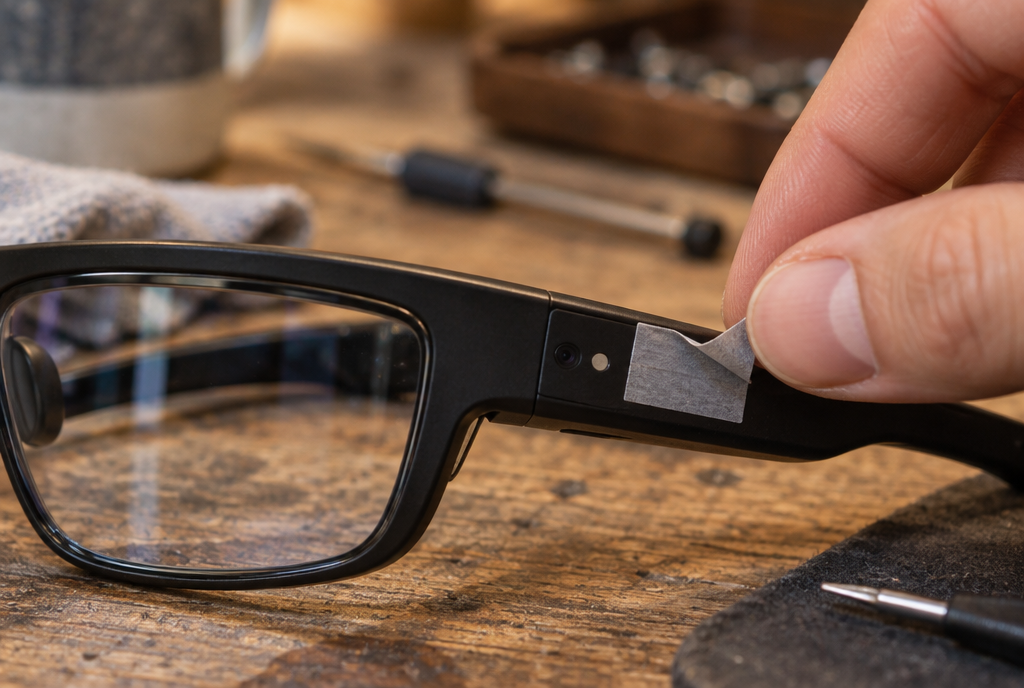
Two dollars of adhesive tape were enough to make the little light lie
If you run into someone with thick glasses and a slightly embarrassed smile, you know what to install. And if you're the one wearing the glasses, don't worry too much: your case gives you away before you've even set foot in the room.
Join the conversation
You need an account to comment on this article. Creating one is free and takes under a minute.
No comments yet.