Two surveys came out a few weeks apart, they did not coordinate with each other, and they tell the same story. The first is the quarterly BairesDev barometer, 705 developers in more than 60 countries surveyed in August, plus, for the first time, 41 technical directors. The second is the big annual survey from JetBrains, its tenth edition, more than 15,000 professional developers, collected between May and July.
The figure that sums it all up: 42% of the developers surveyed say that today AI writes half or more of their code. They were 12% a year earlier, when asked the same question. Multiplied by three and a half in twelve months.
A precaution before going any further, because it applies to all surveys of this kind: BairesDev sells outsourced development, so it has an obvious interest in AI being good news. JetBrains sells tools to developers, same thing. That does not make their figures false, you just read them with the source in mind.
What has changed is the tool we work in
The most interesting thing in the JetBrains survey is not the total, it is the ranking. Where BairesDev asks how much code comes from the machine, JetBrains asks what people work with, and across 15,000 people, the picture has shifted in eight months.
First the setting: nine out of ten professional developers use a coding agent at work at least once a week, and almost seven out of ten use one every day. Then the showdown. Claude Code went from 18% to 39% usage between January and the summer, and it is the main tool for 31% of developers. Codex multiplied by five, from 3% to 16%. And during that time, GitHub Copilot fell from 29% to 21%, Cursor from 18% to 12%. The rest share the scraps, Google's Antigravity is stuck at 6%, OpenCode at 7%.
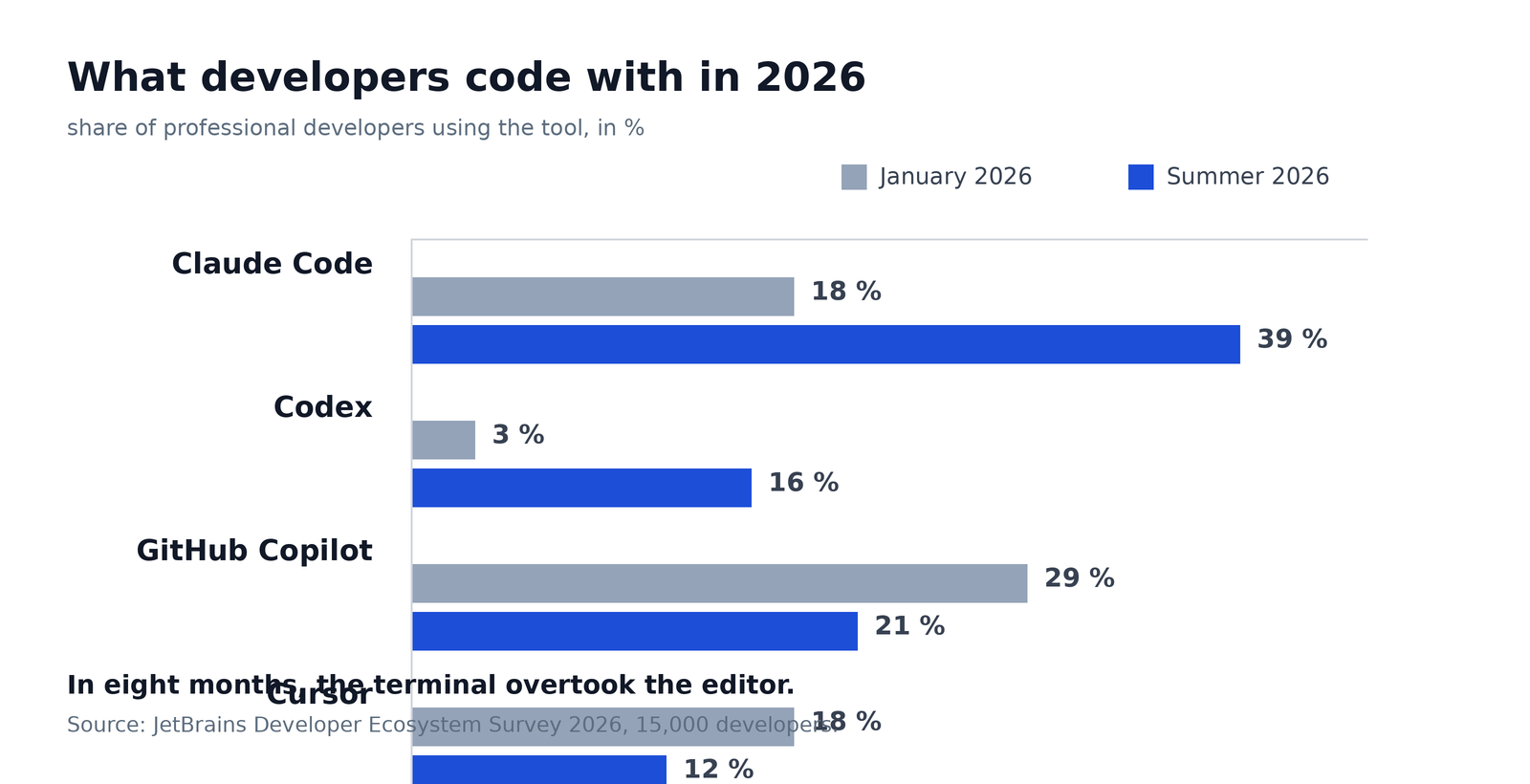
Two going up, two going down. Eight months between the two measurements
Read it backwards and it is even clearer: the assistant that completes the line while you type has fallen behind the one you give a mission to. The first lives in your editor, the second lives in a terminal and goes and opens files on its own. The market has voted, and it voted for the agent.
The bill comes due on the review side
Since the machine writes more, the developer should work less. On paper, yes: thirteen hours gained per week on average, compared with seven a year earlier. Except that the same 705 people report the opposite for part of their time.
They are 67% spending more time reviewing than a year ago. Half spend more than a quarter of their week reviewing what the machine produced. 59% say it takes more mental effort to catch subtle bugs, and 52% spend more time fixing problems that AI introduced. There is the real story of this year: we did not get rid of the work, we moved it from the keyboard to the screen.
And when a bug gets out, the question of who wrote that no longer has a simple answer, I was talking about it just a few weeks ago regarding an error that even the researchers who found it had attributed to the wrong author.

The prompt took eight seconds to write. The review, the whole evening
There’s one figure in the bunch that should interest everyone who runs a team: 58% feel more responsible for code they didn’t write entirely, compared with 51% at the start of the year. Nobody signed up for this, and that’s exactly where the rub lies. 41% say that almost no AI-generated code makes it into production without a thorough human review. 32% delegate the decision to ship to AI with a human in the loop, and 7% without any human at all. That last figure sends a chill down my spine.
What the job is really becoming
One figure says it all, and it’s the one people mention the least: 21% of developers still spend most of their week writing new code. The others aren’t idle, they’re doing something else. They read, they integrate, they make the calls, they fix things. The job hasn’t been emptied out, it’s moved up a level, and the part we thought was noble (typing lines) is precisely the part we delegate.
I wrote an article about this six weeks ago, about what a developer is becoming in this world and the hole it’s digging for juniors. I haven’t changed my mind, but this survey adds an answer I wasn’t expecting: 86% say AI has made their job more interesting, compared with 76% four months earlier. The detail is even better. Of those who use it fully, 95% say so, while among those who barely touch it, it’s 58%. So it isn’t the tool that makes you happy, it’s the tool you took the time to train.

Three projects, three sessions, and an evening spent validating
What does it look like at my place
Three Claude Code sessions open at the same time, one project per session, and I jump from one to the other to check what comes back. What I’ve been noticing for months is that typing time has collapsed and review time has exploded. The survey finally puts a figure on an impression I didn’t dare generalize.
And there’s one figure in the bunch that’s just me: 46% say that token prices or usage limits have changed the way they work. That’s me exactly. When quota week ends while a job is still open, you look at your plan B instead of finishing what you started.
So this is where we are. The machine types, the human reviews and signs off. There’s one question nobody measures, and it’s the one that bothers me: what exactly is he signing on the day he can no longer write half of what he reviews?
Join the conversation
You need an account to comment on this article. Creating one is free and takes under a minute.
No comments yet.