AI is no longer the leading cause of layoffs. And what about tech?
AI is no longer the leading cause of layoffs. And what about tech in all this?
Well, I'm going to start with the news that feels good, because there is some.
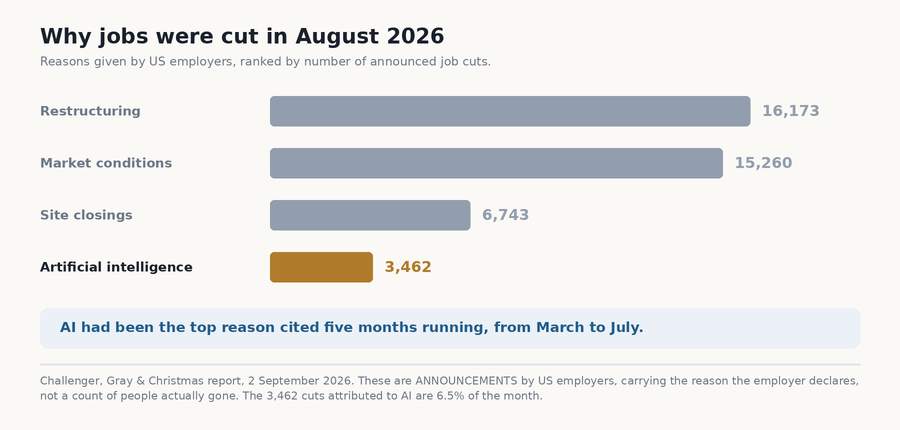
Since March, it had been the same old story. American companies announce job cuts, people ask them why, and the same answer comes out on top of the rankings: artificial intelligence. March, April, May, June, July. Five times in a row.
The August report came out at the beginning of September. AI is fourth.
3,462 jobs, compared with more than 16,000 for the good old internal reorganization. That's its lowest level since December, and over the whole month it accounts for only 6.5% of the announced cuts. Well, I didn't see that coming.

We're unpacking the boxes again. Well, in some companies.
Except there's a second figure in this report. And that one is looking us tech people straight in the eye. We'll get to it, but first we need to know what we're reading.
Who counts, and above all what
The figure comes from Challenger, Gray & Christmas, an American firm that has been recording the job cuts announced by companies every month since the 1990s. The entire business press picks it up, and that's where its interest lies: it also records the reason the employer gives itself.
Read that sentence again, because every word counts. Jobs announced. In the United States. With the reason the company itself declares. This isn't a count of people who cleared out their desks, and it definitely isn't an audit. Come on, let's not kid ourselves: nobody went to check. Keep that in mind, we'll come back to it further down and it changes quite a lot of things.
The August ranking
First place goes to the word that means nothing. As usual.
At the top, then, internal reorganization: 16,173 jobs. Translation for those who've never read a management announcement: we change the org chart, merge two teams, get rid of a floor. It's the catch-all reason, the one you tick when you don't want to say anything specific, and it wins pretty much every month for the last thirty years.
Behind that, market conditions with 15,260 jobs. Then site closures, 6,743. And finally AI, 3,462.
Still, one month doesn't turn a year around: over 2026, AI remains in the lead with 116,175 jobs, or about 22% of everything announced since January. The decline is real, it's recent, it doesn't erase anything.
And overall, things are frankly much better
This is the part you won't read anywhere, so we might as well say it out loud.
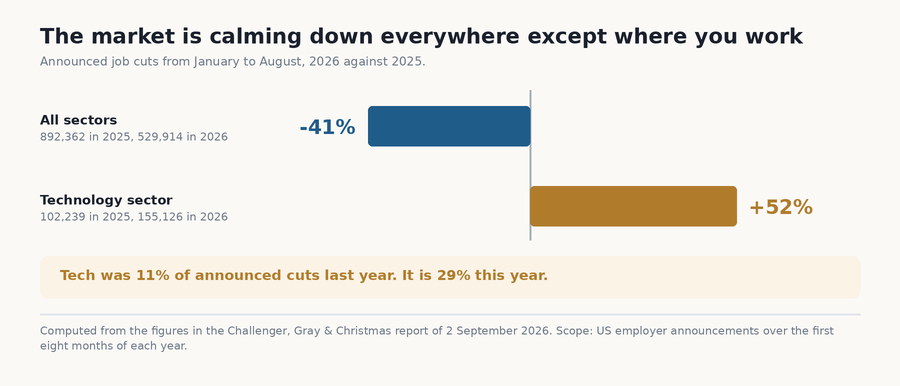
Over the first eight months of 2026, American employers announced 529,914 job cuts. Last year, on the same date, 892,362. A drop of 41%, and the lowest total since 2022.
Hiring is moving in the same direction. 12,325 hires announced in August, which is ridiculous in absolute terms, but that's eight times more than in the previous August. For the year, 119,825 compared with 87,626, or one third more.
The firm's boss sums it up without breaking a sweat: “it's the quietest August since 2022, but overall within the monthly average since the middle of the 2010s”. In other words, we're getting back to normal. It was the last two years that were abnormal, not this one.
On paper, everything is fine. Let's take a closer look.
Because the average is very polite. It never says who's getting fired.
Two arrows, two directions. Guess which one we're in.
The technology sector has announced 155,126 job cuts since January. Last year on the same date: 102,239. This isn't a 41% drop, it's a 52% increase.
And here is the figure I calculated myself from the report, the one that made me do the division twice: tech accounted for 11% of all the announced cuts last year. This year, 29%. Almost one job cut out of three, across all sectors, is in our line of work. A line of work that is far from representing a third of the American economy, it should be said.
So when you read this week that “layoffs are falling sharply”, it's true. It just doesn't concern us in quite the same way.
One nuance, though, and it's a big one: August was the best month of the year for tech, with 6,103 jobs cut, its lowest total of 2026. The big cuts came from elsewhere, consumer products and food. The year-to-date total is bad, the recent trend is good, and both are true at the same time. That's exactly why you can make this report say whatever you want, depending on the line you decide to quote.
So why did AI decline?
Two explanations hold up, and I have no way of telling you which one is right. It bothers me as much as it bothers you.
The first is the nice version: the wave has passed. The companies that wanted to hand tasks over to machines did it between March and July, it's done, and the pace is slowing down.
The second is less nice: they simply stopped saying it or put it in the “restructuring” box.

Four boxes, a pen hesitating. Nobody ever checks “we screwed up”.
Remember what this report measures. The reason is chosen by the employer, all by themselves, in their press release. But “we're replacing people with AI” was a flattering sentence for a year, the kind that makes you look modern in front of shareholders. It's becoming a sentence that attracts headlines and lawyers. “Internal reorganization”, on the other hand, has never upset anyone.
I have no way of deciding, and watch out for anyone who claims otherwise. One thing is certain, though: the number of jobs cut in tech does not depend on any statement. It is rising, whatever box gets checked.
What I take away from it
Three things, and the last is the one that really matters.
First, the grand story of machines causing the collapse of work does not survive a look at the figures. Cuts are down 41%, hiring is up by a third, and AI comes fourth. The people who announce the end of salaried work to you every morning should subscribe to the monthly reports.
Next, our sector is still taking most of the hit, and that isn't contradictory with the previous point. Tech hired like never before between 2020 and 2022, it has been deflating since, and that correction would have happened with or without language models.
Finally, and this is the real subject: the stated reason doesn't matter at all. Whether your job disappears because a machine does the work, because the company hired too many people in 2021 or because an executive redrew an org chart, the result is exactly the same. What changes is what you know how to do the next morning.
A month ago I wrote that the machine was going faster than me and that this wasn't what worried me. I still think so.
What worries me is elsewhere, and this report doesn't say a word about it, because it counts jobs without ever looking at who holds them. A sector that deflates for two years in a row does not deflate at random, and the Korean study I talked about this summer already showed that beginners are no longer learning the trade in the same way. Where exactly are the seniors of 2036 being made?
Sources
- Challenger, Gray & Christmas: report on August 2026 job cuts, published on September 2, 2026, the month's total, the ranking of the reasons given, the decline of artificial intelligence to fourth place, the year-to-date totals and hiring plans
- The full report in PDF, with the breakdown by sector, including the 155,126 jobs announced in technology since January and the 102,239 during the same period last year
- FXStreet: the data timestamped when it was released, 52,881 jobs in August compared with 33,429 in July, to check the raw figure independently of the commentary accompanying it
Join the conversation
You need an account to comment on this article. Creating one is free and takes under a minute.
No comments yet.