Has an AI ever found something nobody knew?
Has an AI ever found something that nobody knew?
In a laboratory in Washington State, there is a battery that works. Nothing extraordinary when you look at it, except that the material it is made of did not exist anywhere two years ago. No book, no catalogue, no thesis, no human brain. A machine found it by searching through 32 million possibilities, and the sorting took it 80 hours.
Eighty hours. A long weekend.
That is the kind of story that interests me. Not an AI neatly copying a demonstration that humans had already done, no: a machine putting something on the table that nobody had ever seen before.
So let us ask the real question, the one we all ask ourselves. Can a machine find what nobody has ever found? Not find it again, not verify it, not tidy it up. Find it.
The answer is yes. With stars next to it, because there are three ways to find something and they are not at all equal.
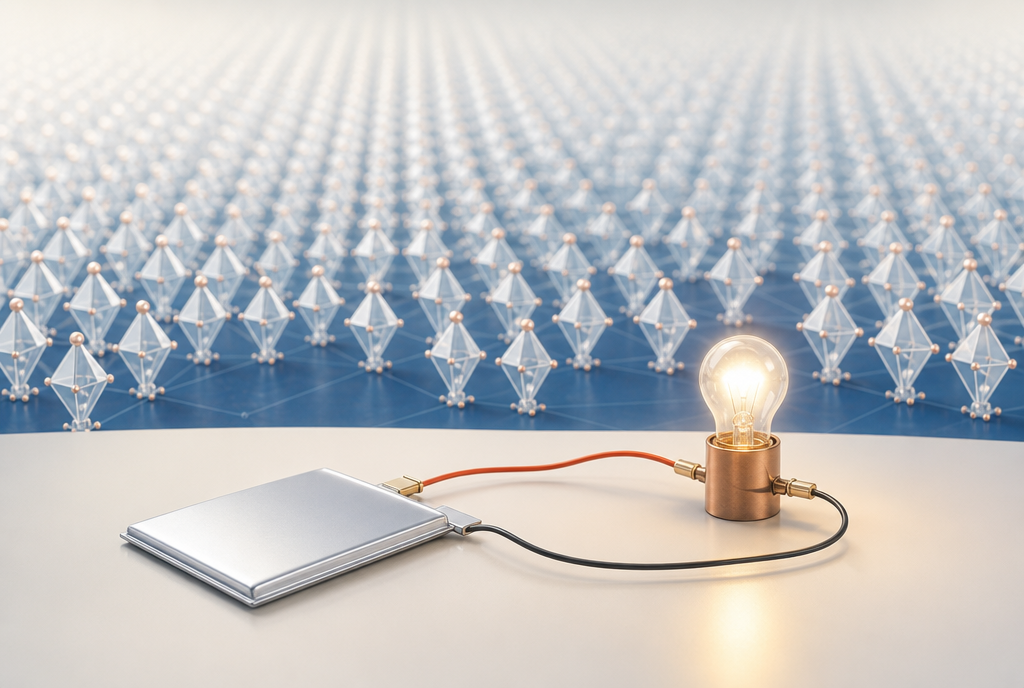
One thing that works, emerging from an ocean of things that did not exist.
The battery that was written nowhere
The story begins at Microsoft, with an American public laboratory, the Pacific Northwest National Laboratory. The goal is simple to understand: in the battery of your electric car or your phone, there is lithium. It is expensive, it is rare, it is extracted in mines that nobody dreams about, and everyone is looking for ways to use less of it.
Except that a battery is chemistry. To know whether a mixture holds together, you have to make it and test it. A chemist tries a few hundred over their entire career. At that rate, seriously exploring the problem takes decades.
The machine examined 32 million possible combinations. Then it sorted them.
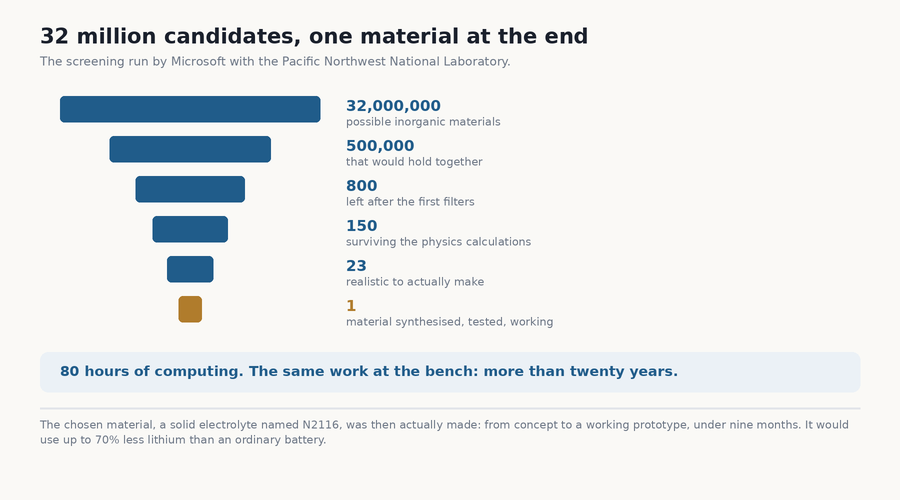
From 32 million to a handful. The hardest part is not finding, it is throwing away.
At the end of the funnel, one material remains, named N2116, which nobody had ever made. The laboratory synthesized it for real and made a working prototype from it, in less than nine months. It would use up to 70% less lithium.
I will repeat it, because this is the key part: this material existed in no book. It was not discovered at the bottom of a mine, it was found in a list of possibilities that nobody had had time to read.
How you try 32 million things without making a single one
This is where people imagine a genius machine that has intuition. There is no intuition in this, and it is almost more interesting.
Imagine a four digit combination lock. You can think long and hard about the combination, or you can try all ten thousand. A human takes hours, a machine takes a second. Nobody will say that the machine was clever: it was fast, and from a certain point on, speed has the same effect as intelligence.
The real feat lies elsewhere. A machine cannot make 32 million mixtures, that would be absurd. What it knows how to do is calculate whether a mixture would hold together, without making it. The laws that determine whether a crystal is stable have been known for a century, they are written down, and a computer can apply them to a combination that has never existed.
In other words, it is allowed to be stupid. It can suggest millions of absurd ideas and let physics sort them out, because being wrong costs it nothing. A human researcher, on the other hand, has only a few attempts in their life, so they only allow themselves reasonable ideas. And sometimes the good idea was not reasonable!
In maths, it is even more unsettling
Take the multiplication of two arrays of numbers. It smells like a middle-school exercise, except it's the operation your phone executes billions of times per second as soon as it displays a photo, your console calculates a shadow or an AI thinks. Gaining a single operation there means gaining everywhere, across the whole planet, at the same time.
In 1969, a German mathematician, Volker Strassen, figured out how to do this calculation in 49 operations instead of 64. Nice one. And then, nothing. For fifty-six years, thousands of very smart people searched, and nobody got below 49.
In 2025, a Google system found 48.
Just one fewer, yes. But it's the first one since the year man walked on the Moon. And the funniest thing is that this system hadn't been built for that: it had been set loose on algorithm problems in general, and it stumbled onto this one along the way.
Same thing with an old Hungarian gentleman, Paul Erdős, who spent his life posing problems rather than solving them and left hundreds behind him, some of them open since the thirties. Since December, they've been falling one after another.
And mathematicians, who are serious people, keep a public page where they record who solved what. With separate columns, and it's that separation that interests me: around fifty problems where the machine worked without notable human help, about a hundred and thirty where it worked with someone, and twenty-four where people realized afterwards that the solution was already sitting in an old paper that nobody had connected to the problem.
I love those twenty-four. The machine really did solve the problem, except some guy had done it before it in 1973 and everyone had forgotten. Embarrassing for absolutely everyone.
Okay, but does it really find things all by itself?
There are three steps, and we don't climb them at the same pace.
The first is cleanly redoing what already exists. Translating an old proof into a language that a computer checks line by line, for example. It's useful, it helps out, and it invents absolutely nothing.
The second is finding something new about a question a human asked. The battery, the 48 operations, the Erdős problems: it's all there. The result existed nowhere, and it really did come out of the machine.
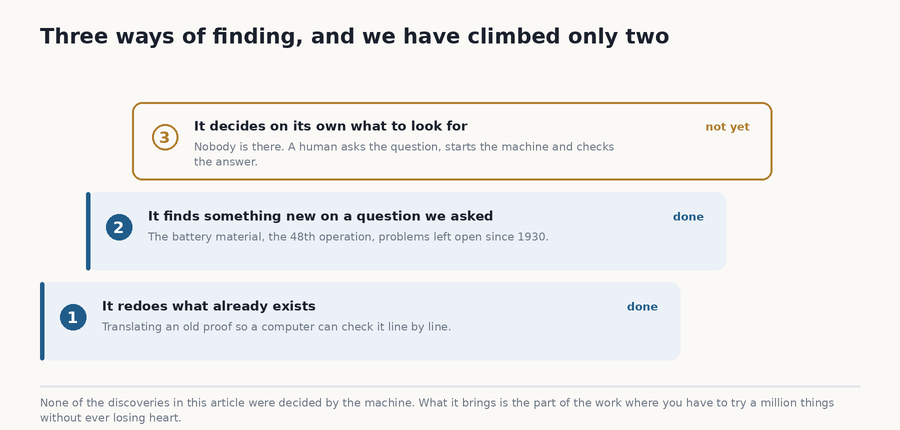
Nobody has climbed the third step yet. We're halfway up the staircase, which is already a lot.
The third would be for it to decide all by itself what to work on. And there, no. In each of these stories, a human chose the problem, a human started the machine and a human checked the result. No AI woke up one morning thinking "hey, what if I looked into batteries". What it brings is the part of the work where you have to try a million things without getting discouraged. In other words, precisely the part nobody likes.
And it goes both ways, which delights me. On a geometry problem, the Google system had beaten a record several decades old. A Finnish researcher came along afterwards, looked at how it had gone about it, and did better than it. One all, ball in the center.
It looks a lot like what I was telling you about Amazon's service where people thought they were buying AI and there were humans behind it, but the other way around: here the machine does most of the work, and the human stays in the room, choosing the question and checking the answer.
What this changes for you, and when
Three things, with the timeframes stated honestly, because that's where people often sell dreams.
The battery first. Less lithium means it's cheaper to manufacture and fewer mines to dig, and lithium is one of the reasons an electric car costs what it costs. But we're talking about a laboratory prototype, not a product. Between a material that works on a lab bench and a battery in your garage, there's a factory to build, a supply chain, safety tests and a lot of projects that die along the way. Ten years, and it may never happen.
Then there are medicines, and that may be the most important part. At McMaster University in Canada, a system designed an entirely new antibiotic by exploring 46 billion possible compounds. When you know that bacteria are becoming resistant to everything we have in stock and that we have found almost no new families of antibiotics since the 1980s, this undertaking is not a gimmick.
And materials in general. A Google team published 2.2 million unprecedented crystal structures, including 380,000 that should hold together. That multiplies by ten the number of stable materials known to humanity. How many will be useful for something? We have no idea, and it's honest to say so. A catalog is not an invention.
One reference point to put all this into perspective: when the laser came out in 1960, it was long called “a solution in search of a problem”. It's now in your supermarket checkout and in the fiber that brings this article to your screen. A catalog of 380,000 materials is exactly that: a reserve of solutions waiting for their problem.
So tomorrow, antigravity?
No. Well, not like that, and the explanation is more interesting than the refusal.
Everything I just told you works because the playing field is known. Atoms exist, the rules that determine whether a crystal holds together have been written for a hundred years, and the machine simply goes through the combinations at a speed no one can keep up with. It's looking for a needle in a gigantic haystack, but it knows what a needle looks like.
Antigravity is not a needle in the haystack. It's a needle we don't know whether it exists, in a haystack whose shape we don't know. A machine can't find what isn't in the rules of the game, and so far nothing in known physics says that gravity can be canceled. The same goes for teleporting a person: the problem isn't that we haven't searched hard enough, it's that we have no rule that makes it possible.
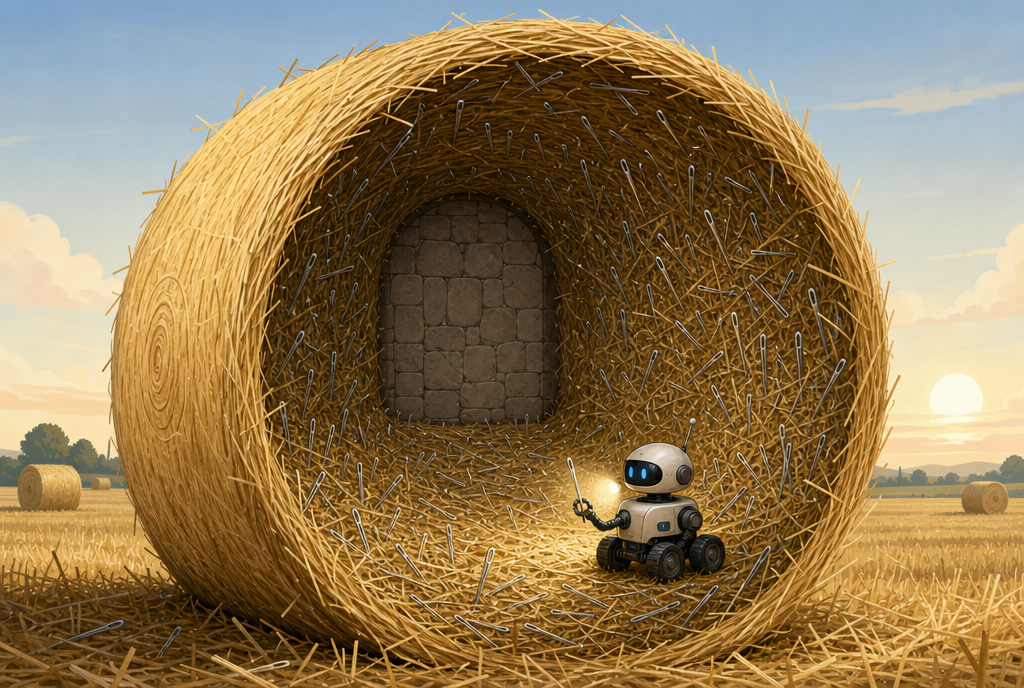
It's very good at rummaging through the haystack. It can do nothing about the door at the back.
But don't close the case too quickly, because the haystack is enormous and there are needles in it that look like science fiction. An antibiotic against bacteria that nothing can cure anymore. A material that carries electricity without losing a watt along the way, at room temperature, which would change the planet's electrical grid. A battery that cuts the price of a car in half. All of that is in the haystack, all of that obeys rules we know, and no one has found it yet because no one has had the time to look.
Time, precisely, we've just gained an indecent amount of it. The same kind of tipping point as Google's quantum computer that learns to correct itself : these aren't machines that think better than us, they're machines that never get tired.
So teleportation, no. But remember that in 1969, when Strassen came up with his 49 operations, the idea that a machine might one day do better than him would have made his whole department laugh. It took fifty-six years, and it happened. I have no idea what will come out of a computer in fifty-six years, but the list of impossible things gets shorter every year!
Sources
- Microsoft: How AI and HPC are speeding up scientific discovery, the screening of 32 million inorganic materials, the filtering stages down to 23 candidates, the 80 hours of computing and the joint work with the Pacific Northwest National Laboratory
- TechRound: Microsoft's AI-powered battery discovery could replace lithium, the name of the N2116 material, the 32 million candidates reduced to 18, the reduction of lithium by around 70% and the transition from raw material to working prototype in less than nine months
- Google DeepMind: AlphaEvolve, the multiplication of 4×4 matrices in 48 operations instead of Strassen's 49, the first progress since 1969, achieved by a general-purpose system
- The public count of AI contributions to Erdős problems, maintained by mathematicians themselves, with its separate columns: AI alone, AI accompanied by a human, and cases where existing literature was found afterward
- Quanta Magazine: Why the Legendary Erdős Problems Are Falling to AI, August 3, 2026, the context of this series of resolutions and the debate it is opening among mathematicians
- Helsinki Institute for Information Technology: a researcher improves the bounds of the kissing spheres problem, by doing better than Google's system on the same problem after studying its method
- Google DeepMind: Millions of new materials discovered with deep learning, the 2.2 million crystal structures, the 380,000 predicted to be stable and the tenfold increase in the number of known stable materials
- Drug Target Review: AI designs new antibiotics to take on drug-resistant superbugs, the work of McMaster University and the University of Pennsylvania on designing novel antibiotic molecules
Join the conversation
You need an account to comment on this article. Creating one is free and takes under a minute.
No comments yet.