Nvidia announces 370 frames per second. The card computes 62.
Nvidia announces 370 frames per second. The card calculates 62.
DLSS 5 launches tonight. Only one game at launch, NBA 2K27, and only on RTX 50 graphics cards, the brand's most recent ones.
On Nvidia's page, one big number: up to 370 frames per second in 4K with an RTX 5090. To give you some perspective, a movie in a cinema runs at 24 frames per second and a very good gaming monitor displays 240. So 370 is huge.
Except that when you dig into it, you find out where those frames come from. And that's where it gets interesting, in both senses.
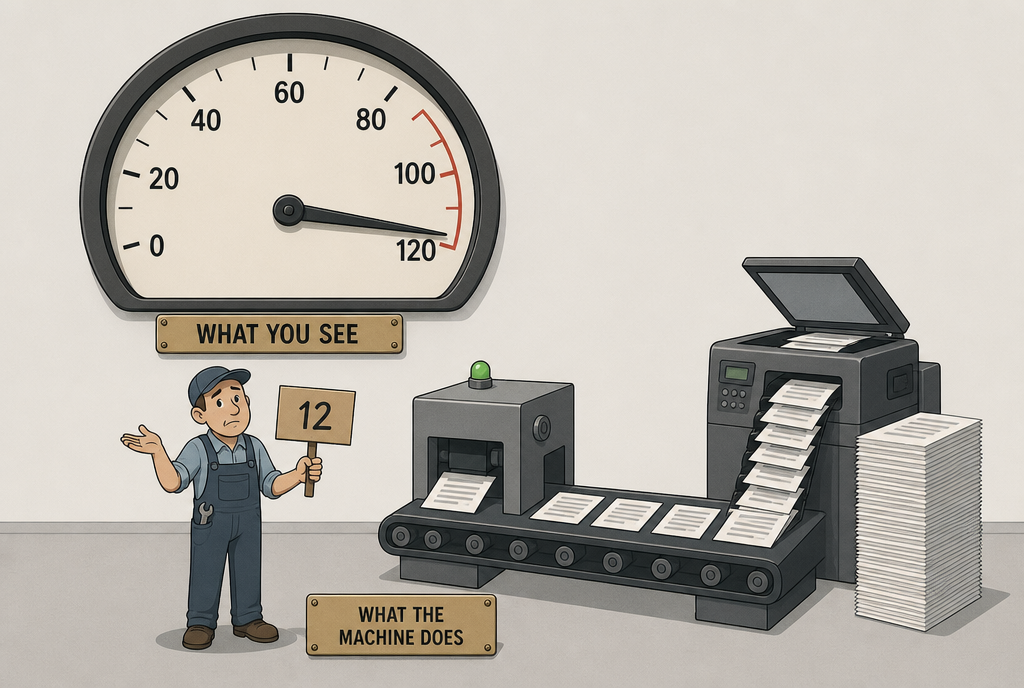
The counter displays 370. The engine produces 62.
First, what it does, because it's astonishing
Let's start with the merit, because it's real and it's going to get lost in the controversy.
Until now, a graphics card calculated a game image like a painter fills a canvas: each pixel, one by one, according to rules of light. The more realistic shadows and convincing reflections you want, the more it costs, and at some point you have to give up. Developers actually spend their lives giving things up: that light is too expensive, this reflection, we'll pretend.
DLSS 5 changes the method. The card first calculates a basic image, complete but poor, with the geometry and textures wanted by the artists. Then an artificial intelligence goes over it and adds back everything we had had to abandon: the richness of the light, the texture of materials, the way skin catches lighting. Nvidia calls this 3D-guided neural rendering.
The result, in NBA 2K27, is a level of realism that until now we associated with animated cinema, where each image requires minutes of calculation in a server farm. Here, it comes out in real time, on a consumer card, while you play. Technically, hats off.
Now, let's break down the 370 frames
Two mechanisms are hiding behind this figure, and neither of them is a lie. But they don't tell the same story.
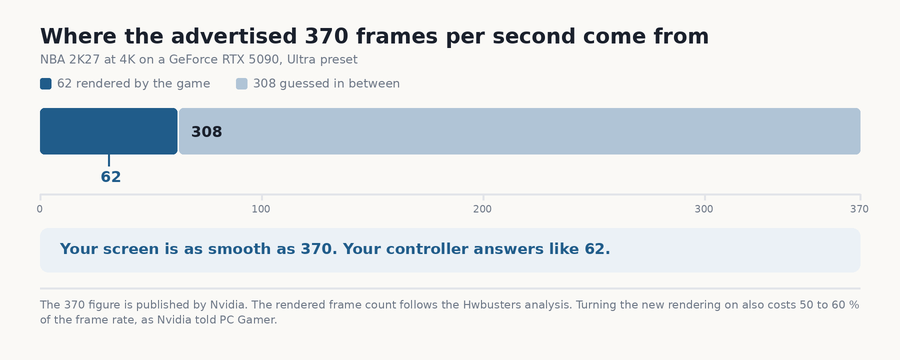
Out of a hundred displayed frames, seventeen come from the game engine. The others are guessed in between.
The card really calculates around sixty frames per second. Then frame generation steps in: between two real frames, the machine makes several more by guessing what happens between the two, a bit like filling in the missing panels of a comic strip by looking at the one before and the one after. These invented frames are displayed, they make the movement look smoother, and they count in the score.
Is that cheating? No. The movement really is smoother to look at, and that's what you ask of a game.
But there is one thing a guessed frame will never do: react. When you press a button, only the next genuinely calculated frame can take your action into account. In other words, your screen is as smooth as 370, and your controller responds like 62. In a basketball game, you won't feel it. In an online shooter, that's a different conversation.
And the new rendering costs half your frames
Here's the admission that made people grind their teeth, and it came from Nvidia itself, when questioned by PC Gamer: activating the new rendering costs between 50 and 60% of the number of frames per second. All cards in the series combined, all resolutions combined.
Read the sentence again. The technology that has existed for six years to give you more frames now takes half of yours. It only produces them on condition that you also turn on the creation of intermediate frames.
That makes sense, mind you: we don't add light and matter to every image for free. But the marketing display has a supermarket-style “strikethrough price” feel to it. They show you 370, they don't tell you that the same card, without all that, would produce more than 62 real ones.
The controversy over the faces
The other criticism was more unexpected, and it came from the players themselves: at the first demonstration, the characters no longer quite had the same faces. More realistic skin, different lighting, and in some places a face that no longer looked like the one the artists had drawn.

On the left, the drawn player. On the right, the same one after the machine had worked on him. Look for the jaw.
That's the crux of the problem when an AI beautifies an image: it adds what it thinks is plausible, not what the author had in mind. Nvidia replied that the rendering “preserves the original artistic intent” and that studios remain in control of the settings. It also explains that the process relies on the engine's base image, which is a serious guarantee: we are not starting from a blank page.
We'll see in practice. For now, only one application lets us judge it, and it's a basketball game.
Should you rush to turn it on?
If you have an RTX 50 and NBA 2K27, yes, give it a try, if only to see with your own eyes what neural rendering looks like. It's the sort of thing we'll talk about in ten years.
If you play something else, you have nothing to do: there is nothing else. And if you have an RTX 40 or older, the question doesn't arise, you aren't entitled to it.
What leaves me thoughtful is the reversal. For years, we bought a bigger card to calculate more images. Now, we buy a bigger card to calculate fewer of them and have it guess more. The result on screen is prettier, that's indisputable. But when a manufacturer sells me 370 and its own documentation counts 62, I'd just as soon have the big number on the poster be the real one. We can always admire the technology afterwards!
Sources
- Nvidia : DLSS 5, 3D-Guided Neural Rendering debuts in NBA 2K27, the official announcement, the release date, the compatible cards and the frames-per-second figures published by the manufacturer
- Notebookcheck : DLSS 5 release date confirmed, but be ready for a massive performance loss, the 50% to 60% cost confirmed by Nvidia to PC Gamer, and the controversy over the appearance of the characters
- Hwbusters : DLSS 5 ships September 3 with one game, and it still costs half your frame rate, the details of the frames actually calculated behind the announced figures
Join the conversation
You need an account to comment on this article. Creating one is free and takes under a minute.
No comments yet.