Wi-Fi 8: it doesn't go faster than Wi-Fi 7. And that's good news.
Wi-Fi 8: it isn't faster than Wi-Fi 7. And that's good news.
TP-Link drew first blood. Yesterday, at the Berlin trade show, the brand presented the first Wi-Fi 8 devices for the home: a router, the Archer 8 Ultra, and a multi-access-point system, the Deco 8 Ultra. Preorders on September 30.
On the spec sheet, one number in big letters: 22 Gbps. Impressive. Except that this number means nothing more than last year's number, and the real change is somewhere else. It's even so far somewhere else that it deserves us stopping to look at it, because this is the first time in twenty years that this has happened.
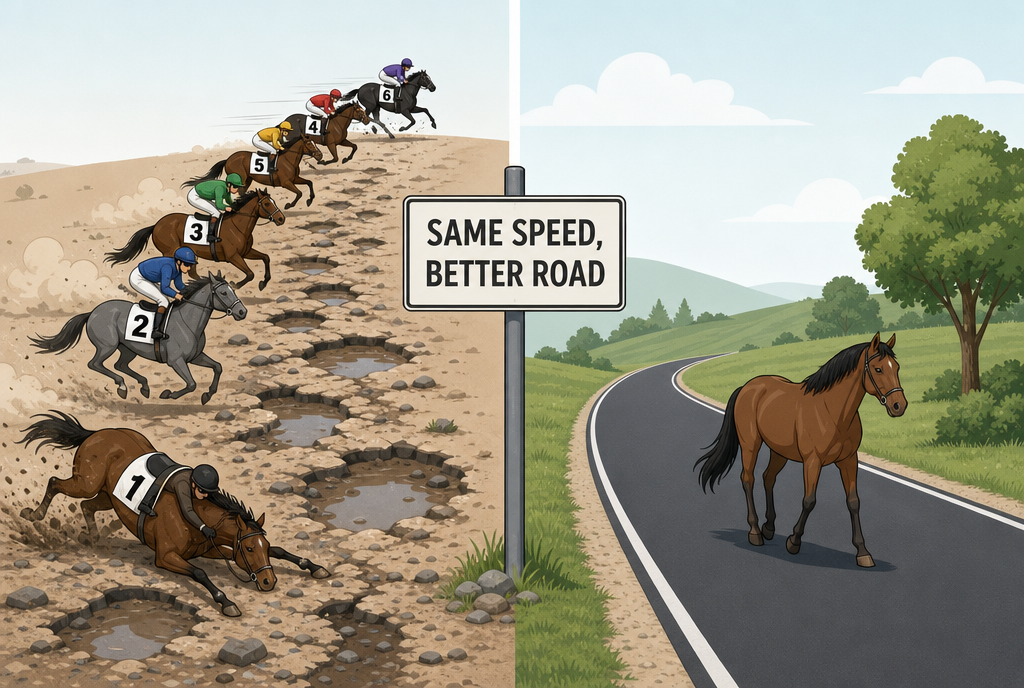
Twenty years of being sold faster horses. This time, they repaired the road.
The maximum speed doesn't move an inch
Wi-Fi 7: 23 gigabits per second at best. Wi-Fi 8: 23 gigabits per second at best.
There. That's all. No increase.
You have to grasp how unusual this is. Since Wi-Fi 4, every generation was sold on a single argument: the number on top is bigger than the one before. Wi-Fi 5, faster. Wi-Fi 6, faster. Wi-Fi 7, faster. And now, for the first time, the engineers behind the standard looked at the curve and said: that's enough, the problem isn't there anymore.
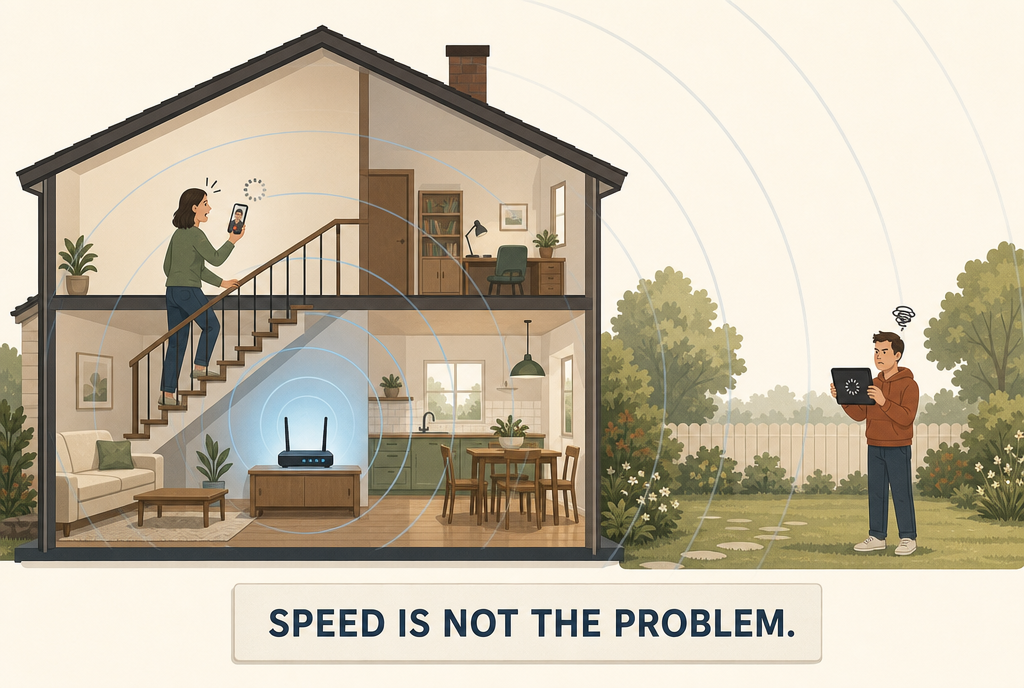
The Wi-Fi on the spec sheet is an empty room. Real Wi-Fi is this guy at the back of the garden, and his face.
They're right, and you already know it without knowing it. Nobody has ever had 23 gigabits at home. That number is the speed of a race car on a closed track, measured in an empty room with a single device pressed against the router. Your real life is the back of the garden, the bathroom behind two walls, fifteen devices switched on at the same time and the neighbor who put his access point on the same channel as you.
So what did they improve?
Three things. They all show up in a real house, and none of the three shows up in a speed test.
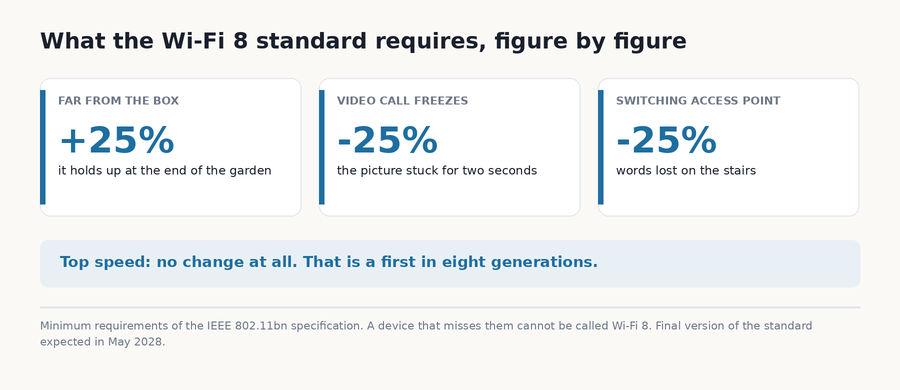
Three times 25%, and zero extra speed. It's the first honest Wi-Fi.
Far from the box, it holds up better
You know the route by heart. Sitting next to the box, everything is fast. In the back bedroom, it gets mediocre. At the back of the garden, the video turns into big squares and the phone eventually drops Wi-Fi to switch to 4G.
Wi-Fi 8 isn't faster when you're pressed against the box. It's a quarter faster when you're far away. Same walls, same box, same deck chair at the back of the garden: it just gives up less quickly.
The image freezing in the middle of a video call
What ruins a video call is never the speed. It's the moment when the image freezes even though everything was going fine, when the voice turns robotic, and when you end up saying, "Can you hear me?". It lasts two or three seconds and happens once in twenty.
The engineers aimed exactly at those moments. Not the average, which is very good and which nobody gives a damn about: the glitches. When it freezes, it freezes for a quarter less time.
The silence when you go up the stairs
If you have several access points at home, the box downstairs and a repeater upstairs, for example, you've already experienced this: you're going upstairs in the middle of a conversation, and there's this two-second silence while your phone drops one access point to grab the other.
During this handoff, bits of your conversation get lost along the way, and you have to ask for them again. Wi-Fi 8 loses a quarter less of them.
And it's mandatory
These three numbers aren't an advertising promise. They're written into the standard's specifications: a device that doesn't meet them isn't allowed to call itself Wi-Fi 8. That's the difference between "our engineers worked really hard" and a checkbox.
The little detail the press release doesn't highlight
The 802.11bn standard doesn't exist yet.
Well yes, it exists, but in draft form. Its final version is not expected before May 2028. In other words, TP-Link is selling hardware in September 2026 that complies with a text that will be finished in twenty months.

The furniture is already on the shelf. The instructions come out in twenty months.
It's not a scandal, it's even become routine: Wi-Fi 6 and Wi-Fi 7 went through exactly the same scenario, and in both cases the first devices could be updated to the final version. But updated does not mean guaranteed. If a detail changes between the draft and the final text, it's the early buyers who discover the problem, and the word you're looking for in the product sheet is called "draft".
There's also a very simple question: what are you going to talk to over Wi-Fi 8? Today, nothing. Not a phone, not a laptop, not a tablet. The first compatible devices are announced for sometime in 2027, and there won't be many of them at the beginning. In the meantime, your brand-new router will spend its days talking Wi-Fi 7, or even Wi-Fi 6, to absolutely everything you own.
Should you buy it?
No. Well, not now, and not for the reason they'll sell you.
If your problem is the far end of the hallway, the upstairs bedroom or the video call that freezes, the real answer in 2026 is a second access point, not a new standard. A multi-access-point Wi-Fi 6 system will fix your coverage problem today, for three times less money, and without waiting for the rest of your house to catch up.
And if you're replacing a router that's seven years old, get tried-and-tested Wi-Fi 7, or wait until next summer for the phones to catch up.
What makes me happy about all this isn't the product. It's the shift. For twenty years, the industry sold us closed-loop figures that nobody ever reached, and we all pretended to believe them while looking at the box. This time, they put their 25% on what actually fails, in a real house, with real walls. It's less appealing on a box, and infinitely more useful.
It took twenty years and eight generations for a Wi-Fi manufacturer to stop talking to me about the maximum speed I'll never get. Welcome to the real world, guys!
Sources
- TP-Link : TP-Link Unveils World's First Complete Wi-Fi 8 Lineup at IFA 2026, September 1, 2026, the official press release, the models, the advertised speeds and the pre-order date
- TechSpot : After Wi-Fi 7's speed push, Wi-Fi 8 is turning to reliability, the identical peak throughput between the two standards and the details of the three reliability objectives
- Hwbusters : TP-Link Wi-Fi 8 routers hit pre-order September 30, two years before the standard is final, the finalization date of the IEEE 802.11bn standard in May 2028
- Towards Ultra-High Reliability in Wi-Fi 8: IEEE 802.11bn Core Features, the details of the three quantified requirements of the standard
Join the conversation
You need an account to comment on this article. Creating one is free and takes under a minute.
No comments yet.