A robot that walks on two legs for $399. Where's the scam?
A robot that walks on two legs for $399. Where's the scam?
Yesterday, I was telling you that Nvidia would put $12.9 billion into Hugging Face, the big public library of artificial intelligence. The next day, the same company opens orders for a $399 robot duck. Some weeks lack consistency.
Except no, actually. It's the same story, seen from the other end.
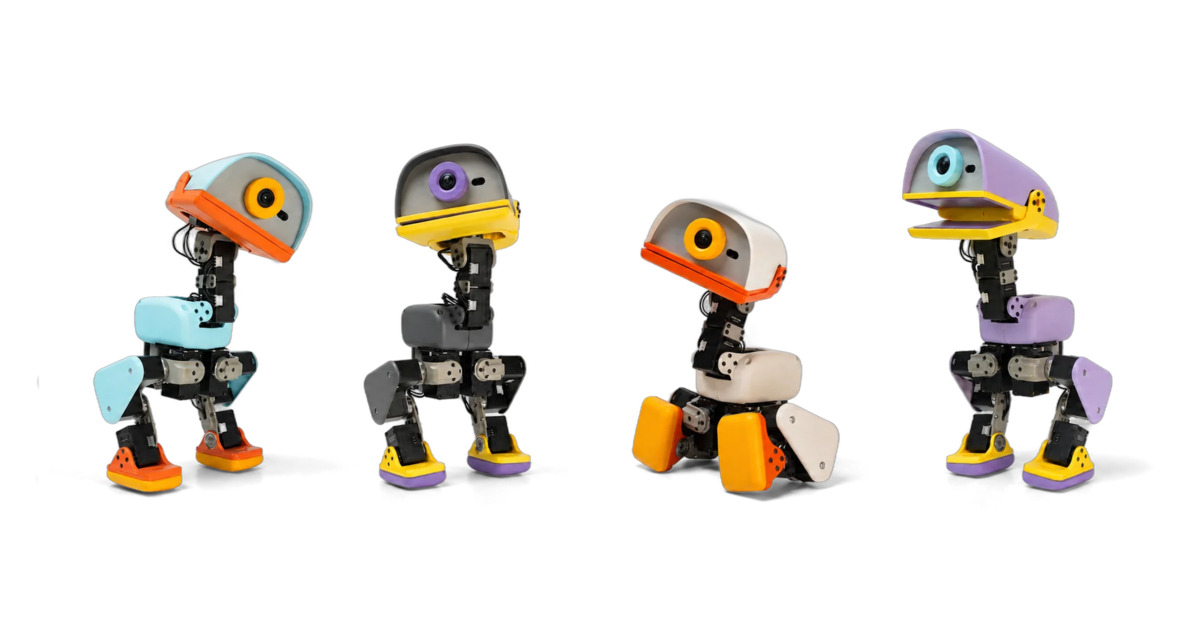
Twenty-five centimeters, 800 grams, four colors and a look that says don't touch me. Photo Pollen Robotics.
What exactly is this thing
It's called the Microduck, it comes from Pollen Robotics, a company from Bordeaux bought last year by Hugging Face, and orders have been open since August 27 for delivery announced before Christmas.
Physically: 25 centimeters tall, 800 grams, two legs, fifteen small motors to articulate them. One eye, which is a wide-angle camera. A laser rangefinder, in other words a thing that constantly measures the distance of the objects around it, like a car's parking radar but sweeping all around. Two balance sensors, exactly the ones that make your phone's screen flip when you turn it. A microphone, a speaker, and a beak that grabs objects.
In the box: the robot, the battery, a cable and a game controller. You take it out, put it on the floor, it walks. It comes in four colors, which adds nothing to the debate but I prefer to specify it before I'm asked.
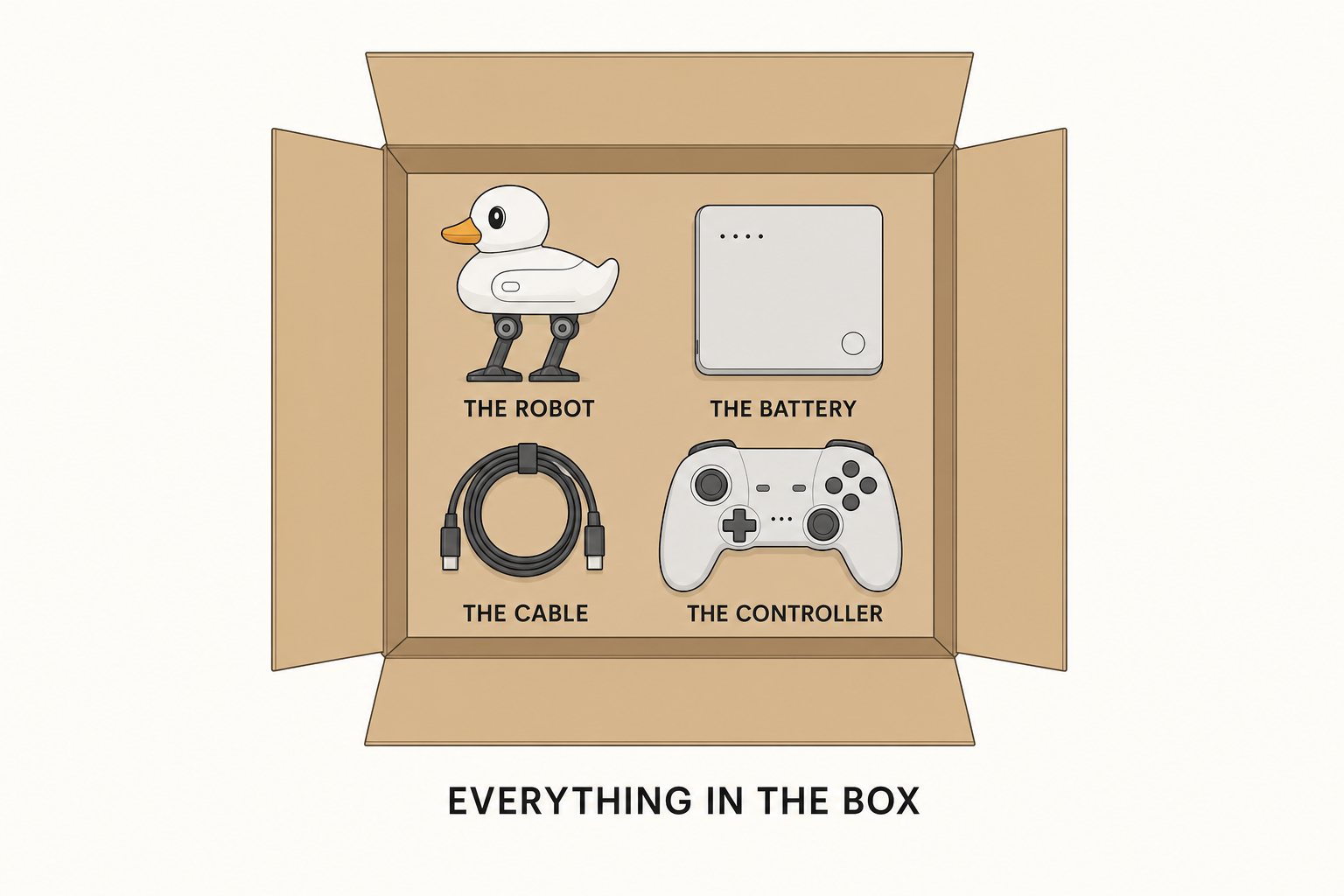
No screws to tighten, no three-hour tutorial. A controller.
Seven things it can already do out of the box
Walk. Sit down and stand back up. Kick a ball. Grab an object with its beak. Roller-skate, yes yes. And above all get back on its feet by itself after falling, which is by far the most difficult of the seven.
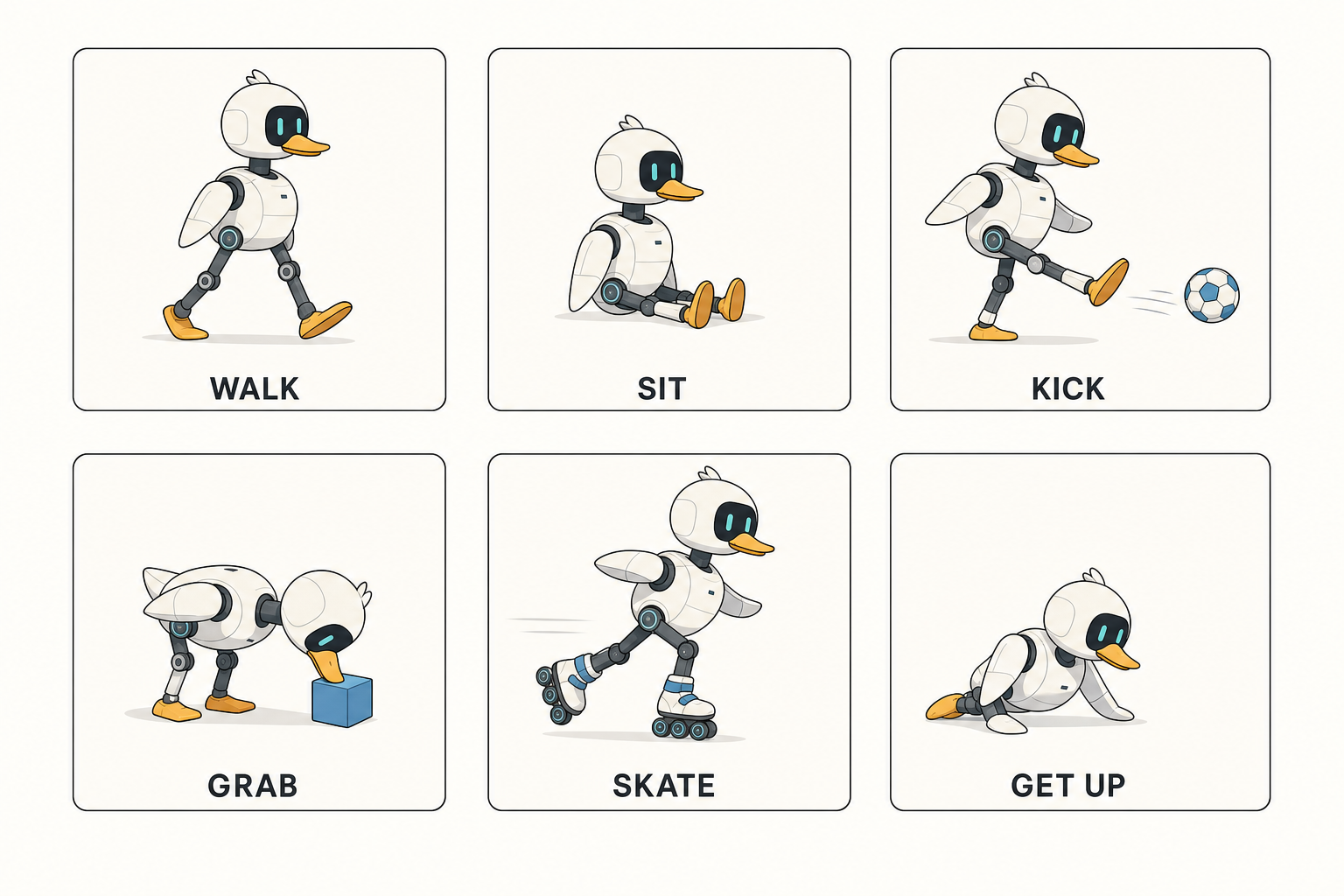
Roller-skating is useless. That's exactly why it had to be included.
These seven movements weren't programmed line by line by an engineer who would have written "raise the left thigh by twelve degrees". They were learned. We make a copy of the robot in a simulator, let it try thousands of times, tell it on each attempt whether it was better or worse, and after a while it figures out by itself how not to collapse. It's brutal as a method, and today it's the only one that really works for teaching a two-legged thing to stand upright.
The price, that's the information
A two-legged robot that really walks, until now, started at around $13,500. That's the listed price of the Unitree G1, the little Chinese humanoid seen in every demonstration, recorded in July. The laboratory version goes up to $43,900. The Microduck is $399.
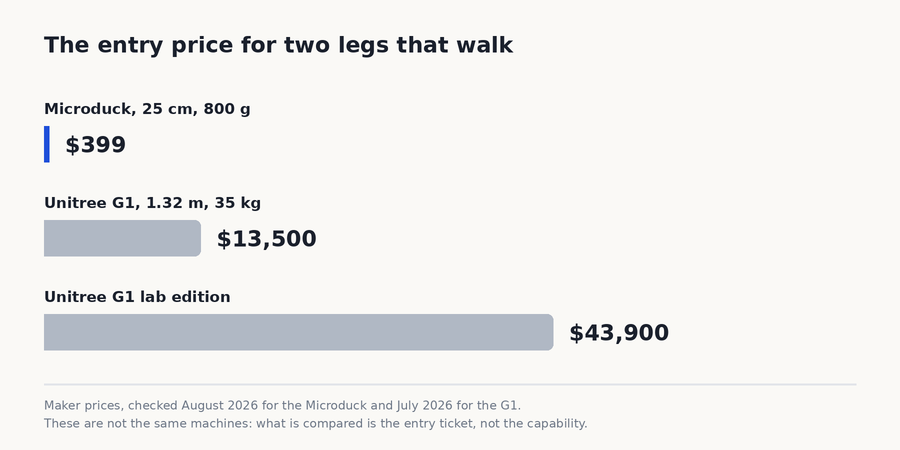
The first bar is almost invisible. That's the subject of the article.
Now careful, I'm not saying it's the same machine. The G1 is 1.32 meters tall and weighs 35 kilos, it has arms, hands, it carries loads. The duck weighs 800 grams and reaches your ankle. What collapses here isn't the price of a humanoid, it's the price of entry: the amount you have to spend to have at home a machine that stands upright on two legs and learns.
Open, and not just in the brochure
The word “open” gets used for everything and anything, so let's look at what it covers here.
The robot's software, the simulator used to train it, and the seven behaviors delivered with it are published under a license that allows absolutely anything, including making a commercial product out of it and reselling it. You can open the “walk” behavior, see how it was learned, redo it your own way, or teach it something else. Hugging Face boss Clem Delangue presents it as a robot that can be taught new tricks.
This isn't a communications posture, it's the company's business model from the beginning: make free what everyone uses, and make yourself indispensable along the way. They did it with artificial intelligence models, they're doing it again with legs.
If you're a developer
There's nothing essential here to understand what follows, you can skip it.
The package is under Apache-2.0, which means commercial use is allowed, patents are granted, and there's no obligation to share your modifications. Published are: the development kit, the simulation environment under MuJoCo, the complete reinforcement learning stack, and the seven policies delivered with the robot, which can be inspected and retrained.
The control loop runs at 50 Hz, meaning one decision every twenty milliseconds. That's the rate that explains the size of the beast: the smaller and lighter the robot, the faster it falls, but the easier the corrections are to calculate. A 35-kilogram humanoid that starts falling forward, you have to catch it with torque; an 800-gram duck, you just have to put one foot back in place.
The real interest for anyone who likes tinkering is the complete loop: you train in the simulator, you put the resulting policy into the real machine, you watch the gap between the two worlds jump out at you, you start again. This transition from simulation to reality is the most thankless research subject in robotics, and until now it cost the price of a used car to tackle it seriously.
Concretely, what does this change for you?
If you don't have a curious child and don't feel like tinkering, it changes absolutely nothing. There, I've said it.
For everyone else, the interest is where you don't expect it. A twelve-year-old can now get their hands on a real walking robot, not a remote-controlled car. A school can buy three for the price of a laptop. And the day it falls over and breaks a plastic leg, the part's design is public and can be reprinted.
We've already seen this movement twice. A 3D printer cost €2,000 in 2012 and can be found for 150 today, which did far more for middle-school workshops than any speech about digital technology. And the Raspberry Pi, that little $35 computer released the same year, which serious people took for a toy, has since ended up in production lines and weather stations.
Now, honesty requires saying what it doesn't do. It won't carry your shopping, it won't watch the house, it won't pick up the socks. It weighs 800 grams and comes up to your ankle. It's not a household robot, it's a walking workbench. And “delivery before Christmas”, in hardware, remains a promise as long as a box hasn't rung the doorbell.
What I think
There's something I like about this, and it's not the duck.
While everyone is watching the $40,000 humanoids walk on conference stages, the first two-legged machine that normal people will really touch, put on the floor, make fall over and repair, is going to be an 800-gram thing with a beak. And since everything is open, what they'll teach it, nobody planned for.
I predict six months of the internet filled with ducks doing stupid things, and then one day, somewhere in the middle, someone will have solved a problem that laboratories had been looking for three years. That's always how it happens!
Sources
- Pollen Robotics: official Microduck page, specifications, box contents, license and orders opening on August 27, 2026
- TechCrunch: Hugging Face is selling a cute $399 open source duck robot, Microduck, August 27, 2026, price, delivery and acquisition of Pollen Robotics
- The Register: Hugging Face offers $399 robot duck, August 27, 2026, sensors and delivered behaviors
- There's a robot for that: Unitree G1 price 2026, prices recorded in July 2026, for comparison
Join the conversation
You need an account to comment on this article. Creating one is free and takes under a minute.
No comments yet.