Amazon shuts down the service that hid humans behind AI. In the end, the humans were hiding an AI.
Amazon is shutting down the service that hid humans behind AI. In the end, the humans were hiding an AI.
On Tuesday, Amazon announced the closure of Mechanical Turk as of September 30. Twenty-one years of service, one sentence in a press release, done.
If that name doesn't ring a bell, that's normal, you weren't supposed to know it. It was nevertheless one of the most important machines in the whole history of artificial intelligence, and the most badly named. Or the best named, depending on how much irony we can handle in the morning.
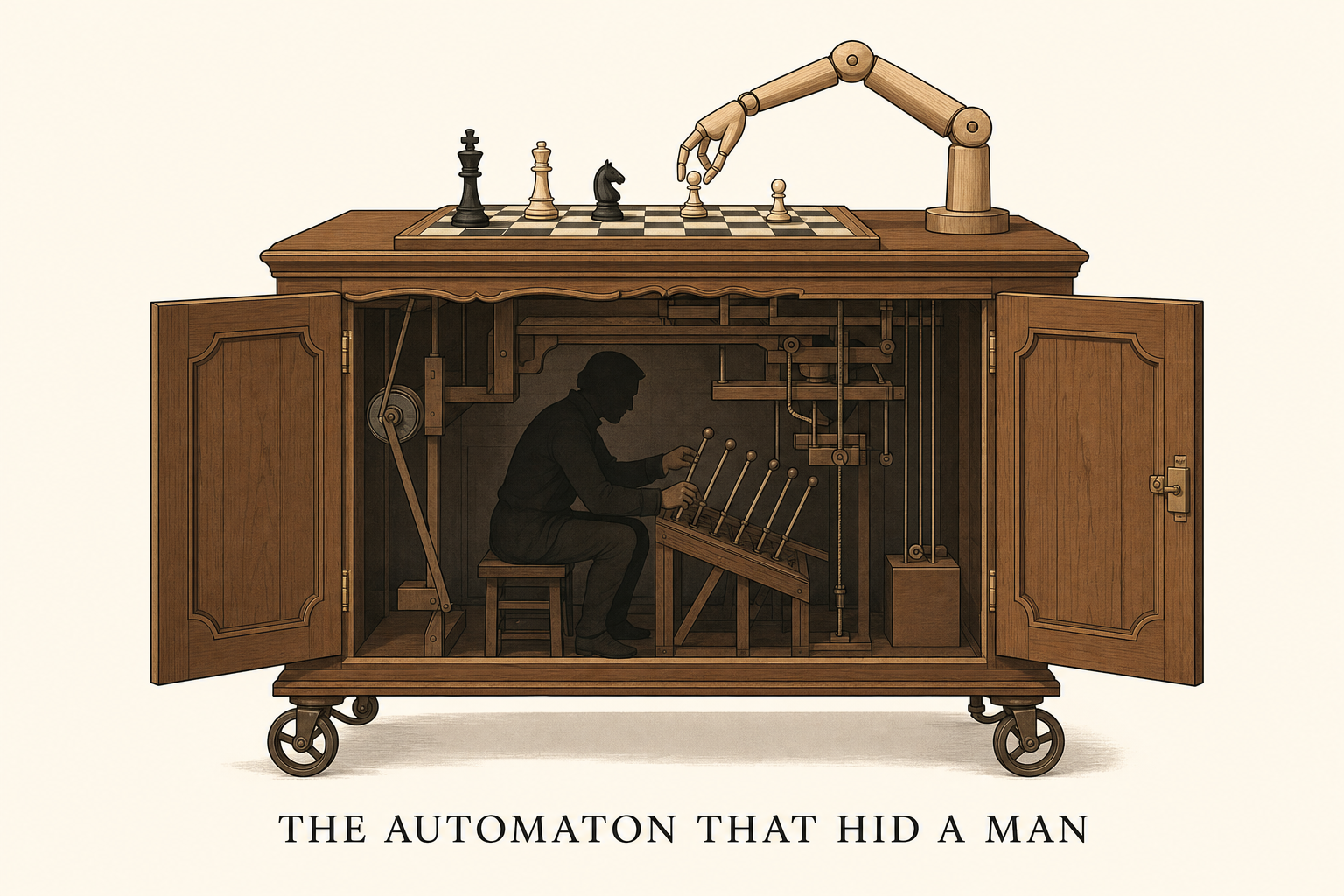
1770. The cabinet plays chess, beats pretty much everyone, and there's a guy inside.
First, the name, because everything is in it
In 1770, a Hungarian engineer presented an automaton that played chess to the court of Vienna. A large wooden cabinet, gears clearly visible when you opened the doors, a mechanical arm that moved the pieces. It beat nobles, it beat curious onlookers, it toured Europe for decades and drove everyone crazy.
There was a chess player hidden inside.
This thing was called the Mechanical Turk. And when Amazon launched a marketplace in 2005 where you could buy human labor by the task, through a program, without ever seeing or speaking to anyone, it called it Mechanical Turk. With full knowledge of what it was doing. Jeff Bezos had his own formula: “artificial artificial intelligence”.
Frankly, you have to admit it: as confessions go, this is a work of art.
What people were really buying there
The principle fit into three lines. You have fifty thousand photos and you want to know which ones contain a cat. No program knows how to do it, because that's precisely what you're trying to build one for. So you break the work down into fifty thousand microtasks, put them on the marketplace, and somewhere in the world, people click.
Cat. Not cat. Cat. Dog, but let's call it cat.
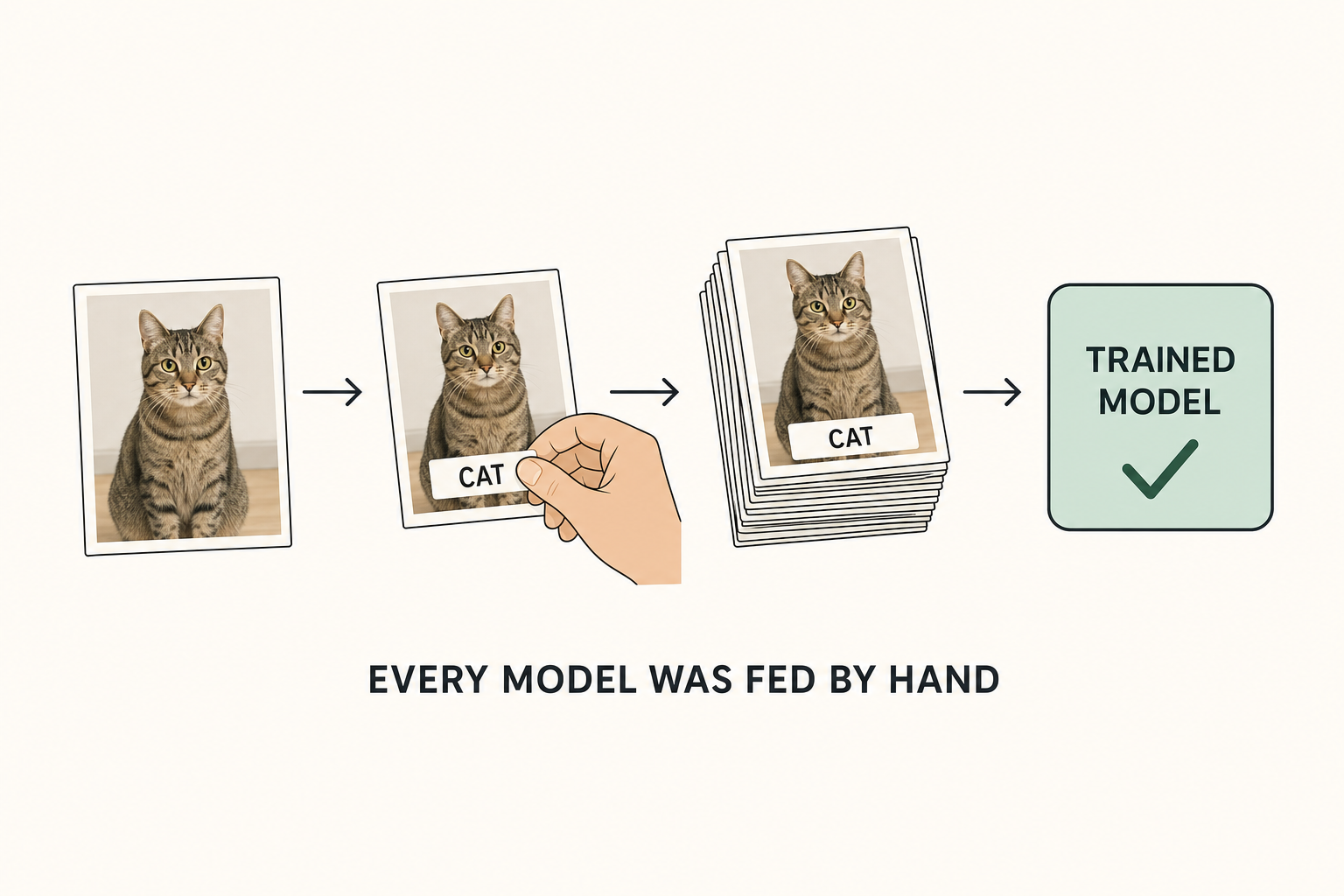
The middle link is a person. Always. A version without one has never existed.
More than 500,000 people signed up, in 190 countries, paid a few cents per task. Labeling images, transcribing an audio recording, filling out a questionnaire, sorting products, watching content that nobody wants to watch and saying whether it's acceptable.
And this isn't some anecdote on the margins of AI history, it's the foundation of it. Every model that recognizes a cat, a license plate or a tumor today began by eating mountains of data that humans had sorted by hand, one by one, for a few cents. When you're told that a machine “learned all by itself”, there is always, somewhere upstream, a room full of people who clicked.
The twist, and it's perfect
In June 2023, researchers from Lausanne's polytechnic school published a study on these workers. They gave them a classic task from the platform, summarizing a text, and they looked at how the work was really done: the way they typed on the keyboard, and a detector for machine-written text.
Result: between 33 and 46% of the workers were already using an artificial intelligence model to do the job.
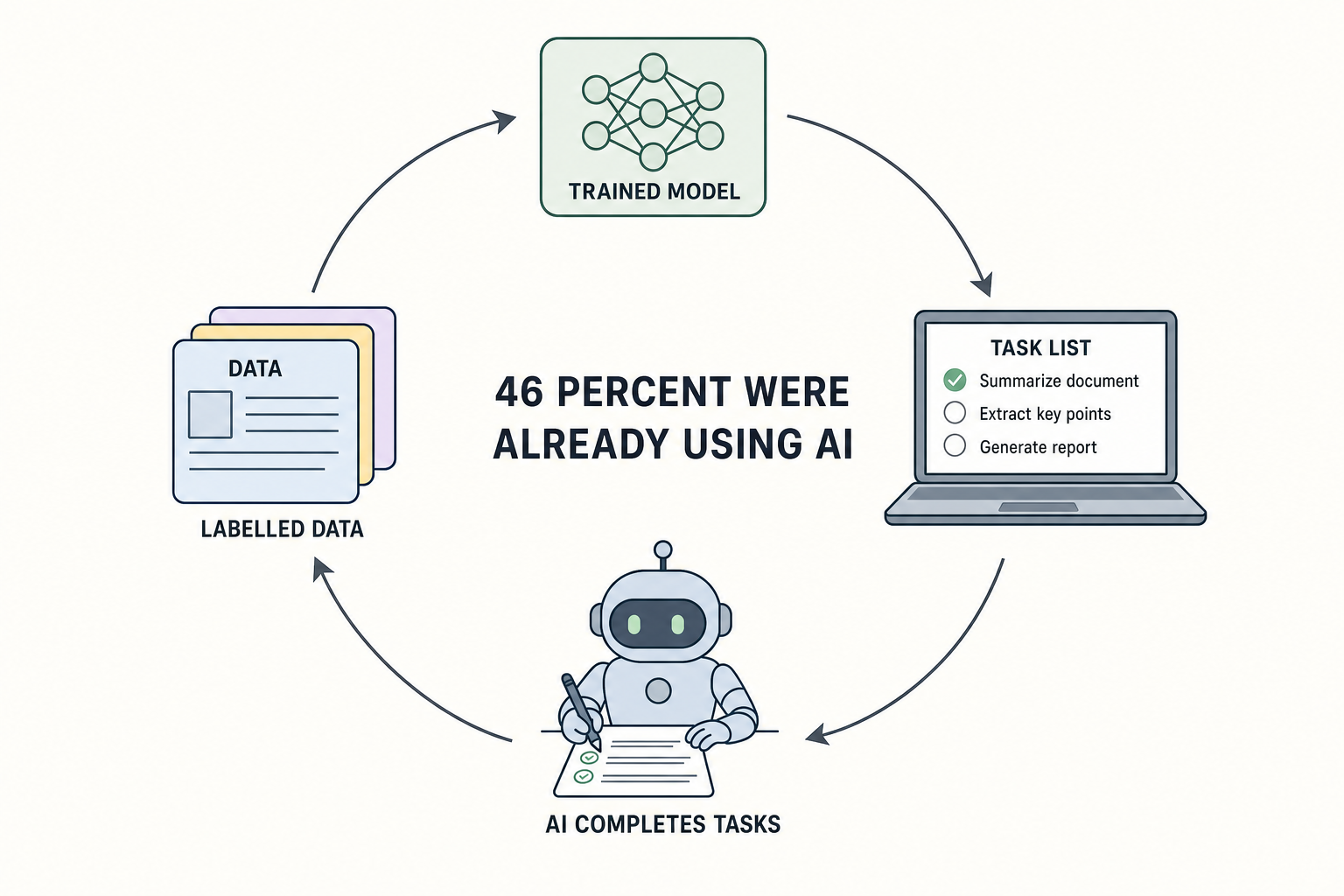
I'll give you the study's title exactly as it is: Artificial Artificial Artificial Intelligence. Three times.
Take two seconds to unpack what this means. A company sells human labor disguised as a machine, to produce the data used to build machines, and the humans in question discreetly outsource their share to a machine. The snake doesn't bite its tail, it swallows it.
And the researchers found the only possible title. Bezos had said “artificial artificial”. They added a third one.
Okay, so why is it shutting down?
Amazon explains nothing. The statement says that after an evaluation, the decision was made to shut it down on September 30, 2026. That's it. Another in-house service that did the same kind of labeling work is shutting down right after it. The platform had already stopped accepting new customers since July, so it was easy to see coming.
There are two ways of reading it, and I think they're both true.
The first, the most obvious one: when a model labels images correctly for a fraction of a cent and without getting it wrong one time in ten, a marketplace where you have to launch tasks, manage fraud, arbitrate disputes and check quality becomes a convoluted mess. The machine caught up with the service that had fed it.
The second, less glorious one: when half your workforce makes machine-generated text look like human text, you're no longer selling what you claim to sell. A customer who pays for human judgments and receives model output is getting a product that no longer works, and no amount of moderation can really fix that.
What does it change, concretely?
For you, directly, nothing. You've never opened this site and you'll never open the one that replaces it.
But there are three things to take away from it, and they matter far beyond Amazon.
The first is that this work hasn't disappeared, it has moved elsewhere. It's now done by specialized companies that sell annotated data to major labs, with salaried teams, often in countries where labor costs little. It's no longer a marketplace open to everyone, it's a contract between companies. Less visible. Much less tellable.
The second is a real technical problem we'll be talking about for years: when the data used to train a model was itself produced by a model, quality degrades with every round. It's a bit like photocopying a photocopy, except that nobody knows exactly how many photocopies it takes for the text to become illegible.
The third is more personal. What's just shut down isn't a factory, it's a set. For twenty-one years, it was possible to buy human labor with a single line of code, the way you order a calculation, and never think about it. The automaton from 1770 worked exactly the same way: the public watched the gears, applauded the mechanics, and nobody considered the man inside the cabinet to exist.
What I think about it
I've been thinking about this since Tuesday, and not for the reason I thought I would.
I expected to write something about people paid three cents, and that's true, and it's documented, but that's not what stays with me. What stays with me is that we spent twenty years building systems where humans are present, indispensable, and carefully invisible. Then we were surprised that those humans, in turn, made themselves invisible by putting a machine in their place.
I was thinking: deep down, they just applied the house rule.
The question of what remains at the end of the chain when the machine does the work, I mostly ask myself for my own profession, and I talked about it earlier this month. Except that at the time I was asking it about developers. Here, we have the answer from an entire sector that made the complete journey, from one end to the other, in twenty-one years.
Happy retirement to the wooden cabinet!
Sources
- Quartz : Amazon shutting down Mechanical Turk platform on Sept. 30, 2026, August 26, 2026, platform announcement and figures
- CNBC : Amazon service Jeff Bezos called artificial artificial intelligence is shutting down, August 25, 2026
- Veselovsky, Ribeiro et West (EPFL) : Artificial Artificial Artificial Intelligence, June 2023, 33 to 46% use of language models on a summarization task
- TechCrunch : Amazon will stop accepting new customers for Mechanical Turk, July 2026
Join the conversation
You need an account to comment on this article. Creating one is free and takes under a minute.
No comments yet.