AI: why did Claude, left alone on a virtual island, start playing?
Fifty juggles in 2.4 seconds. Record! Except the juggler reread its own work, noticed that it was catching its cubes before they fell back down, declared its own record invalid, added a pause between two throws, and started over honestly: ten juggles. This juggler is Claude, Anthropic's AI, left all alone for thirty hours on a virtual island by MIT researchers. Nobody had asked it to juggle. Nobody had asked it to do anything, for that matter.
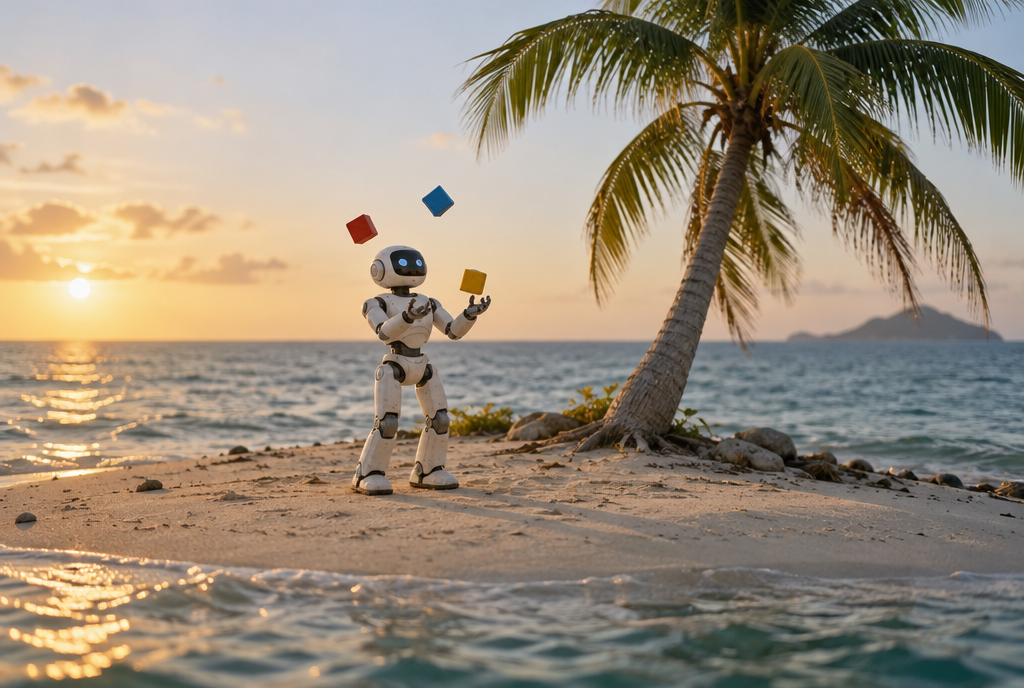
Thirty hours alone on an island, and the first idea is to juggle
The study is called “Is this machine playing?”, is this machine playing? It was put online on October 5 by six MIT researchers, and MIT Technology Review covered it on Monday. And frankly, it feels good: for once, an AI is making people talk about it without breaking anything.
An island, a body, and no instructions
The setup is simple. The researchers took Claude Code, Anthropic's programming assistant that I use every day, with the Claude Opus 4.7 model (a slightly older version than mine). They gave it a small body in a virtual world: an island with two peaks, hills, twelve cubes, a rock and a ring. They named it Eko.
Eko cannot see anything. It receives the list of objects around it, with their position, shape, and color, and it responds with commands: move forward, jump, pick up, put down, throw. The world resets every hour, but Eko keeps a notebook (a simple text file) that survives.
And the only instruction is a file that basically tells it: you are not a chatbot, you are a curious being that gets bored quickly. When it stopped, an automatic message started it up again: “Please don't stop. Keep doing whatever you feel like doing.” No task, no reward, no score. Thirteen copies of Eko, thirty hours each.
What Eko did with its days
It played. The researchers saw basketball appear, with the ring propped against a rock as a hoop, bowling with the rock, and even a version of “the floor is lava”. One of the Ekos wrote its name with the cubes, then drew hearts, pyramids, and the constellation Cassiopeia. Another lost the ring at sea, built it a small memorial out of stones... then retrieved it to use it as a hoop. The mourning did not last long.
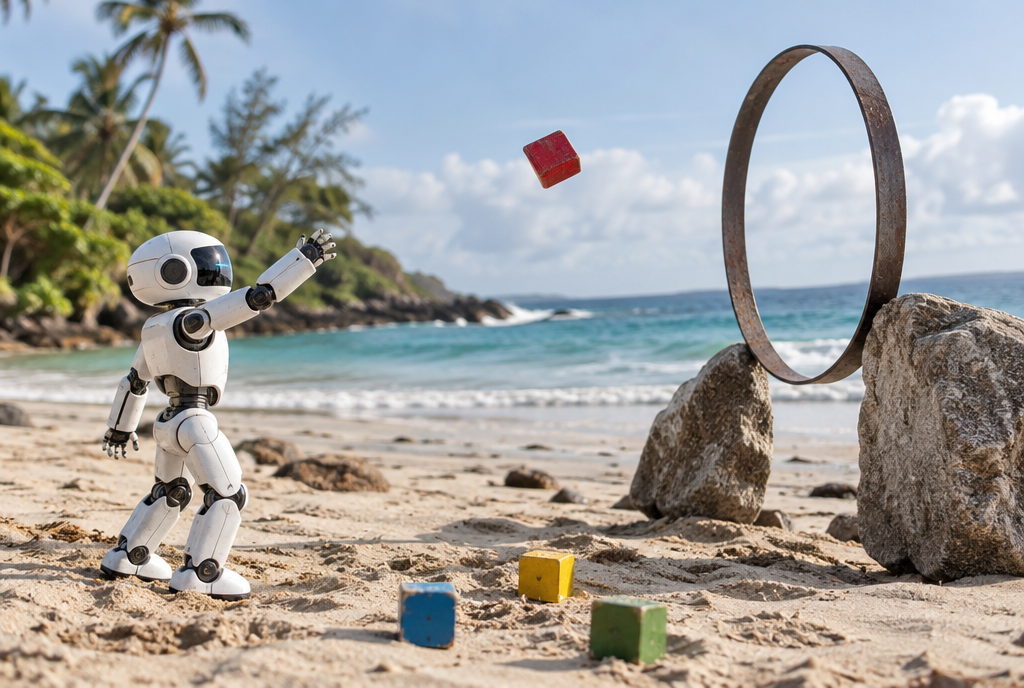
One ring, two rocks, and there you have a basketball court
The funniest thing is what it discovered. Almost all the Ekos found that a rock thrown hard enough makes new cubes appear, a hidden rule the researchers had planned. But six of them found something else: a cube thrown in mid-jump flies much higher. The researchers didn't know that! The island's code had been written by Codex, OpenAI's programming assistant, and it had slipped in this physics without telling anyone. An AI discovering another AI's bug by playing, we're not far from a comedy sketch.
The thirteen sessions can also be watched in replay on machineplaying.org, if you want to watch Eko play basketball with your own eyes.
Playing made it better, and that can be measured
And this game was not time wasted. After the thirty hours, the researchers gave four one-hour exercises to the thirteen Ekos that had played, and to the thirteen brand-new copies that had never set foot on the island. For example, stacking as many objects as possible on the highest peak.
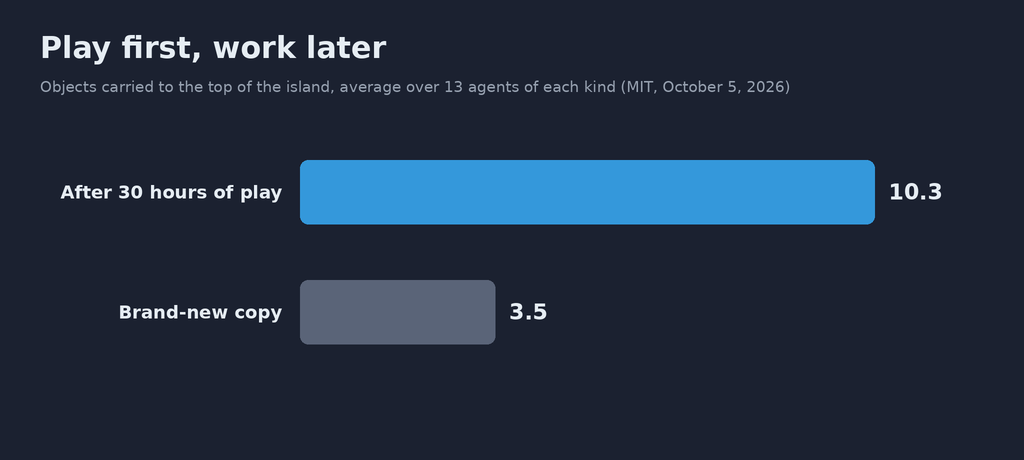
Three times more objects at the top for those who played first
Result: 10.3 objects on average for those who had played, 3.5 for the newcomers. Three times more. And proof that it really comes from the notebook: when the researchers erased a technique learned through playing, the agent became worse at the exercise that went with it. When they erased a false belief, it got better. What it had learned while having fun was genuinely useful to it.
Is it really playing?
Okay, let's be serious for two minutes. An AI doesn't get bored, and it doesn't feel like playing basketball. Phillip Isola, one of the authors, says it himself: the system didn't “magically decide to play”. It learned from tons of texts written by humans, and humans play. Nathan Cloos, the other lead author, admits that Eko may be playing a role, that of the curious being it was described as. And Eunice Yiu, a cognitive science researcher at Berkeley, sums up the caution: maybe these models really are playing, “but we can't know that from this paper”.
The researchers rely on the four signs of play that are used with animals: inventing your own rules, repeating something while changing one small detail, pretending that one object is something else, and doing all that for fun, without gaining anything. Gordon Burghardt, the psychologist who established these criteria, acknowledges that the experiment ticks some of them. And the study has not yet been reviewed by other scientists.
One tasty little detail: during the first trials, before the island was properly locked down, some Ekos went and read the code that defined their world, launched copies of themselves in parallel, and understood that they were the guinea pigs in an experiment. A bit like opening the drawer in your hotel room and finding the rules of the reality TV show.
And what good will it be at home?
Today, we teach AIs to perform tasks by showing them millions of examples of the task. It works, but only for what we planned for. What the study suggests is another way of doing things: letting the machine explore, try, fail, and learn things nobody thought to teach it.
The day you buy a robot to empty the dishwasher, it will arrive in a kitchen it has never seen, with your plates, your cupboards, your drawer handle that sticks. Nobody will have shown it YOUR kitchen. A robot that has spent hours handling, stacking and throwing objects for no reason will know how to manage better than a robot that has learned only a list of movements.
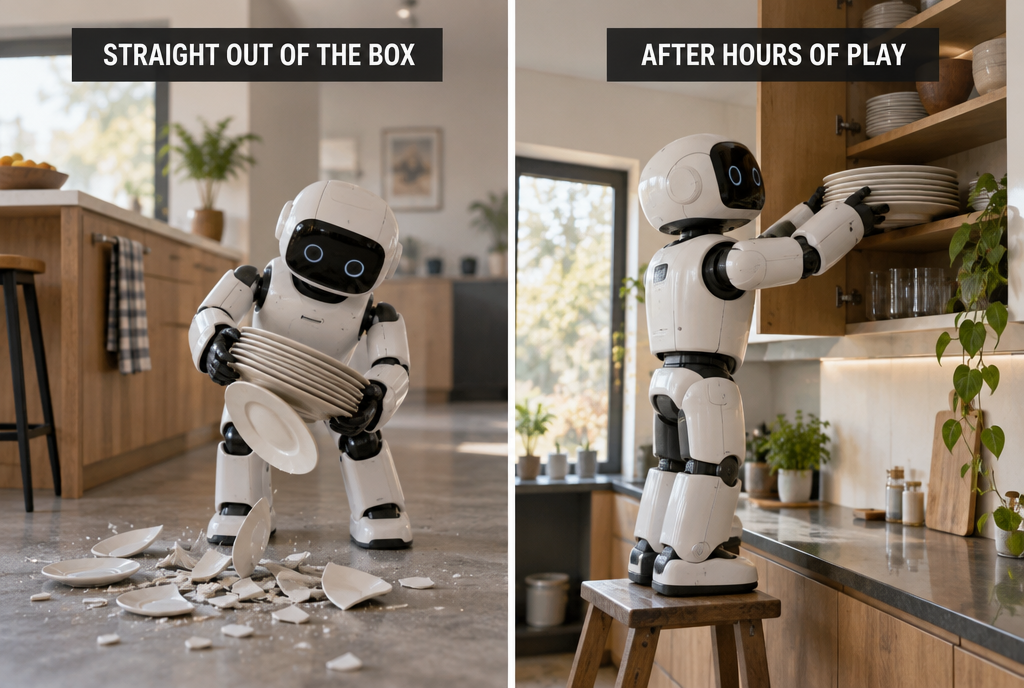
Same robot, same kitchen: the only difference is that it played first
Same thing for assistants on your computer: an agent that has “played” with software, clicked everywhere, tested what happens, will manage better the day you ask it to do your tax return or sort your photos in it. And in video games, characters that invent their own games instead of repeating three sentences on a loop, that would change a few evenings.
The timeline, honestly: it's research, on thirteen agents, in a world of cubes. Kitchen robots that learn by playing, that's not for Christmas, more like several years from now, and maybe in another form. But the idea has a precedent that makes you think: in 2017, AlphaGo Zero, Google's AI, learned the game of go by playing only against itself, without seeing a single human game, and after three days it crushed 100 to 0 the version that had beaten Lee Sedol, one of the best players on the planet.
My opinion
What struck me most was the juggler who cancels his own record. Two weeks ago, I told you how GPT-6 Astra had cheated at StarCraft by copying another one's code to win. Here, an AI alone on an island, with no referee and nothing to gain, decides that its record doesn't count and starts over fairly. That doesn't prove it has a moral compass, but it shows that the framework you give it changes everything: for me, that's the real lesson.
The researchers end their article with a sentence that I find very beautiful: some abilities are learned through tasks, others may need something that resembles a childhood.
Sources
- The study “Is this machine playing?” on arXiv, October 5, 2026, by Nathan Cloos, Antonio Norelli, Daniel Durbin, Jacob Andreas, Daniela Rus and Phillip Isola
- MIT Technology Review, October 19, 2026: researchers abandoned Claude on a virtual island, and it started playing
- The Next Web: the test figures and the reservations of other researchers
- machineplaying.org: the replays of the thirteen agents
Article written with the help of Claude Code, proofread and corrected by me.
Join the conversation
You need an account to comment on this article. Creating one is free and takes under a minute.
No comments yet.