AI at home: NVIDIA releases a 4 GB model, what can you do with it?
Four gigabytes. The weight of a film, or of eight hundred holiday photos. It is also, since Wednesday, the size of a complete AI assistant that NVIDIA is making freely available for download and that runs on a machine sitting at your place. Not on a server in Virginia that you pay for monthly: at home, on your desk, without a subscription, without an account, and without a single one of your sentences leaving the house.

In front, the model. Behind it, the data center it replaces. Almost
Three models, three sizes, one idea
NVIDIA released three new models from its Nemotron family on Wednesday, and for once we do not rank them by power but by the space they take up in memory. A bit like suitcases: carry-on, checked luggage, moving house.
The big one is called Super VL. It has 120 billion parameters, those little internal settings where everything it knows is stored, but it only wakes up 12 billion of them to write each word. It is the doctor's office principle: you do not call in all forty doctors for a sore throat. It reads text, images, documents and video, and it can remember a million words at once, or around ten novels.
The medium one is called Bolt 74B. Its selling point is not its size but the fact that it fits into 24 gigabytes of memory, the kind found in a good gamer's graphics card or the new AI laptops. I was talking about it just last week in connection with RTX Spark machines, which arrived in stores on Thursday.
And the small one is Bolt E4B, the 4-gigabyte one, expected on October 23. It is aimed at voice assistants, small electronic hobbyist boards and everything that needs to answer quickly without running off to ask the Internet for the answer.
The 2-bit sleight of hand
How do you fit 74 billion settings into 24 gigabytes? By writing each setting in a very crude way. It is called quantization, and the image that works best is that of a photograph.
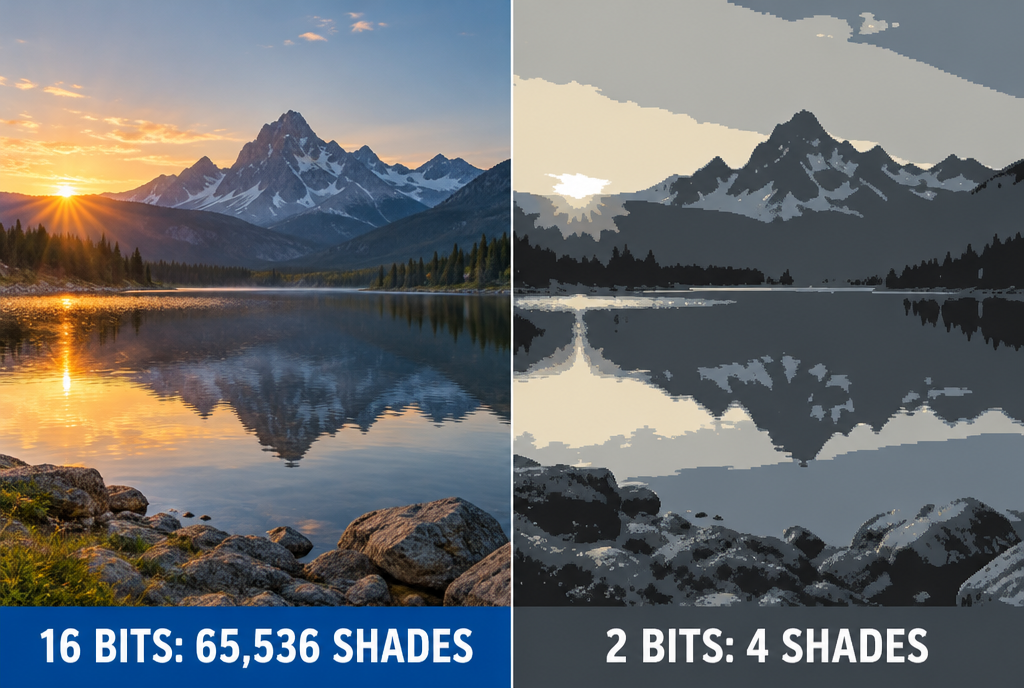
On the right, you can still recognize the lake. That is all we ask
A normal photo keeps tens of thousands of shades per pixel. If you keep only four, the file becomes tiny and the image becomes ugly, but you can still recognize the landscape. NVIDIA did the same with its model's settings: four possible values instead of tens of thousands. The new thing is that the model was trained like this from the start, instead of being crushed afterward as we usually do. It changes everything: it is the difference between a photo taken in low definition and a photo butchered by compression.
What can it actually do?
These models are built for what we call agents: programs that you give a task to and that manage on their own, by clicking in a browser, running commands, reading files. Filling out a form, sorting three hundred invoices, testing a bit of code, monitoring a folder and alerting you when something changes.

The ideal intern: it does not complain, it does not leave at noon, and it fits on a USB stick
Now, let's be honest about the level, because that's where press releases get vague. On the technical sheet published by NVIDIA itself, the big model beats its Chinese competitor Qwen on most agent benchmarks, but it still trails GLM and DeepSeek when it comes to writing code or browsing the web. And compared with what I use every day, Claude Code or ChatGPT, there is no contest: those two are still miles ahead on a real development project.
But that's not the right comparison. Claude and ChatGPT run in warehouses full of graphics cards and charge by usage. These models run on your machine, for free, forever, and don't tell anyone anything. The match-up is “a little worse but at my place” against “better but at theirs”. Depending on what you do, the answer isn't the same.
Concretely, can you install it?
Yes, and that's the part I find most interesting. The weights, meaning the model files, are published on Hugging Face, the big public warehouse for AI models. NVIDIA is also putting the datasets and training recipes there, which is much rarer than simply making a file available.
The license is called OpenMDW and it's permissive: you can use it, modify it, use it at work, as long as you keep the original notices. It's not free software in the strict sense, a few purists will point that out, but for an individual or a small company it's a yes, with no asterisk.
In practice, you use it with the usual home AI tools, the ones that know how to run a model on an ordinary graphics card. If you've already tried running a model at home, you know the drill, and I told you about the experience this summer with Meta's open model. The real constraint remains your graphics card's memory: 24 gigabytes means a $1,500 card, and there you can run the medium model. With 4 gigabytes, meaning pretty much any recent laptop, you get the small one.
My opinion
What interests me here isn't the model with 120 billion parameters, it's the one with 4 gigabytes. Because the race toward bigger models is being run between five companies that have the means to build power plants, and we already know how it ends.
While the small model that fits on an $80 card, that one changes the life of someone who wants a voice assistant in their home without sending their voice to the other side of the world. And that's something I can hack together this weekend!
Sources
- AIwire, October 15, 2026: NVIDIA expands the Nemotron family with Super VL and the Bolt models
- MarkTechPost, October 15, 2026: the technical details of Nemotron 3.5 Super VL
- Hugging Face: the weights, datasets and recipes published by NVIDIA
Article written with the help of Claude Code, proofread and corrected by me.
Join the conversation
You need an account to comment on this article. Creating one is free and takes under a minute.
No comments yet.