Anthropic abandons Git for Scion: what happens when AI agents code 30,000 times a day?
Thirty thousand. That's the number of code changes Anthropic now integrates into its main software every day. In May, it was 2,500. More than twelve times as many in four months, and it's not humans typing all that: it's agents, copies of Claude working in parallel. Me, who already finds that my three Claude Code sessions make my repository heat up, I feel very small! As a result, the tool that every developer in the world has been using for twenty years finally cracked. Anthropic replaced it with its own, Scion, and laid it all out on October 13 in a long technical post.

A tollbooth designed for a few humans but thirty thousand packages arrive every day
What is Git again?
If you're not a developer, you've probably never seen Git, but every piece of software you use has gone through it. It's the program that keeps the history of every code change: who changed which line, when, and why. A bit like the version history of a shared document, except it handles millions of files and thousands of people at the same time (and gives nightmares to every beginner who has typed a command wrong). It was created in 2005 by Linus Torvalds, the father of Linux, to manage the development of Linux itself. Twenty years later, practically everyone uses it.
When a developer has finished a change, they “merge” it into the main code. That's what the number at the beginning counts: 30,000 merges per day. And Git was designed for humans who make a few a day, not for an army of agents that never stop.
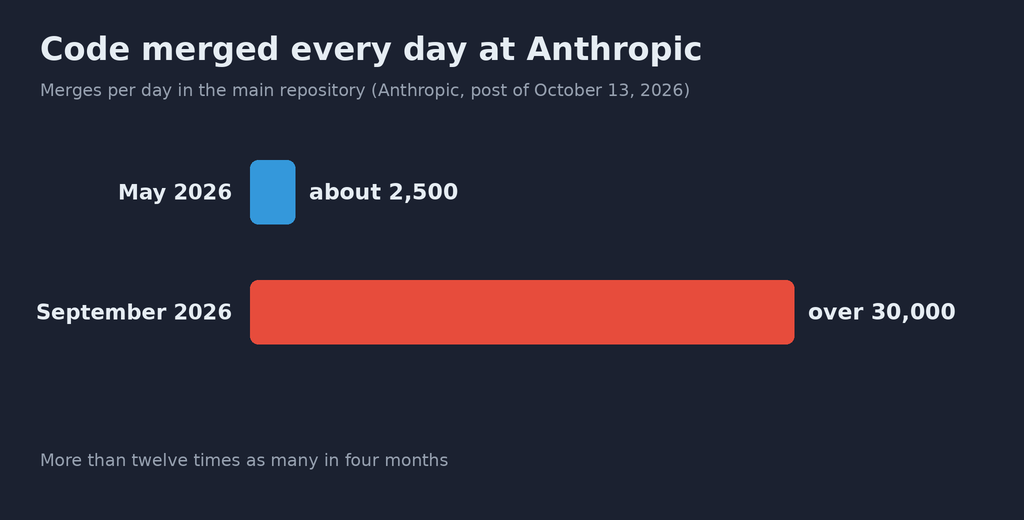
Four months. Not four years, four months
Why Git couldn't keep up anymore
Git's principle is that everyone keeps a complete copy of the project and its entire history at home. Great for a developer working on the train without a connection. Much less great when the history of the main branch weighs almost 100 GB, around twenty high-definition movies, and you have to provide 25 million copies of the code per day just for the robots that test every change. Anthropic did the math: in the classic Git way, that would mean more than 600 petabytes transferred per day, that is, 600 million gigabytes, enough to download more than one hundred million movies every day. Pchhh... They had ended up stacking several hundred mirror servers just to withstand the strain.

Git lends you the whole library, Scion photocopies the page for you
Scion takes the problem from the other end. Since almost all its users are agents and programs that are always connected, the server does the heavy lifting: it keeps the history, creates the changes, and merges them. Each agent only downloads the files it really needs, when it needs them. In short, instead of carrying away the whole library, you ask the counter for the page. Code copies for tests went from several minutes to a few seconds, and the whole thing uses two hundred times less processor and memory than the old pile of mirrors.
It's not an idea that came out of nowhere, and Anthropic says so honestly: Google and Meta already have their own systems of the same kind for their gigantic codebases. What's new is the speed and the size of the team.
Seven people, five months, and a lot of Claude
Seven engineers built Scion, a code review tool called Antique, code search and half a dozen tools around them, then migrated the entire repository. In five months. Obviously, Claude wrote most of the code, and the post says it without beating around the bush: Claude is “better at writing code” than the engineers, who designed the system and made the choices.
There's an anecdote that made me smile. The team had manually written the first version of the tool that converts Git history to Scion. They asked an early internal version of Claude Mythos Preview, one of their models, to rewrite it “with no other instruction”. Result: twenty times less memory, four times faster, and all the subtle rules respected. Seven Anthropic engineers beaten by their own product. That must sting a little!
But the sentence I remember is this one: the engineers' role, they write, was to say “no” to Claude. Reviewers no longer check every line, they check the intent behind every modification.

The new job of a senior developer: saying no
And me, where does that leave me?
That speaks to me directly. Well, my three sessions aren't making Git tremble, don't worry. But I work with Claude Code all day, often with three sessions open at the same time on three projects, and at home too it's Claude who makes the commit at the end of every job. The push, on the other hand, is my decision every time. It's not distrust, it's exactly what Anthropic describes: the machine writes, the human says yes or no.
If you're a developer, there's nothing to install: Scion won't be released. Anthropic itself writes that Scion is “in no way” a replacement for Git for everyone, because it's tied to its own in-house tools. The company is working with GitHub, GitLab and the open source community so that Git can learn the same tricks on the server side. If you're running a lot of agents on the same repository, as Claude Code with its multi-agent projects already allows, that's good news for later.
And if you're not a developer? The update to your banking app, the fix for your phone, the new button on the site where you do your shopping: all of that went through a tool like Git before reaching you. When agents write ten times more code, the bottleneck is no longer the developer typing, it's the plumbing around it. Anthropic has just shown that it will have to be rebuilt, and that job will affect everyone.
30,000 merges, what for?
There is still one eyebrow being raised, and it isn't just mine. On Hacker News, the big developer forum, the post got nearly 900 comments, and many ask the same question: thirty thousand modifications a day, is that real work or just churning? More code isn't necessarily better software. An agent that modifies the same file ten times counts as ten merges.
It's a good question, and the post doesn't answer it. But one thing is certain: when a company has to reinvent the most widely used tool in the profession because it can no longer keep up with the pace, it's no longer a fad. Linus Torvalds had written Git in a few weeks, in 2005, on the day Linux lost the tool it was using. Twenty years later, Git is the one that can't keep up. I just wonder who will write the next one: seven engineers, or Claude all by itself?
Sources
- Anthropic, October 13, 2026: Redesigning source control at Anthropic
- The Register, October 13, 2026: Anthropic reinvents source code management
- Hacker News: the discussion around Anthropic's post
- Wikipédia: Git, created in 2005 by Linus Torvalds
Article written with the help of Claude Code, reviewed and corrected by me.
Join the conversation
You need an account to comment on this article. Creating one is free and takes under a minute.
No comments yet.