Nuclear clock: the first two are ticking in Vienna and Beijing, what is it for?
One second of error in thirty million years. That is the precision of the new clock presented this week by the Vienna University of Technology. If it had been launched thirty million years ago, long after the disappearance of the dinosaurs, it would today be off by just one small second. Wow! And in two weeks, when we switch to winter time on October 25, there will still be an oven, a radio alarm clock or a car at your place showing a time difference until spring. We really do live at two different speeds!
This clock has one particular feature: it does not count time with atoms, like the best clocks in the world today, but with the nuclei of atoms. It is the first “nuclear clock” to run all by itself, and it has a twin: a Chinese team from Tsinghua University, in Beijing, published theirs in the same issue of the journal Nature, on October 7. Physicists had been chasing this dream for almost fifty years.
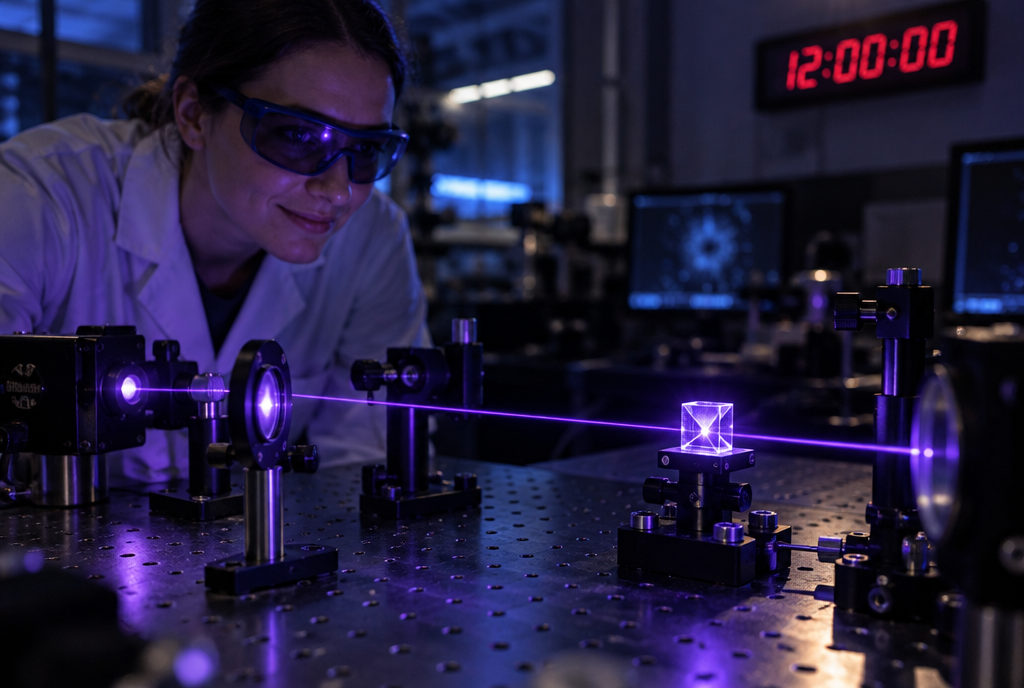
A laser, a small crystal, and time measured right down to the nucleus
Why the nucleus, and not the atom?
A clock, when you get right down to it, is always something that oscillates and a counter that counts the oscillations. The pendulum of your grandmother's Comtoise clock, the little quartz crystal in your watch, which vibrates 32,768 times per second. The faster and more regular the oscillation, the more precise the clock.
Atomic clocks, the ones that give the official time for the whole world, use the electrons that orbit atoms: we make them jump from one state to another with a wave, and we count. The problem is that electrons are outside the atom, exposed to everything: a magnetic field, a change in temperature, a neighbor that is a little too close. They have to be isolated in enormous, ultra-protected machines.
The nucleus, on the other hand, is tucked away in the center, more than ten thousand times smaller than the atom. To give you an idea: if an atom were the size of a football stadium, its nucleus would be a marble lying in the middle of the pitch. Outside disturbances affect it much less, which makes it, in theory, an almost perfect pendulum. Clever, isn't it?
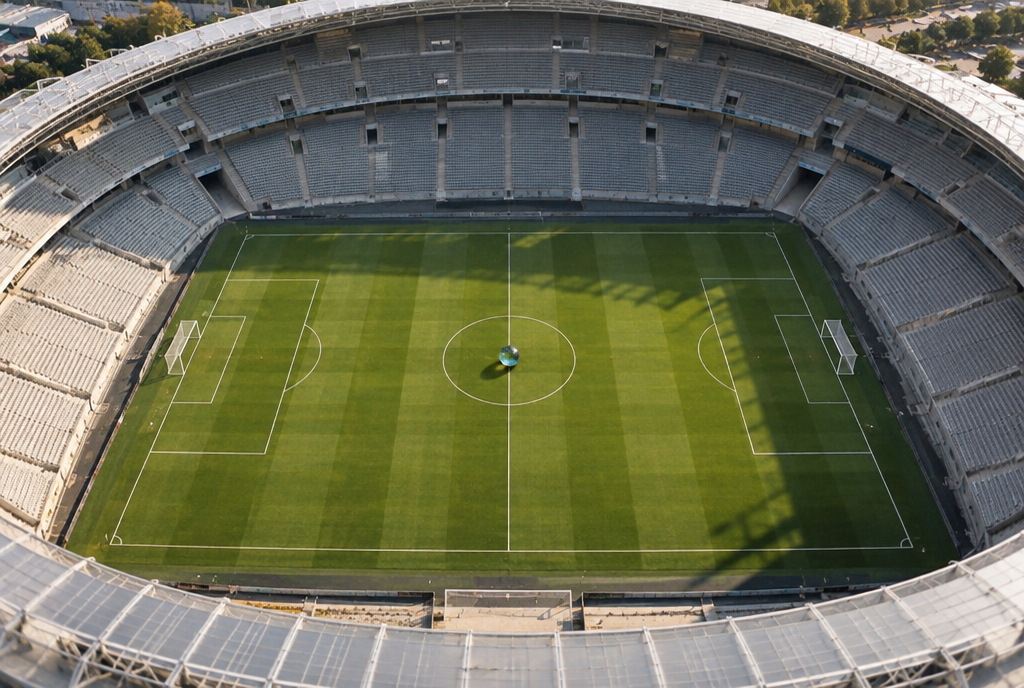
The atom is the stadium. The nucleus is the marble in the middle
The only problem, and it cost fifty years: to make a nucleus “jump”, you normally need enormous energy, far too strong for a laser. Except for one known nucleus, that of thorium 229, a rare radioactive element, whose jump is gentle enough for an ultraviolet laser to be sufficient. We still had to find the right laser color, with insane precision. That is what the Vienna team and its colleagues at PTB, the German institute responsible for official measurements, achieved in April 2024. What remained was to turn the experiment into a real clock.
Vienna and Beijing, in the same issue
It's done. In Vienna, Thorsten Schumm's team shines a light on a small crystal containing thorium atoms. The nuclei absorb light only if the laser has exactly the right frequency. As soon as the laser drifts by the tiniest bit, they absorb less, the machine sees it and corrects the laser all by itself. “The basic idea is simple: you have a laser and you have thorium,” Schumm sums up. The clock ran for more than 24 hours without anyone touching it, with a precision of about one second in thirty million years, according to the university's announcement.
In Beijing, Shiqian Ding's team built the same kind of clock, with the same thorium in the same kind of crystal. According to the South China Morning Post, the first Chinese results would be about six times more stable than those from Vienna. The two teams are engaged in “fierce but friendly” competition. I love the expression, it sounds like a pétanque tournament between two villages.
And Schumm is honest enough to say it himself: his clock is “not yet on the level of the best optical atomic clocks in the world”. For a first prototype, it is “a fantastic result”, but more powerful lasers and better crystals will be needed to surpass them. What I like most is the crystal: a cutting-edge atomic clock is an entire room full of equipment, whereas here the heart fits inside a transparent pebble a few millimeters across. The Chinese team is already talking about “compact” nuclear clocks.
Well, and what use is that to me?
Your watch won't change, and neither will your phone. But you use atomic clocks several times a day without knowing it. Your phone's GPS, first of all: it calculates your position by measuring how long the signal from several satellites takes to reach you, and each of these satellites carries atomic clocks. An error of a billionth of a second, and your position shifts by thirty centimeters. The mobile phone network, exchanges between banks, stock market transaction records: all of that relies on an ultra-precise time shared by everyone.
And there is a more surprising use, straight from Einstein: time does not pass at the same speed everywhere. The higher up you are, the faster it passes, because gravity is just a little weaker there. Yes, your head ages a tiny bit faster than your feet. Sorry. In 2010, American researchers measured it with two atomic clocks one of which was placed 33 centimeters higher than the other. With clocks that are precise enough, we can therefore measure gravity, and so guess what is beneath our feet: an aquifer, a pocket of magma swelling beneath a volcano, the ground sinking.
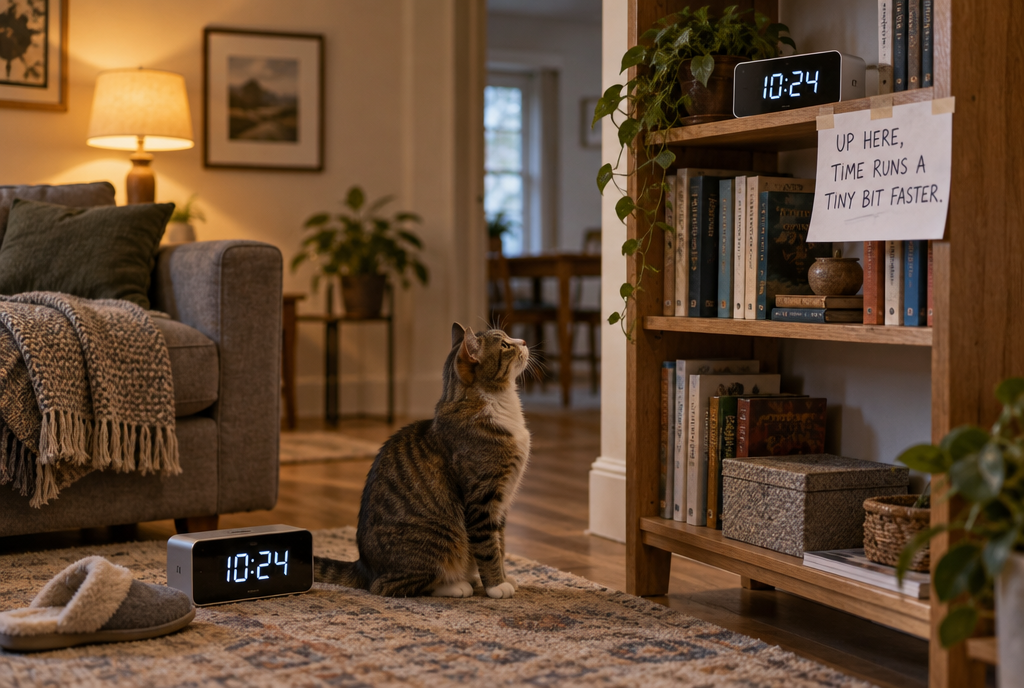
The difference is counted in billionths of a second
When? For GPS, the stock market or volcanoes, not for many years: these two clocks are lab prototypes, and first they will have to beat today's best clocks. Ten years, twenty years, maybe never for some uses. Physicists, for their part, have a more immediate need for them: these clocks can check whether certain constants of nature, which we have always believed to be fixed, shift ever so slightly. If that were the case, it would be one hell of a thunderclap.
And we have already traveled this path once. In 1955, in the United Kingdom, Louis Essen and Jack Parry got the first cesium atomic clock running: a large cabinet full of tubes, in a lab. Nobody imagined putting them in space back then. Twenty-three years later, in 1978, the first GPS satellite went into orbit with its atomic clocks on board. Today, it is thanks to them that your phone knows which street you are on.
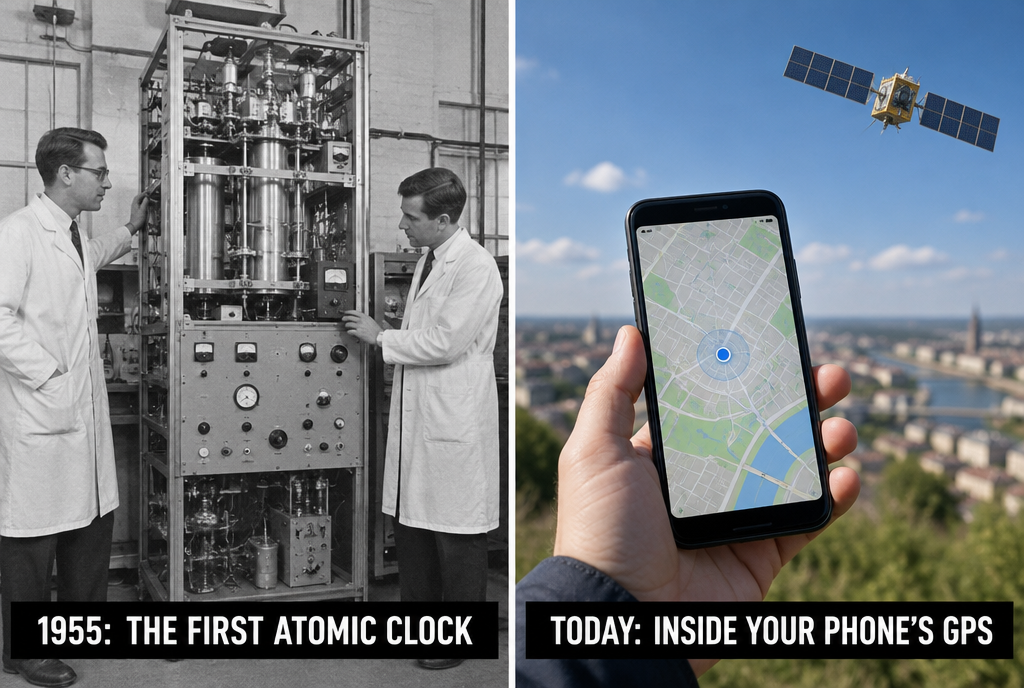
From the 1955 cabinet to the blue dot on your map: twenty-three years to the first satellite
A fifty-year dream
For me, this is science as I like it: a fifty-year-old dream, two teams making it happen in the same week, and a researcher calmly saying that his baby is not yet the best in the world. No promises, no “it's going to change everything”, just a clock ticking. And the day it fits in a shoebox, we will no longer measure only the time, we will measure the Earth.
So to the teams in Vienna and Beijing: bravo! And for Europe, when will you disable this summer/winter time change? We're fed up with it.
Sources
- TU Wien, October 8, 2026: the first self-stabilizing nuclear clock ticks in Vienna
- Nature, October 7, 2026: the nuclear clock from the Tsinghua University team
- ScienceDaily, October 10, 2026: the Vienna study in Nature and its figures
- South China Morning Post, republished by The Star, October 9, 2026: the Chinese clock about six times more stable
- NIST, 2010: two atomic clocks show relativity over 33 centimeters
Article written with the help of Claude Code, proofread and corrected by me.
Join the conversation
You need an account to comment on this article. Creating one is free and takes under a minute.
No comments yet.