Quantum computer: DARPA tests six machines to find out whether one will be profitable by 2033
One hundred qubits, one thousand, one million... For years, quantum computers have been sold to us by their number of qubits, the way cameras used to be sold by their number of megapixels. Yeah, well. What I want to know is whether they're useful for anything. And on October 7, an American agency finally asked that question: will this machine ever bring in more than it costs? It sounds silly, and yet nobody knows how to answer it yet!
That agency is DARPA, the one that funds cutting-edge research in the United States, and that launched the ancestor of the Internet in 1969, when it was still called ARPA. It announced that four companies, Atom Computing, Diraq, IBM and IonQ, are entering the final stage of its major review of quantum computers. They join Microsoft and PsiQuantum, qualified since February 2025. Six candidates, six completely different ways of building the same machine, and a deadline: 2033.
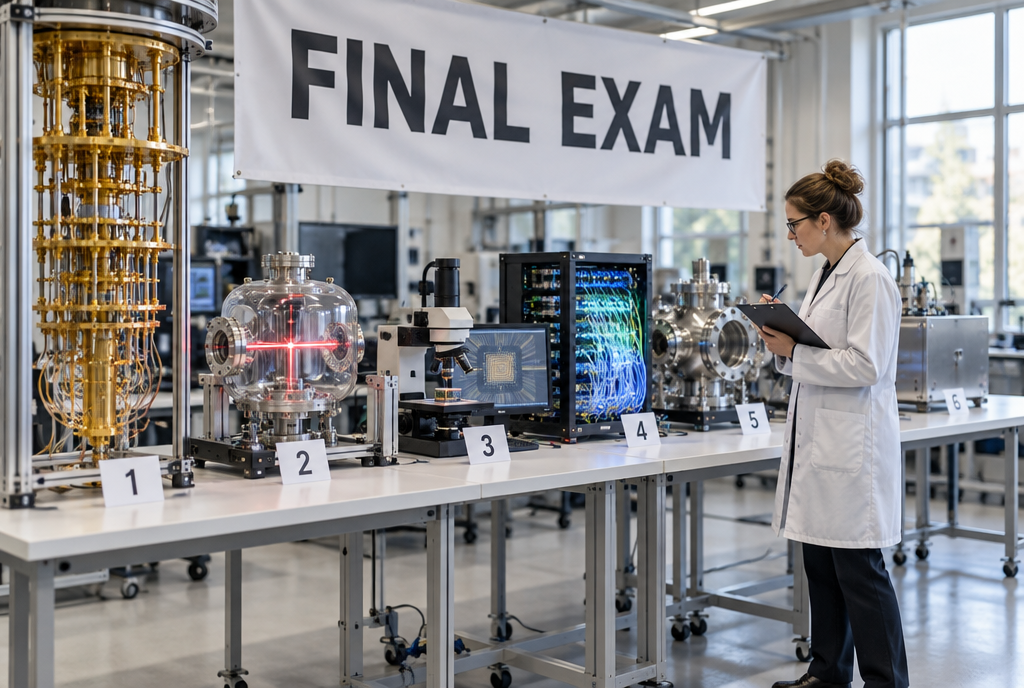
Six machines, six technologies, a single jury
What does profitable mean for a quantum computer?
DARPA has a very down-to-earth definition: a “utility-scale” machine is a machine whose calculations are worth more than what it costs to build and run. Not a laboratory record, not a demonstration that makes the headlines: a machine that pays its bills.
And it's anything but obvious. A normal computer calculates with bits, 0s and 1s. A quantum computer calculates with qubits, which obey the strange rules of the physics of the infinitely small, the physics of atoms. On certain problems, like imitating the behavior of a molecule, it's simply the right tool, because nature itself works that way. The problem is that qubits are insanely fragile: a vibration, a little heat, and the calculation goes in the trash. So we need huge machines, very cold, very expensive, and tons of qubits that spend their time watching over one another to correct their own errors.
Basically, it's like a race car that only starts at minus 273 degrees, stalls as soon as a grain of sand touches the engine and needs an army of mechanics to check every turn of the wheel: for it to be profitable, it has to win a whole lot of races!
Six recipes for the same machine
What fascinates me about this list is that none of the six does things the same way. Nobody knows yet which recipe is the right one, so DARPA is testing them all:
- IBM makes its qubits with tiny electrical circuits cooled to temperatures colder than outer space. It's the famous golden chandelier we see in all the photos.
- IonQ catches electrified atoms, ions, and makes them float in a vacuum using electric fields.
- Atom Computing holds ordinary atoms with laser beams, “light tweezers”. The company says it has already built machines with more than 1,200 qubits.
- Diraq, an Australian company, etches its qubits into silicon, in the same factories as the chips in your computer. It's the same bet as French company Quobly, which I told you about three weeks ago with its quantum chip made in a normal factory.
- PsiQuantum calculates with grains of light, photons, which travel through fibers.
- Microsoft is betting on the most exotic path, “topological” qubits, supposedly naturally protected from errors. It's also the one physicists argue about the most.
It's a bit as if, in 1900, we had put the steam car, the electric car and the gasoline car side by side, saying: we'll see which one makes it around the country without breaking down. Spoiler: at the time, the electric one was far from being the most ridiculous.
From plans to proof
Until now, DARPA had been reading proposals, basically very serious presentations. For a year, its experts have gone over each company's plans, their technical risks and the promised prototypes with a fine-tooth comb. From now on, an independent government team will measure, test and verify on actual hardware that each machine can be built as planned and work as advertised. “Stage C is where we start moving from plans to proof,” sums up Micah Stoutimore, who runs the program.
And there is money on the table: up to $300 million for IonQ, the same for Atom Computing, the same for Diraq, including a first tranche of $51 million. IBM has not given an amount. The schedules announced, for their part, come from the companies themselves, so they are promises, not facts: IBM is aiming for its first machine capable of correcting its errors in 2029, Diraq is talking about 2 million qubits on a single chip in 2031.
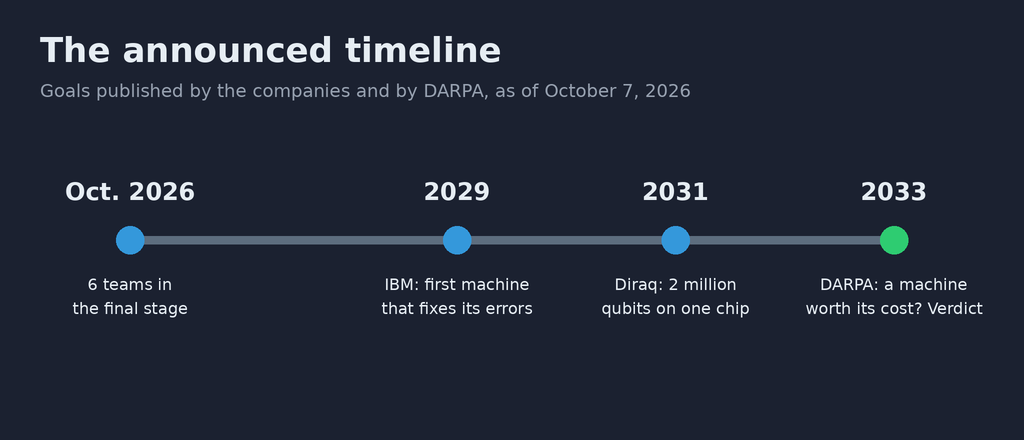
Dates announced by the companies themselves. We'll talk about it again in 2033
What I like is DARPA's tone. No “revolution”, no “in two years”: “We are increasingly expecting someone to build a profitable quantum computer by 2033, says Micah Stoutimore. What we still don't know is which team will get there, or with which approach.” Honest!
Two caveats all the same, and DARPA itself is the one writing them. First, this stage won't build the final machine: it only says who will be ready to build it. Then, its profitability calculation counts construction and operation, but not the billions already spent on research. Profitable, yes, but only if you forget how much has already been spent.
Okay, and what will it be useful for?
Not to watch Netflix faster, or even to write an email. Your computer and your phone will remain normal computers, and that's just fine. I know, it's less sexy than a quantum computer on your desk. A profitable quantum computer will be a machine in a computing center, rented by the hour by laboratories, and it won't be for playing a video game through streaming.
The best example is medicine. Today, to find a molecule that treats an illness, chemists test thousands of them, one by one, for years, and the vast majority end up in the trash. If a machine can calculate in advance how a molecule will behave, we can eliminate the bad leads. Same idea for car or phone batteries, which we could make last longer by inventing new materials on a screen, or for fertilizers, whose production devours a huge amount of energy, and therefore affects the price of what's in your shopping cart.
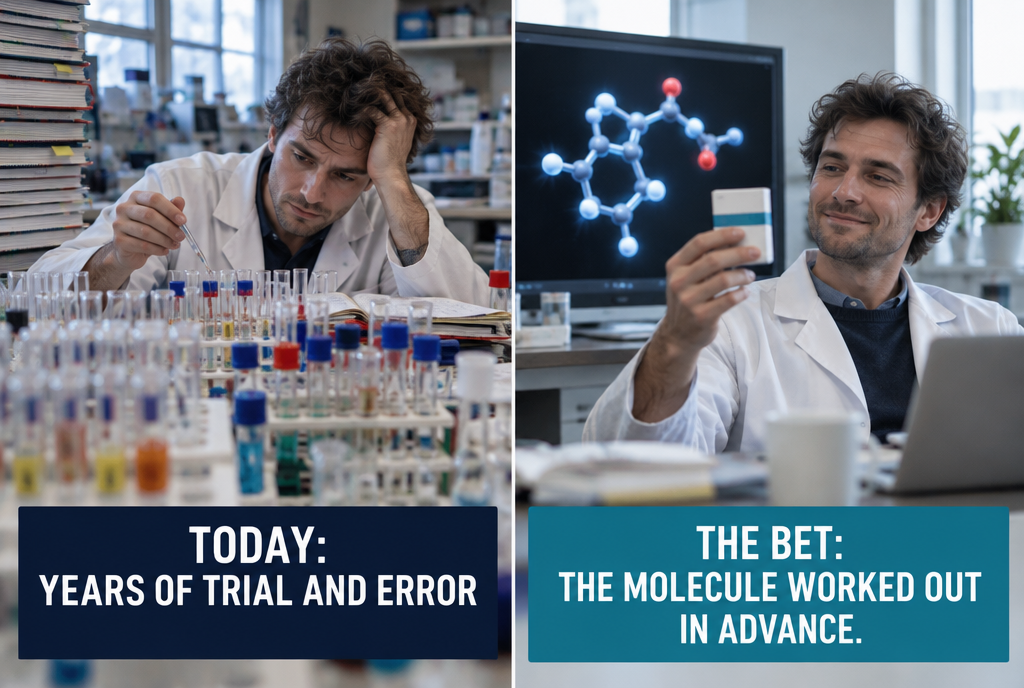
The quantum gamble: fewer test tubes, more calculations
When? Not before 2033 to find out whether it's possible, then add more years before the first medicines found this way reach pharmacies. Ten years, twenty years, or never. Fine, maybe.
But the question of profitability has already been asked by computing. In 1956, IBM released the first hard disk, the RAMAC: a cabinet weighing more than a ton for about 5 megabytes, barely one photo from your phone. The computer that went with it rented for $3,200 a month. Only a few large companies could afford it, and only because it made them more than it cost. Today, a memory card the size of a fingernail stores hundreds of thousands of times more, for a few euros.
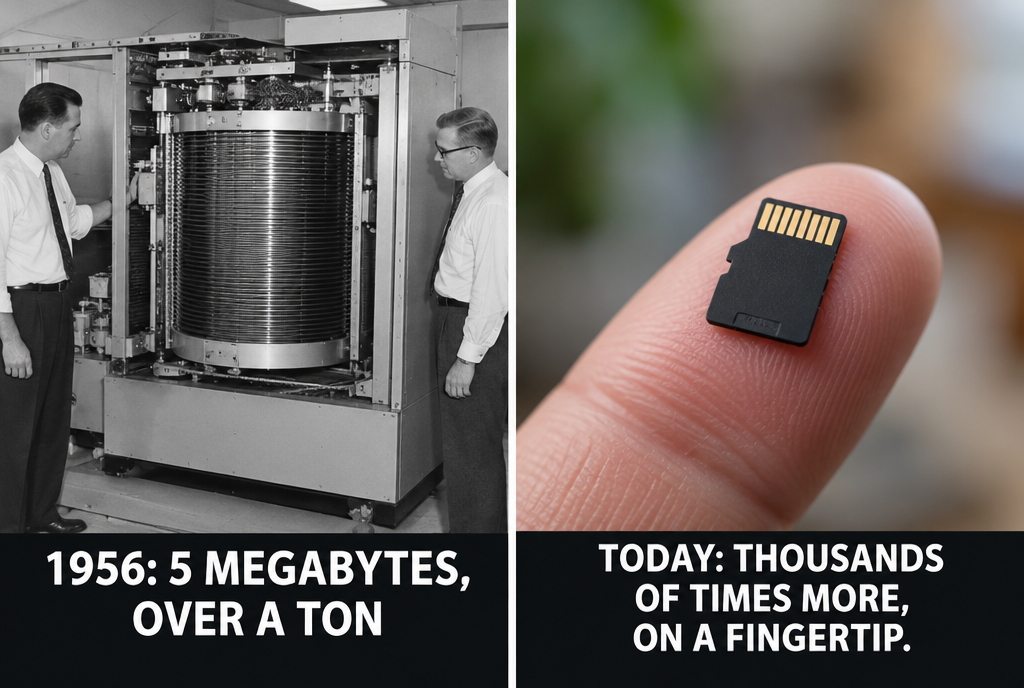
The first hard disk weighed more than a ton. The one in your phone fits on one finger
The first profitable quantum computer will probably look like the RAMAC: huge, ridiculously expensive, reserved for a few. That's how everything starts.
Who will win?
For once, it's not a company announcing that it has won, it's a jury saying “show me”. If I had to bet on one recipe, I'd say silicon, because the whole world already knows how to manufacture chips by the billions. But in 1900, I surely would have bet on steam.
So to IBM, IonQ, Atom Computing, Diraq, Microsoft and PsiQuantum: good luck with the exam, and no cheating, okay. This time, everything will be monitored and we’ll see what happens.
Sources
- DARPA, October 7, 2026: four new teams enter the final stage of the Quantum Benchmarking Initiative
- Quantum Computing Report, October 7, 2026: technologies, amounts and timelines of the four companies
- PostQuantum: what Stage C will not do, according to DARPA’s frequently asked questions
- IBM: the history of the RAMAC, the first hard drive, in 1956
- Wikipedia: the IBM 305 RAMAC and its rental price
Article written with the help of Claude Code, reviewed and corrected by me.
Join the conversation
You need an account to comment on this article. Creating one is free and takes under a minute.
No comments yet.