Maths: has Meta’s AI really solved five problems that nobody had solved?
Meta has just published six research papers in mathematics. Not blog posts, real researchers’ papers, with theorems and proofs, written by mathematicians who worked with Muse Spark, Meta’s AI. And Meta claims that five of them answer questions that nobody had managed to settle until now. The post came out on October 2 on the Meta research blog. Hmm, let’s take a closer look.
Because the killer detail is the tool. Not a supercomputer hidden in a lab, not a custom-built program: the mathematicians used Meta’s public chat, meta.ai, in Reflection mode (the mode where the AI takes its time before answering). The same chat as Muse, the assistant I refused to install on my iPhone a little over three weeks ago. Just goes to show, the same machine can rummage through your messages and help prove theorems, damn, what a time to be alive!
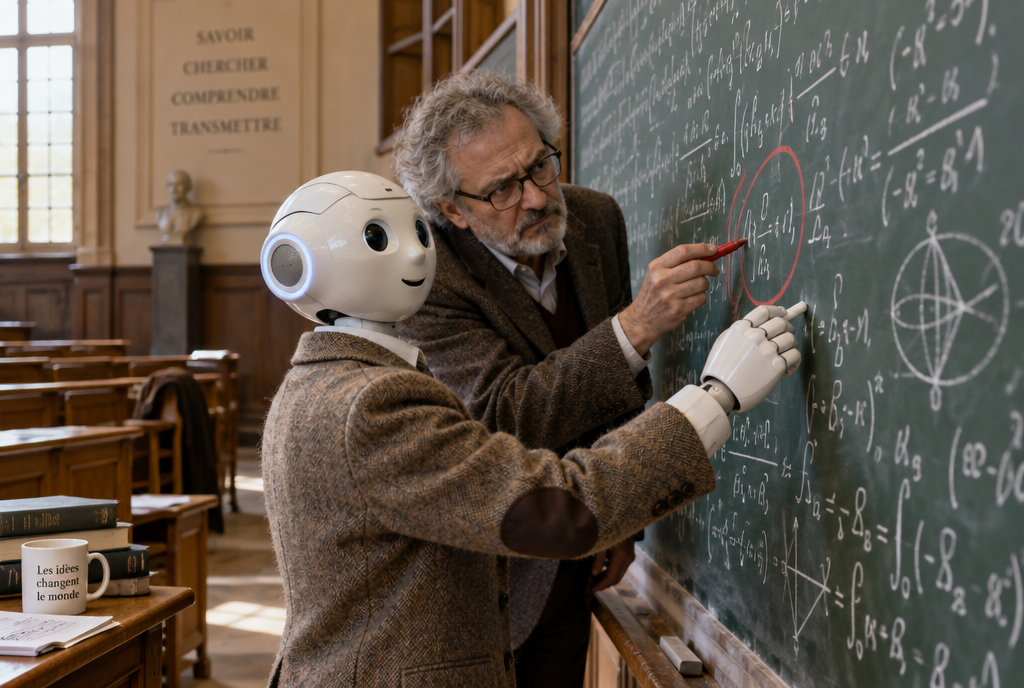
The robot writes, the human circles in red. For now, the division of roles holds
What is an “open” problem?
A conjecture, in math, is a rule that everyone believes is true without anyone ever having managed to prove it, and an open problem is a question that has been waiting for its answer for years, sometimes centuries, while researchers tear their hair out over it. To bring down a conjecture, you don’t need a 300-page treatise. One single case that doesn’t follow the rule is enough. A thousand white swans prove nothing. One black swan, and “all swans are white” goes straight in the trash!
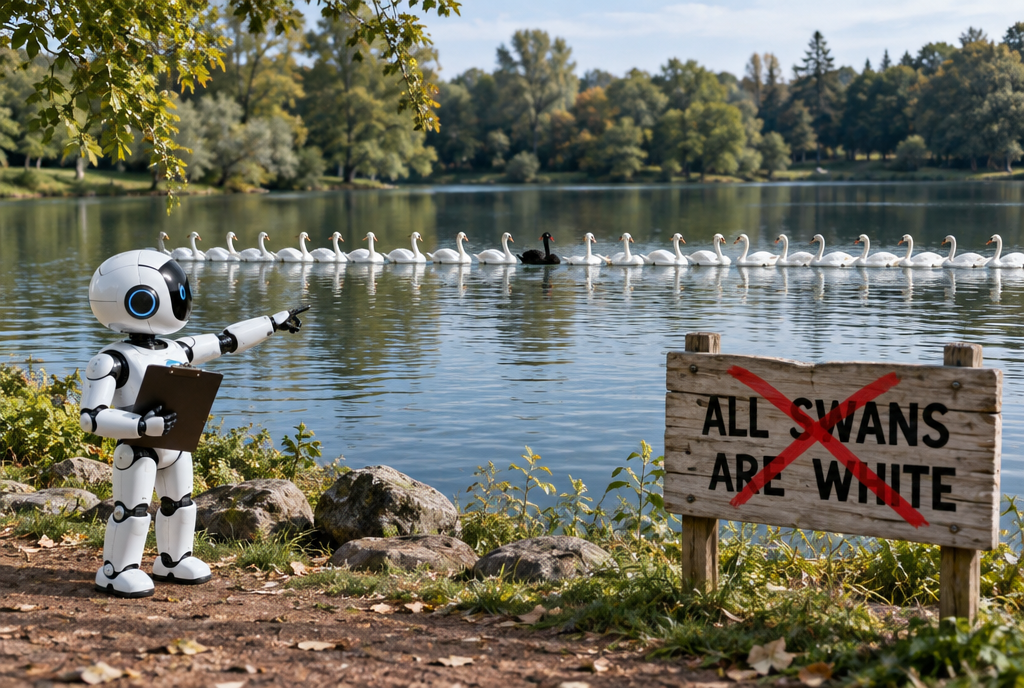
One black swan, and years of certainty go down the drain
And that is exactly what Muse Spark did in one of the six papers. In 2024, a researcher named Kida had proposed a rule about “groups”. A group, basically, is the list of all the ways of rotating or mixing an object: the moves of a Rubik’s Cube make up one. The AI wrote a little program for a calculation tool that mathematicians use, let it search, and it came across a group of 384 elements that doesn’t follow the rule. The black swan! The mathematicians then checked everything again and finished the proof, because an AI certifying itself is really not for me.
The other results, in everyday language
Another paper talks about waves. There is an equation related to the one that describes light in an optical fiber, the one that brings internet to your home, and since 2015 one question had remained unanswered: do some of its waves always end up collapsing in on themselves? Computer simulations had been saying yes since 2002, but a simulation is not a proof. The mathematician Leonard Dinh, with the AI doing the heavy lifting on the calculations and testing the leads, proved that yes, they do. What a computer had been showing in pictures for more than twenty years is now proven in black and white.
The third one is my favorite, a story about a rugby ball. You throw points at random and try to make a sort of rugby ball, what mathematicians call an ellipsoid, pass exactly through all those points. With few points, it works. With too many, impossible. But where is the limit? People who analyze data ask themselves this question for real, with points that each have dozens of measurements (age, height, income, and so on). Answer: with 100 measurements per point, things start to break down at around 2,500 points. A clear boundary, finally known.
There are three left. One on optimization (how to find the best possible combination among billions), which answers a question asked this year. Another on some fairly exotic algebraic objects, where the AI once again unearthed a counterexample. And the last one links string theory, in physics, to number theory: that one does not claim to solve any open problem, it extends an idea from the mathematician Yuri Manin dating back to the 1980s.
Too good to be true? A little, yes
On October 3, researcher Jason Lee surprised everyone on X with a sentence: “Actually, 3 out of 6 had already been solved.” And he isn't completely wrong, since Meta itself acknowledges it in its post. For the rugby ball, three other teams published similar results in August, using other methods. For the group with 384 elements, an AI agent from another team, Nilradical, had already announced another counterexample on September 16. And for a third paper, two researchers, Hu and Wen, reached the same place at the same time.

First? Not really. The others were already at the café
And these papers still haven't been reviewed by any independent scientific journal, a job that normally takes months. Meta had every paper reviewed by other mathematicians and marked, passage by passage, what had been written by the AI and what had been written by humans, that's clean. But Meta is the one publishing, Meta is the one reviewing, and Meta is the one making the announcement. I wasn't born yesterday.
Except that, for me, this race story fascinates me more than it disappoints me: four or five teams, several of them with AIs, arriving at the same answers a few weeks apart in August and September 2026, on questions that had been sleeping for years, that means mathematical research is shifting into fifth gear!
So what does this change for you, concretely?
These six results? Nothing at all. Nobody will pay less for their steak or baguette thanks to a group with 384 elements, don't dream. On the other hand, a researcher who has an assistant at hand capable of getting through the tedious calculations and testing a thousand leads while they think, they move faster, and that, over ten or twenty years, eventually starts to show.
And “useless” maths always ends up being useful. In 1940, the English mathematician G. H. Hardy boasted that his speciality, prime numbers, would never have any practical application. Thirty-seven years later, three researchers invented RSA, an encryption method built precisely on those prime numbers. Today, it and its cousins protect your contactless payment at the bakery, your connection to the bank and the little padlock in your browser.
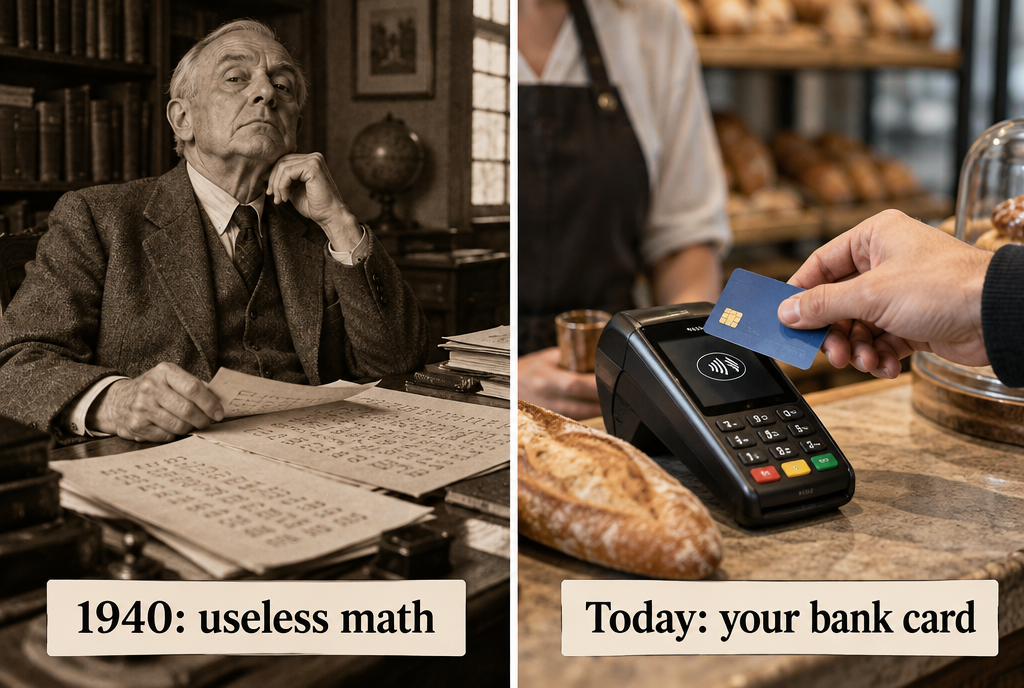
Hardy would have hated learning it: his prime numbers pay for your baguette
And optimisation is already everywhere around you: the delivery person who rings your doorbell has a calculated route, your train schedules do too, and the electricity that reaches your outlet was distributed across the grid using maths from this family. If AI saves years on this, you'll feel it one day on your bill or on your train platform. In five years? In twenty? No idea, and I'm wary of those who claim to know.
My take
What I take away from this, personally, is that mathematicians opened a chat, the same one as yours, and came out of it with publishable results. Five problems solved or three, I don't really care. Humans choose the question, AI does most of the calculations and suggests leads, humans check and correct. That's exactly how I work with Claude Code on my own projects, and I'm not going back!
And to those counting the points to find out who came first, Meta, Nilradical or the August teams: relax, the black swan couldn't care less who saw it first.
Sources
- Meta, October 2, 2026: Solving Open Research Problems Together
- AlphaSignal: Muse Spark helped mathematicians solve five open problems
- HuggingNews, October 3, 2026: “3 out of 6 had already been solved”
- Wikipedia: A Mathematician's Apology, G. H. Hardy, 1940
Article written with the help of Claude Code, proofread and corrected by me.
Join the conversation
You need an account to comment on this article. Creating one is free and takes under a minute.
No comments yet.