Crypto: AI agents can now pay in bitcoin, what is it for?
Since September 24, an AI can pay for a web page in bitcoin, all by itself, two cents at a time. And for that, we dug an item of Web code out of the cupboard that nobody was using: error 402, “payment required”, the little sister of the famous 404, written into the rules of the Web since 1997 with a note that makes me smile every time, “reserved for future use”. Twenty-nine years later, the future has arrived, and it won't be humans doing the paying. It will be machines!
That day, Block, Jack Dorsey's company (the co-founder of Twitter, now running the Square payment terminals and the Cash App), announced that it was joining the foundation that runs x402, the payment system that brings that famous 402 error back to life. And it plugged Lightning into it, the network that lets you pay in bitcoin in a few seconds, often for less than a cent.

The robot pays for its ticket, and nobody pulled out their bank card
How a robot pays for a web page
The principle behind x402 is almost annoyingly simple. Your agent (an AI that does things for you, not just talks) asks a site for a page, for example the detailed timetable for a train or a news article. The site replies “402, that's two cents, here's where to pay”. The agent pays, then asks for the page again while showing its receipt. The site gives it to the agent. Done.
No account to create, no password, no form with your address, no “I accept the terms” box that nobody reads. It's a parking meter: you put in the coin, the barrier lifts.
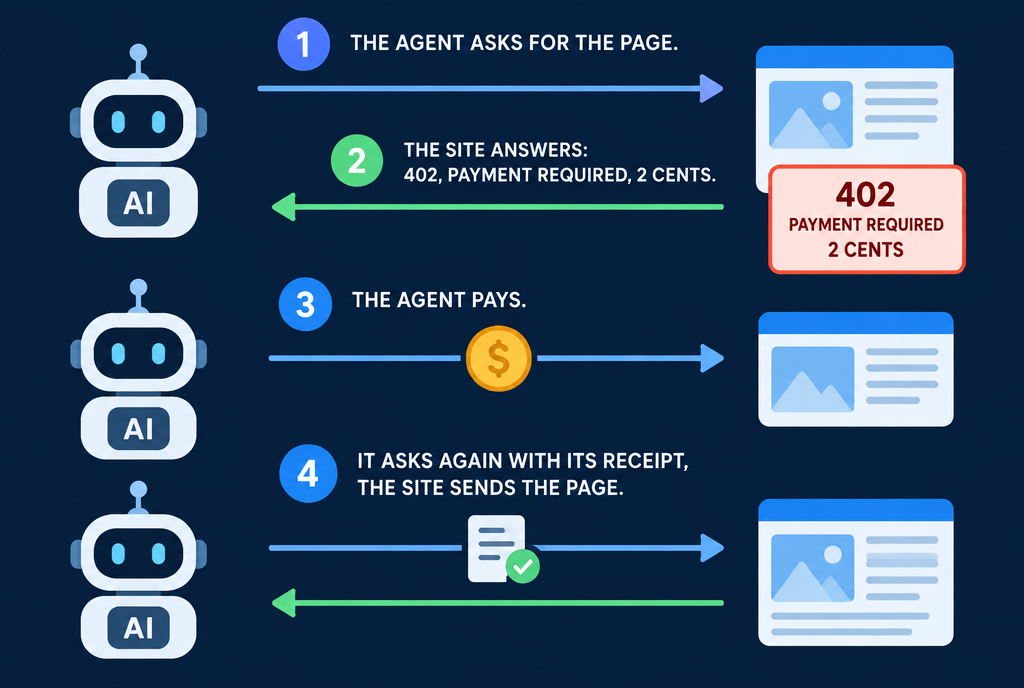
Four steps, zero forms, and nobody had to find their password again
x402 was created by Coinbase, the big American crypto exchange, then handed over in April to the Linux Foundation, an organization that keeps open standards so nobody can claim them for themselves. Around the table, there's Google, Microsoft, Amazon, Cloudflare (which protects a good part of the Web's sites) and Stripe, the online payment giant I was already saying last month was preparing payments by AI agents. These aren't amateurs.
Why Lightning, and not bitcoin itself?
Because paying two cents directly on the bitcoin blockchain is like sending a registered letter to reimburse a coffee. Each transaction waits to be carved into a block, roughly every ten minutes, and the fees can exceed the amount itself.
Lightning is the bar tab. Two people open an account between them, with an amount locked at the start on the bitcoin blockchain. Then they pay each other thousands of times on the tab, in a few seconds and for peanuts, without carving anything anywhere. It's only at the end, when the tab is closed, that the total goes onto the blockchain. And since the tabs are linked to one another, you can pay someone you have never opened an account with, by going through intermediaries.
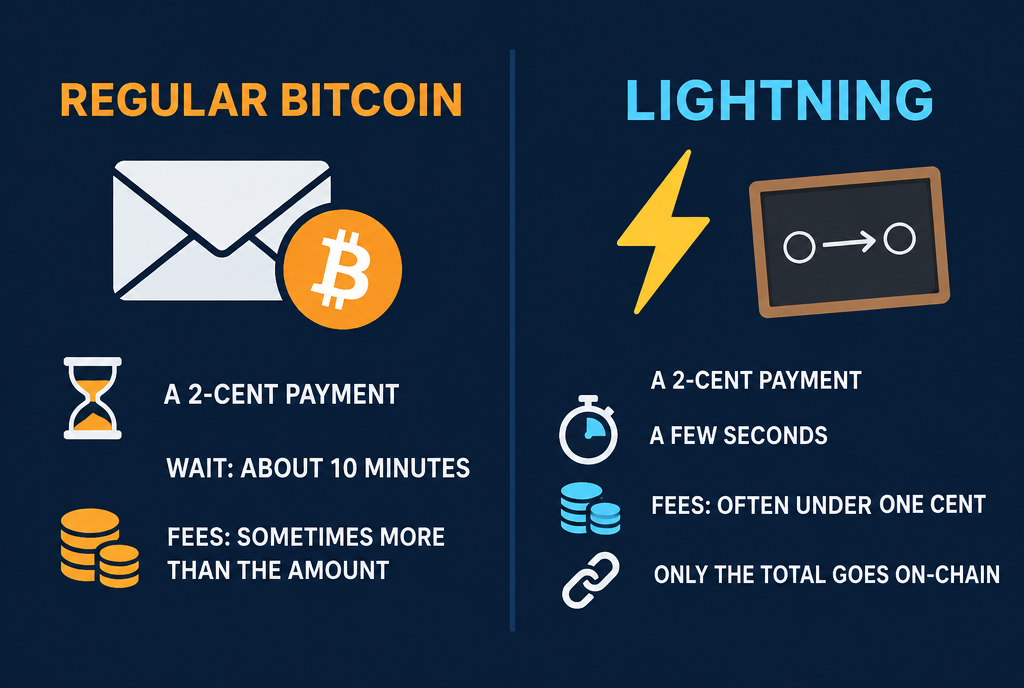
The registered letter with acknowledgment of receipt versus the bar tab
For Block, it's made for agents: tiny payments, repeated thousands of times, where every cent in fees counts. Steve Lee, who runs Spiral, Block's bitcoin team, calls it a “concrete” step toward making bitcoin everyday money, “for people and for agents acting on their behalf”. The code itself was already online the day before the announcement.
Concretely, what does it change for you?
Micropayments have been promised to us since the early days of the Web. Pay three cents to read ONE article from a newspaper you will never subscribe to, instead of running into the “subscribe for 9.99 euros a month” wall. It never caught on, for two reasons. One: bank card fees make a three-cent payment impossible. Two, and this is the more interesting one: humans hate deciding. Ten times a day, “is this article worth three cents?”, is exhausting, and you end up paying for nothing at all.
And that's where agents change the game. An agent doesn't get tired of deciding. You tell it “you have two euros a week to find me the right information”, and it figures things out. Three very simple examples:
- you ask your assistant to plan a weekend, it pays a few cents to a precise weather service and a train timetable site, without creating an account with them or giving them your card;
- you ask it for a news summary, it pays a few cents per article at three paid newspapers instead of sending you three subscriptions to sign up for;
- on my own site, the toolkit is paid for by subscription, 12 euros a month. Someone who only needs one tool, just once, has nothing in between. Pay-per-use is exactly the gap that fills.

Ten subscriptions to read ten articles, or ten times three cents
It works with any agent that speaks x402, and that's the whole point of having an open standard: that's what's missing from the AI agents that get lost on badly made websites I was talking about yesterday. An agent that knows how to read the page AND pay the entry fee is an agent that can really finish the job.
Well, let's be honest about the numbers
The x402 Foundation displays on its home page (figures recorded on September 27) 75.41 million payments over the last thirty days, for a total of 24.24 million dollars. Do the math: about 32 cents of a dollar per payment on average, far from the two cents in my example. This is micropayment all right, but on the scale of online commerce it's a drop in the ocean, and it's a figure from the foundation itself. Today, almost everything goes through “stablecoins”, digital tokens supposedly always worth one dollar: according to Circle, which issues one of them, USDC, that one token accounted for more than 99 dollars out of every 100 paid by x402 in the second quarter. Lightning has only just arrived, and Block has given no usage figures and no date for integrating it into Cash App or Square.
And there's a question I would ask myself before entrusting a wallet to an agent: what does it do when it gets something wrong? An AI that pays all by itself is wonderful as long as it pays for the right thing. The day it pays for the same page a hundred times because it misunderstood its mission, you'd better have a limit. The right reflex, the same as with a teenager and their first prepaid card: a small amount, a daily limit, and you check the statements.
For me, what matters here isn't bitcoin, it's that old 402 code that had been sleeping since 1997 and is finally waking up because machines have the patience to pay three cents a hundred times a day. If one day it lets a small site like mine make a living from a few cents per read instead of chasing subscriptions, I'm signing up right away!
Sources
- The Cryptonomist, September 25, 2026: Block joins x402 with Lightning
- Altcoin Buzz: the September 24 announcement, Steve Lee's quote and USDC's share according to Circle
- x402: how it works and the figures for the last thirty days, recorded on September 27, 2026
- RFC 2068, January 1997: code 402, “reserved for future use”
Join the conversation
You need an account to comment on this article. Creating one is free and takes under a minute.
No comments yet.