Crypto: Belgium has 2 licensed platforms out of 338. So what?
Crypto: Belgium has 2 licensed platforms out of 338. So what?
I came across the European register of crypto platforms this week, and I looked at the Belgium line twice to make sure.
Two. Germany has 81, France 35, the Netherlands 29. Us, two.
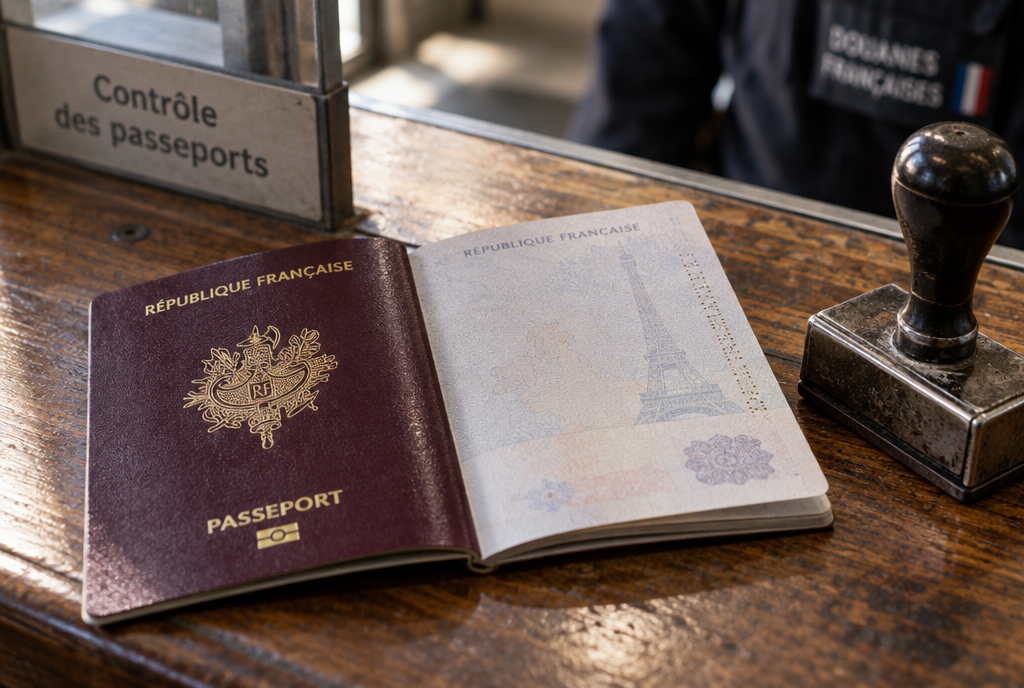
Passport is exactly the right word for what follows
First reaction: we got screwed. Second reaction, after digging deeper: not at all, and it's actually rather good news. Here's what this figure really means.
A license valid everywhere
Since July 1, 2026, a platform that wants to sell you crypto services in Europe has to have a license. Not a declaration, not a registration: a license, issued by a country's financial watchdog after examining the application.
The official term is CASP, for crypto-asset service provider. In concrete terms: the sites where you buy, where you sell, where you leave your tokens sitting around, and the wallets managed for you.
And here's the thing everyone misses: this license is valid in all twenty-seven countries at once. A platform licensed in Germany has the right to serve you in Belgium without asking for anything again. It's called the European passport, and it has existed for a long time for banks and insurance companies.
So yes, Belgium only has two. And no, that doesn't mean you only have a choice between two sites. It means the platforms serving you filed their applications elsewhere, often wherever the team is already based.
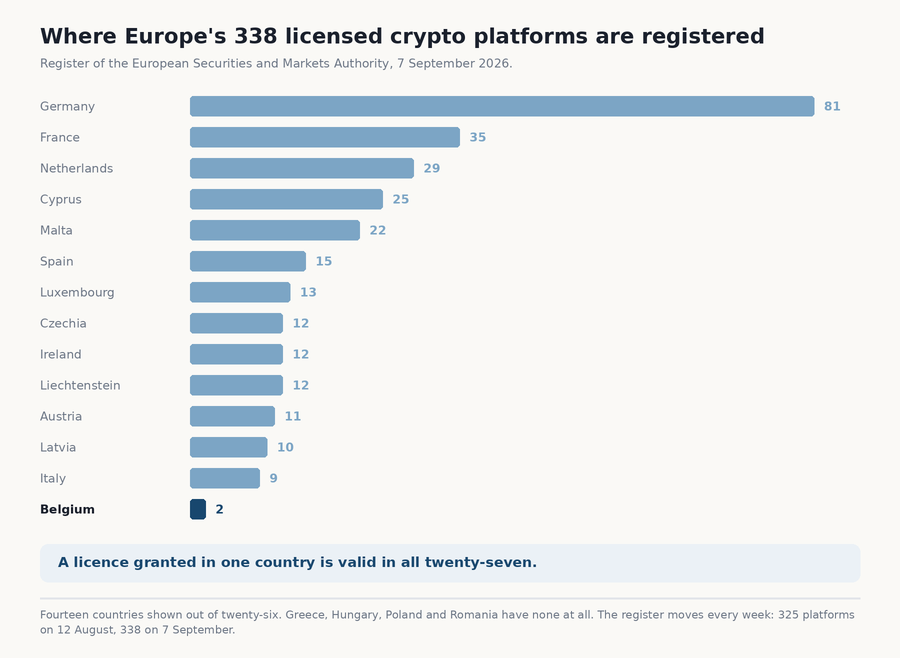
Three countries grab almost half the table. It's no coincidence, that's where the offices are
Four countries are at zero: Greece, Hungary, Poland and Romania. Those countries don't have a crypto desert either. They have customers served from Frankfurt, Paris or Valletta.
What this brings you, in very concrete terms
I'm going to be clear here, because that's the real subject and nobody ever talks about it.
Before, anyone could set up a platform, take your money and mix it with their own. If the company went under, your tokens went under with it, and you found out they had never really been yours.
A licensed platform now has to keep your assets separate from its own, maintain minimum capital, publish its fees before you click, say what it does with your tokens while they are sitting with it, and provide you with a proper complaints service. Two weeks ago, I explained here what happens to your tokens when you lend them to a platform, and it was less pretty than the brochure.
This isn't a guarantee against loss. If the price plunges, nobody reimburses you, and it remains written in black and white in the terms and conditions. But between "the company went bankrupt and your tokens were in the common pot" and "the company went bankrupt and your tokens were in your name", there is a world of difference.
Checking your platform, two minutes flat
The register is public. It is maintained by the European financial markets authority, and it is updated roughly every week: 325 platforms on August 12, 338 on September 7. It is changing all the time.
You look for your platform's name in it. If it's there, check the country that issued the license, because that's the watchdog that will handle your complaint, not ours. If it's Malta or Cyprus, your complaint letter will be sent in English.
If it's not there, two possibilities. Either the platform operates from outside Europe and you're on your own if something goes wrong. Or it's in the process of closing shop here, because since July 1 it's simple: no license, no right to operate here anymore.
The ones who got caught
The Belgian watchdog, the FSMA, didn't wait long. On July 6, five days after the end of the transitional regime, it published a warning naming six companies that were offering crypto services without authorization.
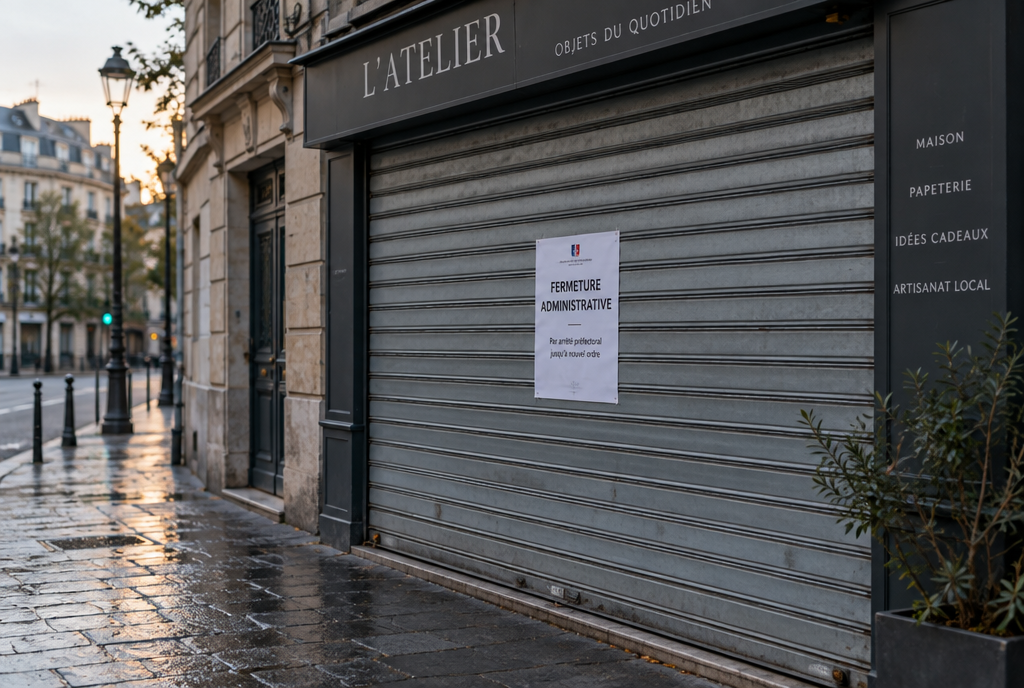
The end of the transitional regime, seen from the shop window
Aurum Foundation, Bank Bit, Bithf Pro, Dxago, Global Dynamic Trade, ZeriaFunding. Names you have probably never seen, and that's precisely the problem: these are the ones that arrive through a message, an ad on a social network, a very friendly "advisor" on the phone.
The FSMA's advice to victims takes five lines, and there's one I find valuable: beware of people who offer to recover your lost money in exchange for a commission. It's the second scam, it targets people who have just fallen for the first one, and it works very well because we're ready to do anything when we've just been conned.
And for you, this morning
Nothing urgent, nothing to click on in a panic.
Open the register, search for the name of the platform where your tokens are sleeping, note the country that authorized it. Thirty seconds. If you find it, you know whom to call the day things go wrong, and you know which language to use.
If you don't find it, it's not necessarily a scam, but it's a question to ask your customer service, and the way it answers will teach you a lot.
Two Belgian authorizations out of 338, I found that insulting when I discovered the figure. In fact, it's the single market working as planned, for once: one application, twenty-seven countries.
Sources
- European Securities and Markets Authority: the MiCA regulation, the official framework and the register of authorized providers
- CASP Tracker: the ESMA register in table form, the 338 providers as of September 7, 2026 and their distribution by country, including the 81 German, 35 French, 29 Dutch and 2 Belgian providers
- FSMA: end of the transitional period for crypto providers, published on June 25, 2026, the date of July 1 and the obligation to stop services without authorization
- FSMA: warning about unauthorized crypto providers, published on July 6, 2026, the six named companies and the five pieces of advice for victims
Join the conversation
You need an account to comment on this article. Creating one is free and takes under a minute.
No comments yet.