Investing as an individual or trading?
Investing as an individual or trader?
Disclaimer
This article shares a personal experience and a philosophical reflection on managing financial stress. It is neither investment advice nor a tax or legal tutorial. Tax rules (the stock market tax on each purchase, declarations, capital gains) are complex and constantly changing: ask a professional for advice. The aim here is to analyze the psychological cost of trading compared with the peace of mind of long-term investing.
Why the idea of investing always comes back
Many individuals have had, sooner or later, that little voice: “Should I invest? Should I dabble in the stock market?”
Sometimes, it starts with something you hear at just the right moment. In the 90s, a client told me enthusiastically: “There’s nothing better than the stock market!”, probably because he had just made a big profit. Be that as it may, the idea stuck.
At the time, a savings account still earned “a few percent”. Then the euro settled in, inflation did its undermining work, and one fact became obvious: leaving your money lying around without any real return means accepting that it will melt away. The most serious mistake is having thousands of euros in a savings account and leaving them there!
Inflation: €100 stays €100… but is no longer worth €100
We often hear: “€100 in 2000 is worth €100 today.” Yes, the banknote has not changed… but purchasing power has melted away.
A simple example. In Belgium, figures from Statbel, the national statistics office, confirm it: prices rose by nearly 79% between 2000 and 2025. In other words, €100 from 2000 is worth around €179 in 2025, and what a €100 banknote buys today corresponds to what €56 bought in 2000. The electricity bill, the tank of fuel, the weekly groceries: everything has gone up, each at its own pace, and everything has gone up faster than the savings account. That is precisely why “doing nothing” with your savings is often the riskiest strategy in the long term.
My switch: from curiosity to trap
The years went by and, around 2019, I heard about crypto and especially Bitcoin. At a time when the idea that “it was only worth a few thousand” was still going around, I got started.
Obviously, the sentence that comes next is universal: “I should have bought more!” I signed up on Binance, bought a few cryptos “here and there”, and fell into the classic trap: Telegram groups, promises of “x100”, and beginner naivety. Yes… some people made x100. But often, it is downward.
Trading vs Investment: The hidden cost of stress
This is where the lesson was the hardest, but the most valuable. I tried trading. I saw what it really costs.
Emotion-driven trading (impulsive purchases, constantly watching charts, late exits) has one major flaw that nobody mentions: it consumes your mental bandwidth. Making €200 trading is good. But if it cost you 20 hours of stress, waking up at night and anxiety, your hourly rate is disastrous.
This is not just an impression: in March 2018, Europe regulated these products after compiling the measures taken by national regulators. Between 74% and 89% of individual accounts lose money on them, with average losses of €1,600 to €29,000 per client. Why? Because we are not robots.
Investing is a different game:
- Choose a solid vehicle,
- Invest regularly (DCA: I explain the method below),
- Accept fluctuations without panicking,
- Let time work for you.
Gold: A brutal reminder of what time can do
Take gold. In January 2026, the ounce reached $5,586, its all-time high. Eight months later, it is at $4,327, or 22% lower.
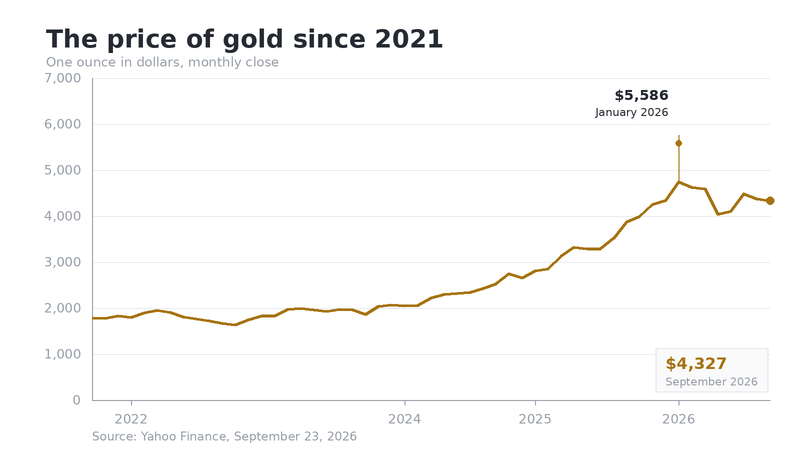
Gold in dollars since 2021. The January 2026 peak, and the 22% lost since then.
The trader who buys at the top of the wave no longer sleeps at night. The investor who has been buying a little every month for years, on the other hand, looks at the chart with detachment. The historical trend remains impressive. Those who invested regularly, a small amount at a time, without looking at the price every morning, bought the most precious thing: time.
A clarification that applies to the entire article: the prices I mention are those from the day I wrote these lines, in February 2026, and they come from the public quotations reported by Yahoo Finance. The two charts themselves go up to September 23, 2026, because a chart stopped in February no longer tells you anything.
The administrative jungle (and why to avoid it)
Very quickly, crypto imposed an absurd reflex: signing up on a multitude of platforms. The result: identity verification procedures everywhere, what the industry calls KYC (photo of your ID card, selfie, proof of address, and two days of waiting before you can buy), plus total dispersal.
Then comes the administrative reality, especially in Belgium. After opening accounts on exotic or foreign platforms, you end up with unmanageable tax complexity (the declaration to the Central Contact Point, the file where the Belgian state expects the list of your accounts opened abroad, the stock exchange tax on every purchase, the calculation of capital gains).
It’s the opposite of peace of mind. By trying to optimize every cent on obscure platforms, you create a mental burden that cancels out the pleasure of the gain.
The ultimate method: DCA (and its "intelligent" version)
A good way to invest without stress is to apply DCA (Dollar Cost Averaging). It's a simple method: you regularly buy a fixed amount (for example, at the end of every month), without looking at the price.
Still, depending on the asset, you can refine the strategy:
1. For Gold: Classic DCA Gold has an upward trend over the very long term. There is often no point in waiting for "it to fall" before buying, because we don't know if it will ever fall one day. If you wait too long, you risk watching the train go by, as has happened several times over the past twenty years.
The strategy: We buy a little every month, whatever the price. It is consistency that pays.
2. For Bitcoin: "Intelligent DCA" Bitcoin is different: its cycles are violent, with gigantic rises and sometimes monstrous falls. Let's take the situation on the day I am writing this, in February 2026: Bitcoin had reached its highest point in October 2025, at $126,198, and was hovering around $67,000. Almost half of it disappeared in four months.
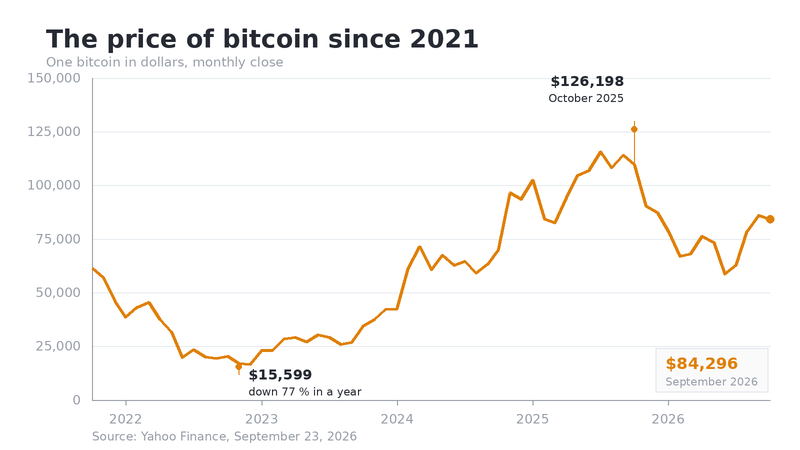
Bitcoin since 2021. Two drops of more than half. Those who panicked at the bottom of the first one missed the second.
- Should you be afraid? Historically, Bitcoin has seen worse: a 77% drop between the high of November 2021 and the low of November 2022. But with adoption by institutional players and even some states, such a deep drop seems less likely.
- The intelligent approach: Instead of buying blindly at the top, we take advantage of these corrections (-50%, -60%) to accumulate.
- The trick: The further it falls, the more you buy. If you can, increase the amount at each lower level. This lets you drastically lower your "average purchase price" (PRU). When the market starts rising again, you will be in profit much faster.
And what about selling? The gentle exit
Knowing how to buy is one thing, knowing how to sell is another. Many don't sell and wait for the very top, but that's a serious mistake. The selling method is identical to buying with DCA, but reversed.
At some point, the market gets carried away. When everyone is talking about it and you tell yourself "Ouch! It's really going up hard!", that's often the signal to start taking profits. Don't sell everything at once. Sell in ascending stages:
- Sell €100 worth of gains.
- If it keeps going up, sell €200 worth.
- Then €300, etc.
This is the key to peace of mind: you buy when everyone is afraid (intelligent DCA), and you sell gradually when everyone is euphoric.
The Apple Example: Understanding the magic of DCA
Imagine that you love apples. You decide to buy €120 worth every year, whatever the price.
- Year 1: Apples cost €10 per kilo. With your €120, you buy 12 kilos.
- Year 2: The price drops to €8 per kilo. (People panic, but you are happy). With your €120, you buy 15 kilos.
- Year 3: The price collapses to €6 per kilo. (It's a crisis!). With your €120, you buy 20 kilos.
The result when it starts rising: The following year, the price goes back up to its initial level of €10. If you had bought everything at the beginning (at the "high price"), you would simply have got your money back. €0 in gains.
But thanks to DCA, let's look at what you own:
- You spent a total of: €360 (3 x €120).
- You own a total of: 47 kilos of apples (12 + 15 + 20).
- Your stock is now worth: 47 kilos x €10 = €470.
Result: The price simply returned to where it started, but you made a €110 profit. Why? Because you turned the drop into an opportunity to lower your "average purchase price" (which fell here to €7.66/kg).
That's the power of DCA: mathematically, a temporary drop becomes your ally.
The mathematical secret: Making money without even returning to the top
You may be wondering: "What if it keeps falling further and further? Do I have to wait for the price to go back up to €10 to get out of this?"
The answer is no. And that's where the magic happens. Let's go back to our apples with an even more violent drop, still with €120 invested per year:
- Year 1: Price at €10 -> You have 12 kg.
- Year 2: The price collapses to €5 -> You buy 24 kg.
- Year 3: The price hits rock bottom at €2 -> You buy 60 kg (a huge amount!).
Let's do the math:
- You spent a total of: €360.
- You own a huge stock of: 96 kg of apples (12 + 24 + 60).
The miracle of averaging: If we divide your spending (€360) by your stock (96 kg), your average cost price is just €3.75 per kilo.
Conclusion: The market does not even need to go back up to €10. Not even to €5. As soon as the price of apples goes back up to €4 (which is still very low compared with the beginning!), you are already making a profit.
- At €4 per kilo, your stock of 96 kg is worth €384.
- You invested €360.
- You made money even though the price is still 60% lower than at the beginning.
That's why DCA puts your mind at ease: the more it falls, the lower your "winning point" falls too.
The one vital condition: This mechanism only works if you buy an asset that is not going to die (don't do this with a bankrupt company or a "shit coin" crypto). With Bitcoin, gold or the S&P 500, it does its job as long as the asset survives.
Investing without suffocating
The years go by and one conclusion keeps coming back like a boomerang: Investing regularly in a solid product very often beats the frenzy of trading.
Of course, investing is never “risk-free”. But there are ways to limit that risk, particularly through diversification: gold, Bitcoin, broad indices (such as the S&P 500). It's a "self-cleaning" mechanism: if a company weakens, it leaves the index. If a new star rises (like NVIDIA, which has exploded in recent years), it pulls the index upward. You don't need to guess the winner, you buy the whole basket.
Conclusion: Investing means choosing peace
Trading promises adrenaline and often ends in stress. Investing builds something lasting.
Investing is better than “dabbling in stocks”. And investing regularly is better than leaving your money sitting in a savings account that gets nibbled away by inflation. Above all, today, it has become simple. We are no longer forced to go into the grand buildings of the Stock Exchange shouting. A phone, a reliable app, and it's done.
A practical tool for some people: Revolut. The company communicates about its status as a licensed bank (EU), which greatly simplifies access. Above all, it allows you to set up automatic recurring purchases. That's the key: turning investing into an invisible routine to prevent emotions from getting involved.
Here, my referral link if you want to treat yourself and support me: https://revolut.com
Investing is ultimately a form of protection:
- Against inflation,
- Against the noise of influencers,
- Against the constant race toward “the opportunity of the day”,
- Against stress and anxiety.
Real wealth is not x100. It's having peace!
Trading cost me hours that no one will ever give back to me. The method above costs me five minutes a month. Guess which one I'm keeping.
Join the conversation
You need an account to comment on this article. Creating one is free and takes under a minute.
No comments yet.