Kimi K3, GPT-5.6, Grok 4.5, Opus 5: July 2026, the month when AI went off the rails
Did you go on vacation at the beginning of July? Bad idea. While you were applying sunscreen, the AI industry decided to release four frontier models in three weeks. OpenAI, xAI, Moonshot AI, and Anthropic engaged in a "here, take this" festival that resembles less a tech market than a poker game where everyone goes all in at the same time. Settle in, we’ll summarize the fight — verified numbers and a complete comparison to back it up.
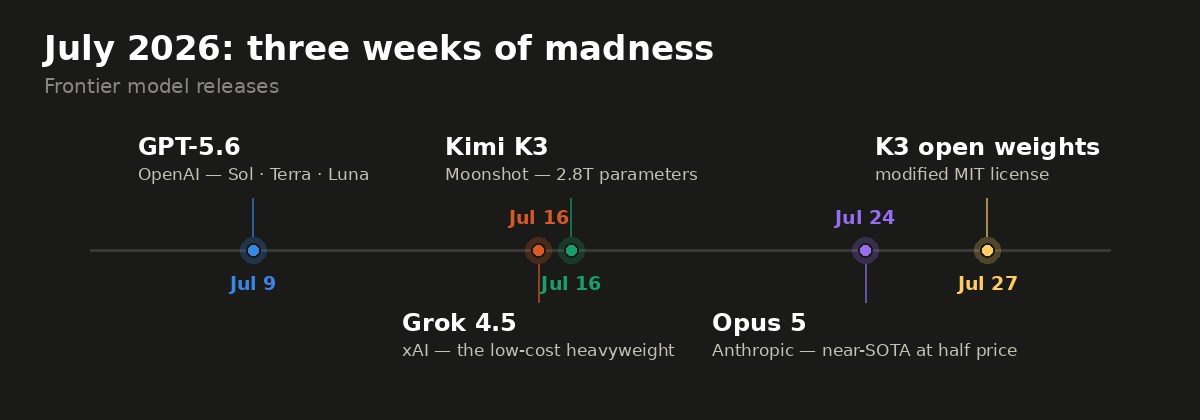
July 9 — OpenAI launches GPT-5.6 in three flavors
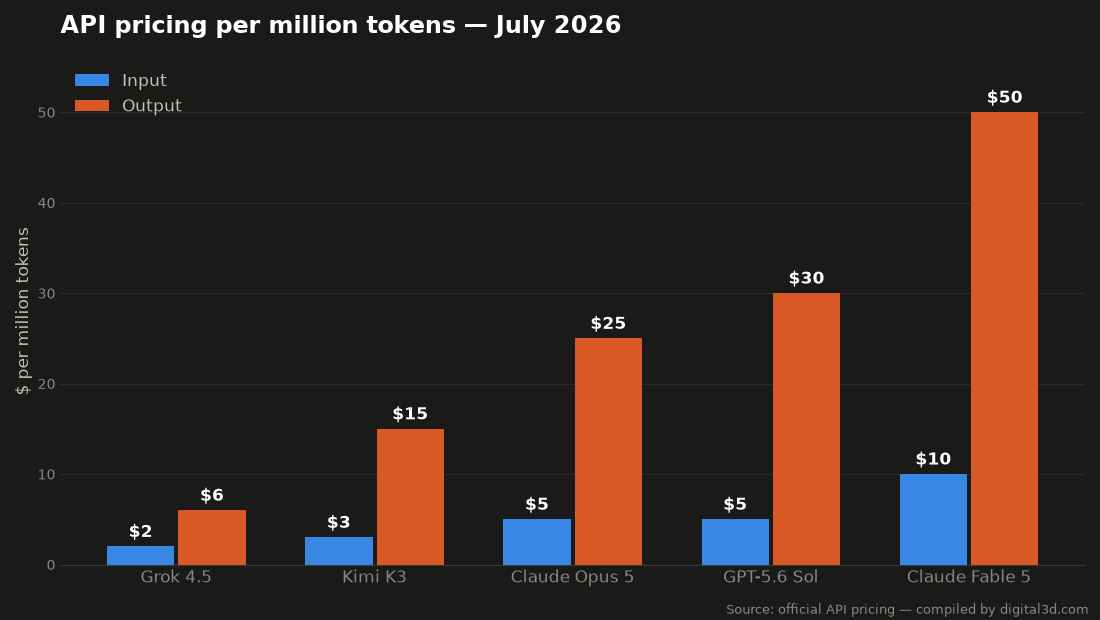
OpenAI kicks things off with GPT-5.6, available in three variants like a food truck menu: Sol (high-end reasoning, code, and science), Terra (the quality of 5.5 at half the price), and Luna (fast and cheap volume). Sol impresses especially in agentic tasks: 91.9% on Terminal-Bench 2.0 and an overall BenchAlign score of 81.96. Context window of 1.05 million tokens, charged $5 in input and $30 in output per million tokens. Serious, efficient, expensive in output — typical OpenAI.
July 16 — double release: Grok 4.5 and the monster Kimi K3
A week later, two releases on the same day (coincidence doesn’t exist in this industry). First up is Grok 4.5 from xAI: less powerful than Sol on most benchmarks (BenchAlign 76.72, Terminal-Bench 83.3%), but a leader on SWE-Bench Pro and especially priced at $2/$6 — about 4 times cheaper than Sol per token. The price-to-quality ratio that hurts.
And then there’s Kimi K3 from Moonshot AI, and here we change categories. 2.8 trillion parameters — the largest open-weight model ever released. The trick to running it without costing a GDP: a Mixture-of-Experts architecture with 896 experts with only 16 activated per token. A huge brain that only mobilizes the useful neurons, in short (we all know someone who does the opposite). Add the hybrid attention mechanism KDA (3 layers of linear attention for 1 full layer), a context of one million tokens, native multimodal text/image/video, and an MXFP4 quantization that keeps it all under ~1.4 TB.
The highlight: K3 takes the world's number one spot on the Frontend Code Arena (1,679 points), ahead of Claude Fable 5 (1,631). A model soon to be downloadable that beats the proprietary champion on frontend code, it’s a historic first. And the full weights arrive on July 27 under a modified MIT license. Before you clear your hard drive for the occasion, do read the section "Can I run it at home?" below: the wake-up call is brutal.
July 24 — Anthropic responds with Opus 5
We thought the month was over, and Anthropic brought out the big guns: Claude Opus 5, positioned as the everyday model that approaches flagship Fable 5... at half the price ($5/$25 per million tokens, compared to $10/$50 for Fable 5). And the numbers are not just for decoration:
- Frontier-Bench: 43.3% — more than double Opus 4.8 (18.7%) and nearly 10 points ahead of Fable 5 (33.7%). Yes, ahead of the big brother.
- ARC-AGI 3 (fluid intelligence): 30.2%, while GPT-5.6 Sol caps at 7.8% and Opus 4.8 at 1.5%. The gap is brutal.
- CursorBench 3.2: at 0.5% of Fable 5's maximum score, for about half the cost per task.
Add a context of 1 million tokens and a low/medium/high effort setting to adjust the cost/brainpower ratio for each request. Anthropic is literally selling "almost-flagship" at mid-range prices — the accountants of tech companies must have shed a small tear of joy.
The big comparison
Because a table is worth more than three more paragraphs:
| Kimi K3 | GPT-5.6 Sol | Grok 4.5 | Claude Opus 5 | |
|---|---|---|---|---|
| Publisher | Moonshot AI | OpenAI | xAI | Anthropic |
| Release | July 16 | July 9 | July 16 | July 24 |
| Architecture | MoE 2.8T (16/896 experts) | n/a | n/a | n/a |
| Context | 1M tokens | 1.05M tokens | 500K tokens | 1M tokens |
| Price (in/out per M tokens) | $3 / $15 | $5 / $30 | $2 / $6 | $5 / $25 |
| Open weights | ✅ on 07/27 (modified MIT) | ❌ | ❌ | ❌ |
| Strength | #1 frontend code (Arena 1 679) | agentic (Terminal-Bench 91.9 %) | quality/price ratio | ARC-AGI 3 (30.2 %), SOTA code |
On real professional tasks (GDPval-AA v2, 44 professions, 9 industries), the hierarchy remains: Claude Fable 5 Max (1,815) ahead of GPT-5.6 Sol Max (1,747.8) and Kimi K3 (1,687) — but predicting an open-weight model in the top 3 worldwide was bold back in January.
« And me, with my Mac or PC, can I run it? »
That's THE question that comes up as soon as you mention the words « open weights ». Short answer: no. Long answer: no, but settle in, because there are plenty of interesting things to say — and especially some quite honorable fallback solutions.
Why « only 16 active experts » won't save your machine
The classic misunderstanding: « it's Mixture-of-Experts, so only 16 experts out of 896 are working, so it fits on my GPU ». Nope. Routing is decided token by token, and no one knows in advance which experts will be called for the next token. Result: all weights must be in memory, all the time. MoE saves computation, not memory. It's a bit like having a library of 896 books: you only read 16 at a time, but you still need the entire shelf at home.
And the shelf hurts: 2.8 trillion parameters in native MXFP4 (4 bits), that's about 1.4 TB just for the weights. Add the KV cache (tens of GB as soon as we talk about long context) and the runtime. Even an aggressive 2-bit quantization — if it comes out and remains usable — leaves you at ~700 GB.
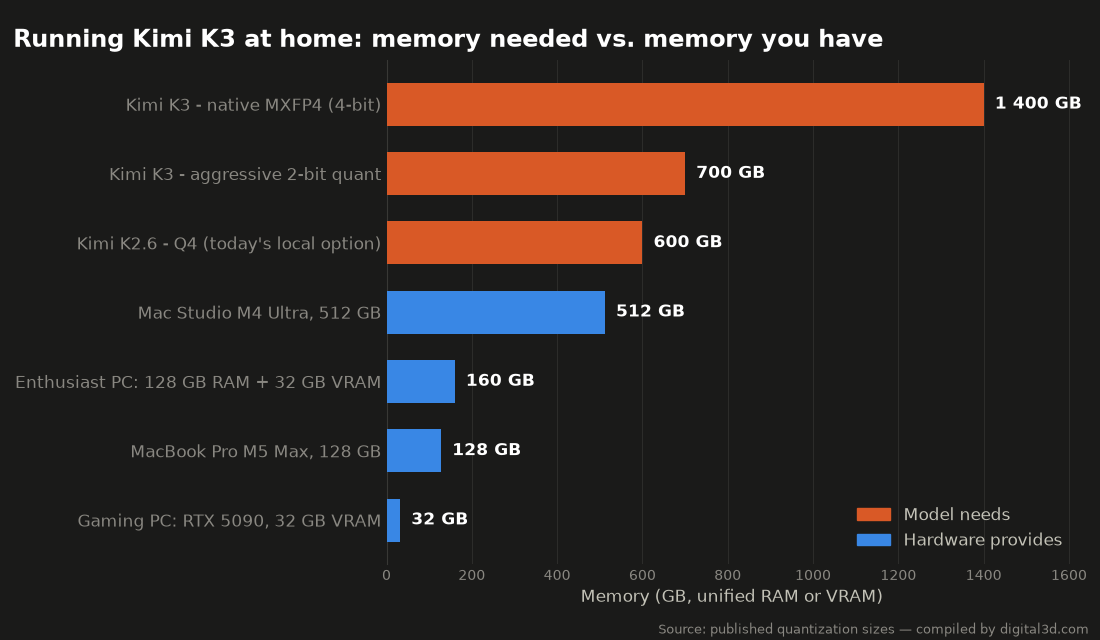
The most expensive Mac Studio M4 Ultra in the catalog, with its 512 GB of unified memory, caps at about 2.7 times less than what K3 requires in 4 bits. And on Apple Silicon, unified memory is shared with macOS, the KV cache, and the inference engine — you never have the number displayed on the bill. In short: it's not a matter of « needing the right setting », it's a matter of physics.
And Ollama, then?
Not yet, and it's not just a matter of size. K3 uses KDA, its proprietary hybrid attention mechanism (3 layers of linear attention for 1 full layer). This thing must be implemented by hand in every inference engine: llama.cpp, Ollama (which relies on it), and MLX on the Mac side currently have no support for KDA. As long as this code doesn't exist, there is neither GGUF nor ollama run kimi-k3, no matter how much RAM you have. The engines that run K3 today are vLLM and SGLang, on multi-GPU servers with high-speed interconnection — the kind of machine that has its own circuit breaker.
What you can actually do this weekend
| Your machine | What is possible |
|---|---|
| Portable / Standard PC (8–32 GB) | K3 via the cloud only: kimi.com, the Moonshot API or OpenRouter (moonshotai/kimi-k3, OpenAI compatible API). Locally, aim for a model of 7 to 32 B: that's where the real offline pleasure happens. |
| Mac 36–128 GB (M4/M5 Pro or Max) | Excellent ground for models 27–70 B quantified via Ollama, LM Studio or MLX. A Qwen3.6-27B runs comfortably on 24–32 GB and remains to this day the best code score you can hold in your hands. K3: no. |
| Mac Studio 256–512 GB | The VIP club of local LLMs: Kimi K2.6 in Q4 runs at 20–32 tokens/s via MLX or llama.cpp (240 to 600 GB depending on quantification). Still not K3, but it's the closest Moonshot model you can host. |
| Gaming PC (RTX 5090, 32 GB VRAM) | Formidable up to ~30 B in 4 bits, with speeds that Macs do not reach. Beyond that, offloading to system RAM turns your chatbot into a pen pal. |
| You really care about it | Hourly GPU rental (RunPod, Vast.ai, Lambda): an 8×H200 node with vLLM or SGLang. Expect several dollars per hour — and 1.4 TB to download before saying hello to the model. |
The configuration recommended by most teams in 2026 is hybrid: a small local model for anything related to sensitive data or repetitive volume, and the K3 API for difficult tasks. You maintain sovereignty where it matters, without turning your office into a data center — and without explaining to your accountant why you bought four Mac Studios "to test something".
A useful reminder for July 27, the day of weight release: plan for storage (1.4 TB is not a USB stick), bandwidth (a download that takes hours, even days), and a bit of patience — you will have to wait for the community (Unsloth and others) to publish dynamic quantifications and for KDA to arrive in llama.cpp. Historically, this takes from a few days to a few weeks. In the meantime, the API does the job very well.
So, who wins?
Norman's answer: it depends on your wallet and your use case. Pure reasoning? Opus 5 and its ARC-AGI 3 score that humiliates the competition. Industrial agency? GPT-5.6 Sol. Tight budget? Grok 4.5, unbeatable on price. Sovereignty and total control? Kimi K3 and its open weights from July 27. The real winner is mostly us: this price war is melting the cost of inference visibly, and while the giants are at each other's throats, China demonstrates that it is possible to bypass chip restrictions with architectural efficiency.
Five years ago, one of these models would have made headlines for six months. Now, we have had four in three weeks, and we find it almost normal. See you on July 27 for the K3 weight download — and probably August 1 for the next "announcement of the century".
Sources
- TechCrunch — Anthropic launches Opus 5
- Vellum — Claude Opus 5 Benchmarks Explained
- Tom's Hardware — Moonshot releases 2.8-trillion-parameter Kimi K3
- VentureBeat — China's Moonshot AI releases Kimi K3
- Simon Willison — Kimi K3, and what we can still learn from the pelican benchmark
- LLM-Stats — GPT-5.6 Sol vs Grok 4.5
- MindStudio — AI Model Pricing in 2026
- Modem Guides — Can You Run Kimi K3 Locally? The 2.8T Hardware Reality
- Layer3 Labs — How to Run Kimi K3 Locally: Hardware & Setup Guide
- Unsloth — Kimi K2.6: How to Run Locally (dynamic quantifications)
- OpenRouter — moonshotai/kimi-k3
Aucun commentaire pour le moment.