Do you remember the paper shares that grandparents kept in a safe at the bank, with their little coupons to cut out to collect the dividends? In Belgium, they have not existed since January 1, 2014. And now, on Thursday, two crypto companies announced that you could once again put shares away in a drawer. Except that this time, the drawer is a little electronic key.
On September 24, Ledger, the French manufacturer of those little boxes that keep crypto off the Internet, and Payward, the parent company of the exchange platform Kraken, signed a partnership. The principle: “tokenized shares”, meaning digital versions of Apple, Nvidia or Tesla shares, which you can keep in your Ledger box instead of leaving them in an online account. Ledger claims around 8 million customers (that is its own figure). On paper, it is the return of the safe at home. Let’s take a closer look.
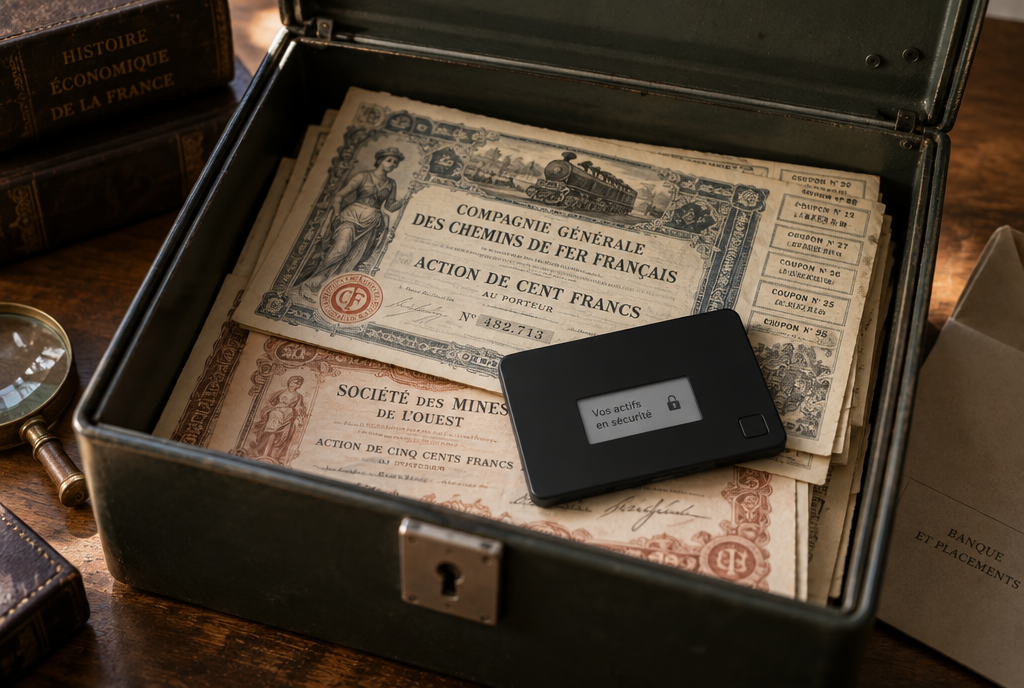
Seventy years apart, and still the same urge to keep everything at home
Bearer shares, 2026 version
A quick step back, because Belgian history is delicious. For decades, a “bearer” share simply belonged to whoever had the paper in their hand. No name on it, no register. You lost it, it was lost. Someone stole it from you, it belonged to the thief. The law of December 14, 2005 abolished all that, precisely because this anonymity served fraud a little too well. On January 1, 2014, the last papers were automatically converted into entries in an account, and those nobody had taken care of ended up being sold, with the money deposited at the Deposits and Consignments Fund. There are surely still a few old certificates sleeping in attics, and their heir can still claim the money from the Fund, subject to a fine that goes up with the years.
Today, a “normal” share is a line in your bank’s or broker’s computer. You never touch it. What Ledger and Kraken are offering is to put the object back in your pocket. But watch out, the object is no longer exactly a share.
What you really have in the key
Kraken’s platform is called xStocks. When you buy an “Apple token” there, you are not buying an Apple share. You are buying a token, meaning a line entered in a large public register shared by thousands of computers (here, the Solana blockchain), which says “this thing belongs to this secret code”. This token is issued by a company based in Jersey, Backed Assets. For each token, it in principle keeps a real Apple share with a custodian, a bank specialized in holding securities. Your token therefore follows the share price one for one.
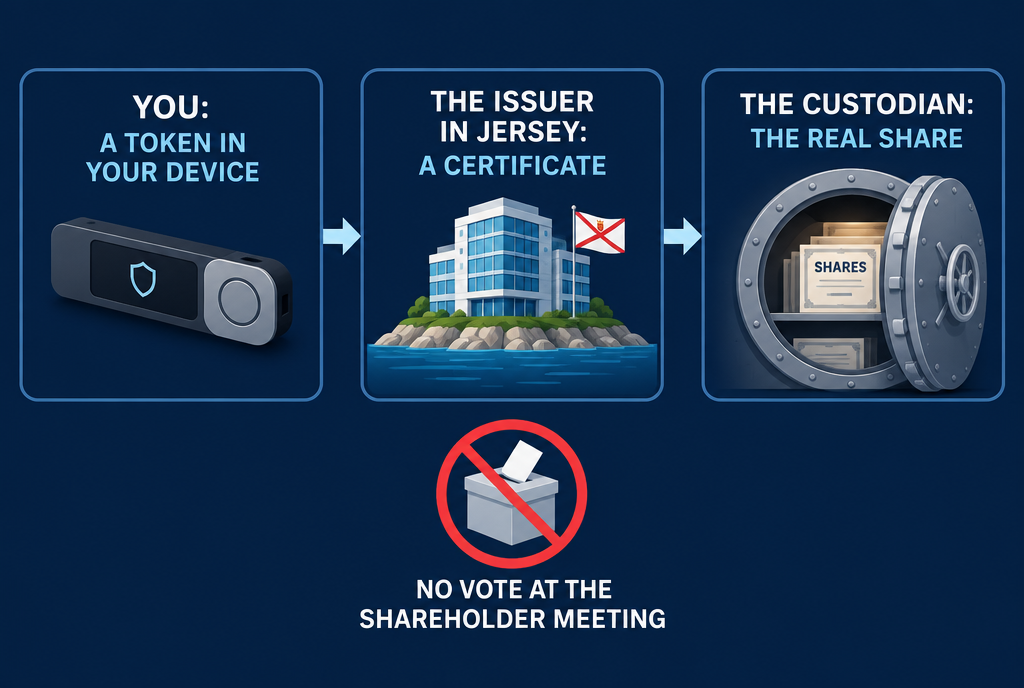
Three levels between you and the share, and you only own the first one
And that is where it gets interesting, because Kraken states it in black and white in its warnings: xStocks holders “do not own” the underlying shares, they have “no voting rights” and no direct legal recourse regarding those shares. So you are not going to Apple’s general meeting to raise your hand. The dividends do not arrive in cash: they are automatically reinvested, and your number of tokens increases a little, after withholding taxes.
So you have a sort of very well-made cloakroom ticket. The coat exists, it is in the cloakroom, the ticket is worth the coat. But you are not the one who has the key to the cloakroom.
In practical terms, the tokens are traded almost all the time, five days out of seven and 24 hours a day for most of them, and even on weekends for some, whereas the New York Stock Exchange closes in the evening. Payward announces more than $42 billion traded in total since the launch of xStocks, the company’s figure, once again. And it is not available everywhere: not in the United States, not in Canada, not in the United Kingdom or Australia. In Europe, since August 18, Kraken has been offering its clients in the European Economic Area more than 700 xStocks alongside more than 7,000 classic American shares, in the same account, through a Cypriot subsidiary that has the European authorization for investment firms. Kraken specifies that country restrictions apply, without detailing them: for Belgium, we will see it in the app.
What works right now
A device like the Ledger is a hardware wallet: it keeps locked away the secret code that proves your tokens belong to you, and that signs every transfer. This code never leaves the device. Even if your computer is packed with viruses, nothing gets sent unless you physically press the button. The brand's high-end model, the Stax, was also designed under the direction of Tony Fadell, one of the fathers of the iPod.
Since Thursday, a Kraken customer who has a Ledger can deposit and withdraw their tokens and approve transactions directly from their device. Before confirming, the screen clearly displays what you are about to sign (Ledger calls this “Clear Signing”): how much, what, where to. No more incomprehensible messages like “sign 0x4f3a…?” that you approve with your eyes shut.
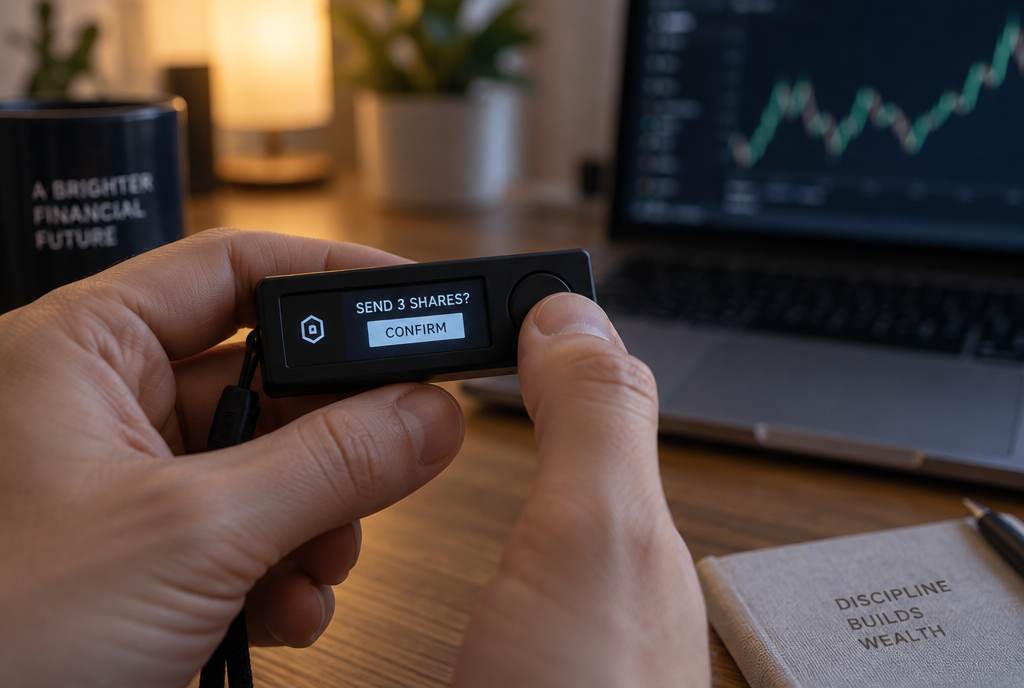
The hacker may have your password, but he doesn't have your thumb
What will come later, with no date announced: buying, selling and sending these tokens directly in the Ledger Wallet app, covering “hundreds” of American and international stocks. And Ledger says it is talking with Coinbase, Binance and Robinhood about doing the same thing with them.
The key protects you, but from whom?
That's the question to ask yourself, and there are two answers.
Against the hacker who steals the password to your Kraken account, yes, frankly, it's rock solid. Without the device and without your thumb, he can't send anything anywhere. For someone who has seen the stories of accounts emptied overnight, it's a real plus.
Against the issuer or the custodian, no. Your device keeps a token, not the stock. If the bank that holds the real stocks goes bankrupt, Kraken says so itself: access to the stocks may be delayed, or even impossible, with a “partial or total” loss at stake. Your Ledger won't be able to do anything about it. It will carefully keep a cloakroom ticket for a cloakroom that burned down.
And then there is the question that the specialist site CoinDesk asked right away: online brokers process thousands of billions of dollars in stock orders every day with relatively few thefts, so does Mr. Everybody really need to take his stocks out in a device? For me, it's mainly a bridge between two worlds: people who already have a Ledger for their bitcoins can now put something else in it, with the same habit and the same button. It's clever, and I think this is only the beginning. But this isn't grandpa's safe. Grandpa's safe, itself, really contained the stocks.
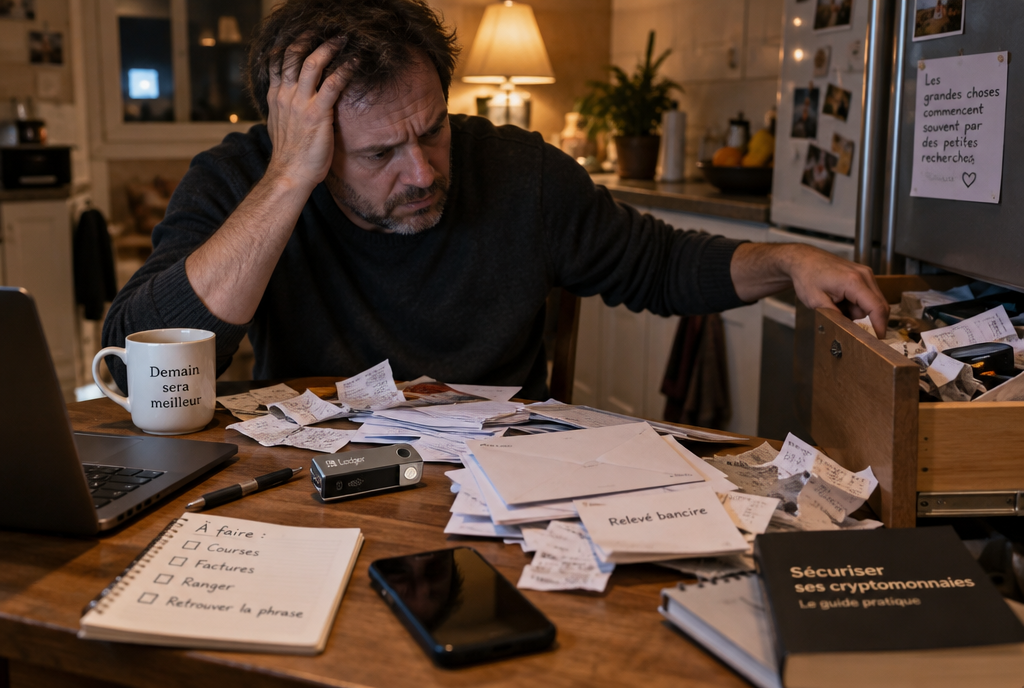
The bank had a teller window. Your 24-word phrase just has a drawer
Because the old flaw of bearer securities comes back with it too: what you keep yourself, you can lose yourself. A Ledger is restored using a 24-word phrase, written down on paper on the day of installation. Lose the device and the phrase, and there is no adviser to call. So good luck to whoever turns the whole house upside down on a Sunday evening looking for the little card put away “somewhere safe”, three years ago!
Sources
- Fortune, September 24, 2026: the announcement from Ledger and Payward
- crypto.news, September 24, 2026: what is available and what is planned
- Kraken, warning about the risks of xStocks
- Kraken, August 18, 2026: American stocks for customers in the European Economic Area
- Belgian Official Gazette: law of December 14, 2005 abolishing bearer securities
Join the conversation
You need an account to comment on this article. Creating one is free and takes under a minute.
No comments yet.