Monday, September 21, the listed funds holding bitcoin took in $999 million. Tuesday, another $714.7 million. Over four sessions, $2.3 billion flowed into these baskets, according to figures published by Farside Investors. And on Wednesday evening, the price had fallen by 2.6%, to $84,007, according to CoinMarketCap figures.
Now there's a week that does us a favor: it puts an end, once and for all, to the belief that all it takes is a wave of institutional buying to make a price go up.
A $5.7 billion hole plugged in ten weeks
To understand what just happened, you have to go back to July 13. That day, the American listed funds showed a negative balance of $5.69 billion for the year: since January 1, more money had left these baskets than had entered them, and the hole had been getting deeper for six months. Since then, $6.04 billion has come back. And for the first time since July 13, the annual balance has moved back into positive territory, at around $349 million. Ten weeks have just wiped out six months of outflows. The figure comes from SoSoValue, which tracks these movements day by day.
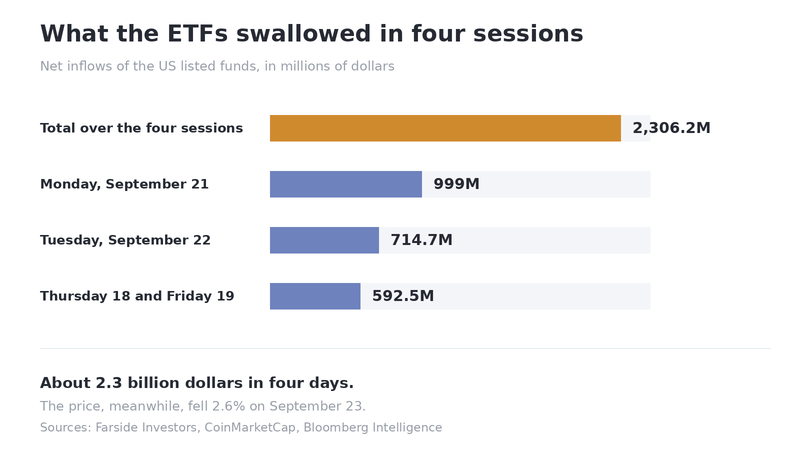
Four sessions, $2.3 billion, and a price that falls
A quick reminder for those who have never bought a fund share. An ETF is a basket that holds something, and whose shares can be bought on the stock market like a stock. Here, that something is real bitcoin. You go through your usual broker, you don't have any keys to keep safe, no wallet to install, and you don't own bitcoin: you own a share of a basket that owns it. If the mechanics of the network itself interest you, I explained how the blockchain works in March.
And that's where these flows become interesting. These baskets didn't push the price up by creating bitcoins: they bought bitcoins that already existed. Every dollar that came in left a buyer's pocket to enter a seller's. The price itself depends on something else.
So why is the price falling
Because on the other side of the purchases, there are sales. And right now, those selling have a good reason to do it.
The average holder had paid $81,700 for his bitcoin. That figure is an analyst's calculation picked up by Bloomberg Intelligence, not an official average, but it gives you the general scale. This week, the price rose above $86,500, and that's the level from which this analyst considers the average holder to be back in profit, for the first time since January. Some of them sold. Not out of panic: out of relief.
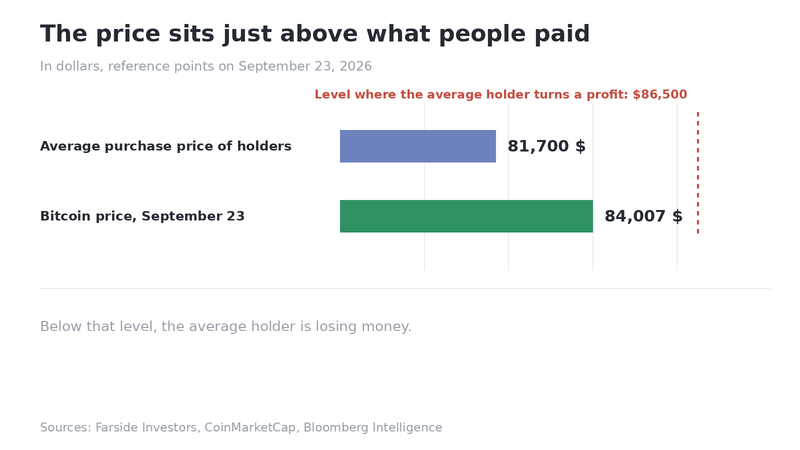
The price is sitting just above what people paid, and you can see it in the order books
The rest of the market followed, and not in the right direction. Still according to CoinMarketCap, Ether fell back to $2,652, down 3.5% on the day, XRP lost 5% to $1.49, BNB is at $763.60 and Solana at $113.80, both in the red. When everything goes down at the same time, it's no longer a bitcoin story: it's a story about appetite for risk, and this week, there wasn't much of it.
To measure how far we've come, bitcoin was falling below $77,000 ten days ago, and that wasn't good news either. It's at $84,007 today, which is 9% higher. Those who bought in that range are therefore in profit, and they are the ones selling now.
So what does that change for you in concrete terms
Three things, and they don't all point in the same direction.
First, the front door has become ordinary. A listed basket can be bought from your brokerage account, in the same section as your stocks, with the same button. No exchange platform to choose, no twelve-word sentence to copy onto a scrap of paper, no hardware wallet to order. Some life insurance policies and some savings plans offer them too, which was unthinkable two years ago.
Then, the downside of this simplicity: you don't own bitcoin. You own a share in a basket, and that share is sold during Wall Street's opening hours, from Monday to Friday. Bitcoin, on the other hand, trades twenty-four hours a day, seven days a week. In practical terms: on Sunday evening, when something moves, you watch the price tick by without being able to do anything. You also pay annual management fees to the fund, a few tenths of a percent, displayed on each product's page.
And then there's the calendar. On September 30, the United States publishes the price index their central bank watches as a priority, the PCE. You don't need to know what those three letters mean: remember that every time this figure comes out, everything traded on the markets, including crypto, moves within the minute. It's the next date when something gets decided, and nobody, myself included, knows in which direction.
What I think about it
This week reassures me, and not for a financial reason.
For two years, we've been told that the arrival of institutions would change the nature of bitcoin, that the market would become sensible, that big purchases would support the price. Look at the facts: $2.3 billion came in over four sessions, and the price fell by 2.6%. Institutions are buying, but they're buying from someone, and that someone is selling. A flow, no matter how big it is, isn't an engine. It's a tap.
The second reason is more personal. I prefer a market that rises 11% in a week because purchases are coming in, then gives back 2.6% because people take their profits, to a market that rises every day for no reason. The first has buyers and sellers. The second has only buyers, and that always ends badly.
The fact remains that these figures move faster than I can write them down. The price quoted here is the one from September 23 at 7:20 p.m., and if you're reading me on the 30th, it will already have told a different story.
$2.3 billion on one side, minus 2.6% on the other. If you're looking for a market that obeys arithmetic, you've still got the savings account.
Join the conversation
You need an account to comment on this article. Creating one is free and takes under a minute.
No comments yet.