On Monday, September 14, a little before 6 a.m., some Oracle employees discovered that they could no longer log in. Sessions closed, Slack cut off. The email arrived just after, and it was two sentences long: your position has been eliminated “as part of a broader organizational change,” and “today is your last day of work.” No meeting, no farewell drinks, a spokesperson who did not call the journalists back. Three employees told Business Insider about the scene, and the email has been making the rounds online ever since.

Waking up at 5:40 a.m., you know that one. The email at 6 a.m., not so much
It is not really a surprise. During the fiscal year that ended on May 31, Oracle went from around 162,000 employees to 141,000. Twenty-one thousand people in twelve months, 13% of the company. An internal document that circulated last month spoke of cuts reaching double digits in percentage terms in some teams. On Monday, the next wave began, and no one yet knows how many people it is carrying away. Oracle has said nothing. Around two-thirds of the employees who remain work outside the United States, and in Romania, 500 positions had already disappeared in June at a site with 4,000.
And here's where you have to be careful, because the obvious explanation is wrong. Oracle is not laying people off because artificial intelligence is doing their employees' work. Oracle does not sell that. Oracle rents out computers. It is an old software company, known for its database, that has made renting out computing power its new business and its new engine.
So where does the money go? Into concrete, cables and graphics cards. A datacenter, if you have never seen one up close, is a gray windowless hangar, with cooling units on the roof and air trembling above it. Inside, there is nothing to visit: rows of black racks, miles of cables, and machines that heat up day and night. It does not make anything, it does not sell anything, it computes. And it costs a fortune before it even brings in its first cent.
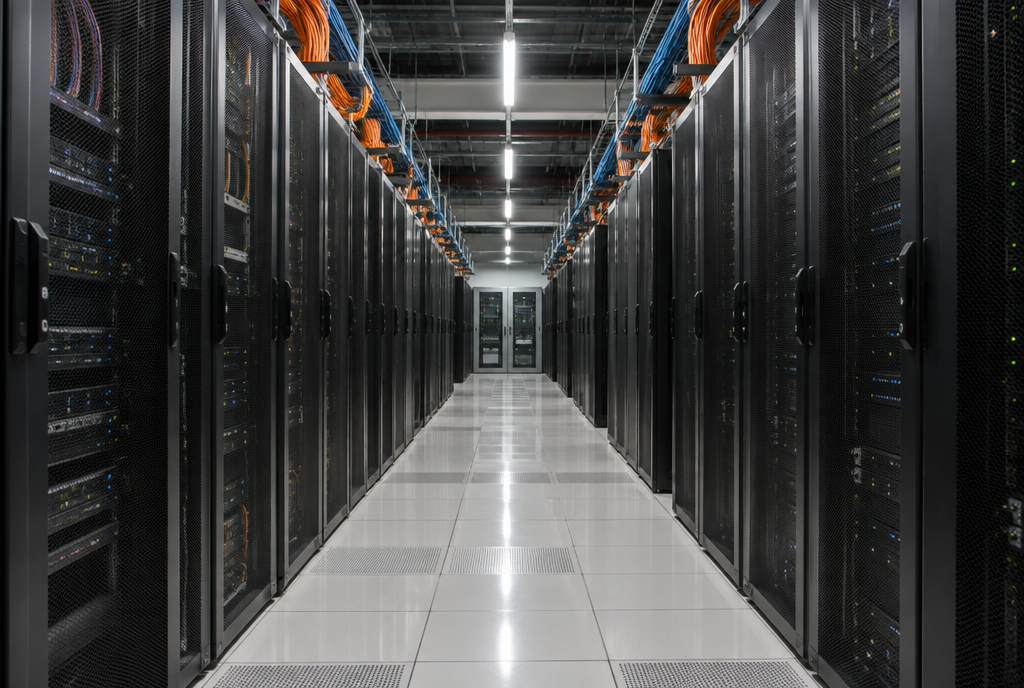
A gigawatt of computing gets poured into concrete long before it gets billed
The clearest example is in Michigan. In Saline Township, Oracle is building a campus planned to exceed one gigawatt. One gigawatt is the output of a nuclear reactor, enough to keep a medium-sized city running. The financing was finalized in April for $16.3 billion, presented as the largest debt package ever put together for a single technology site. On the bill, $14 billion in bonds, including $10 billion snapped up by PIMCO, one of the biggest bond managers on the planet. Rate: 7.5%, over nineteen and a half years.
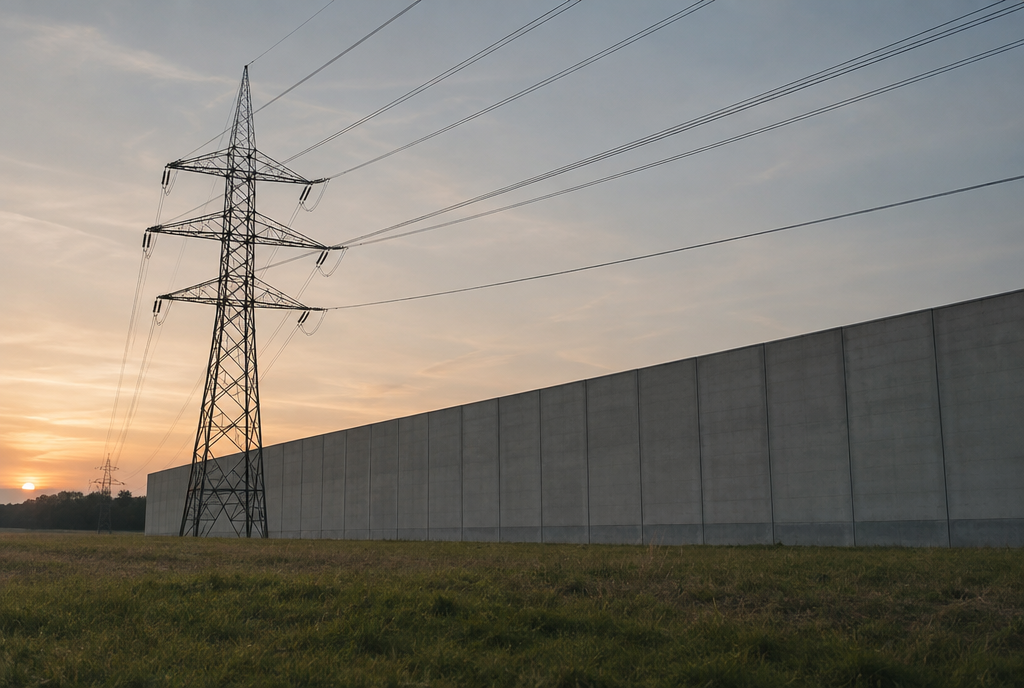
What comes out of the hangar cannot be seen in the photos: it comes out through the high-voltage line
And this is only one site. Oracle is already carrying $72 billion in debt held by its data center partners, between Michigan, Texas, Wisconsin and New Mexico. During the past fiscal year, the company spent $55.7 billion on infrastructure, and it expects $90 to $95 billion for the one that is beginning, including 70 from its own pocket, with the rest being repaid by customers. In the first quarter alone, the bill went from $8.5 billion to $28.5 billion.
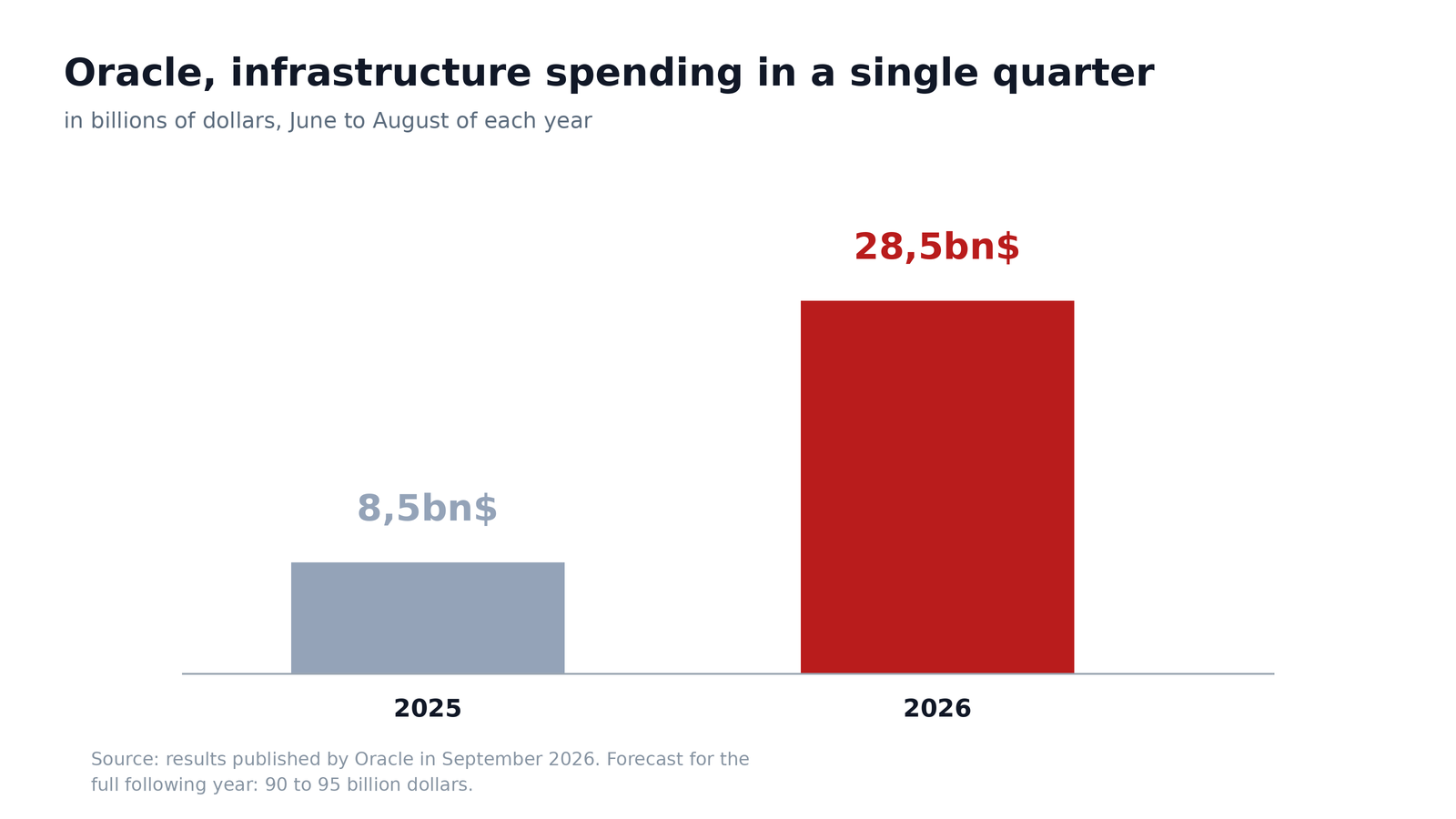
One quarter, from 8.5 to 28.5 billion. The full year is expected to come in between 90 and 95
To pay for it, you have to borrow. Oracle plans to raise nearly 40 billion dollars in debt and equity over the year, and the rating agencies rate it BBB at S&P, Baa2 at Moody's, two notches above speculative grade, with a negative outlook. Translation: people keep lending, but they are watching closely.
There is still one figure that would make any boss dream: 638 billion dollars in signed orders that have not yet been delivered, what is called the backlog. Far more than analysts expected. Except a backlog is not a bank account. The CFO said it himself: only 12% will come in over the next twelve months, the rest is spread over years. And a significant share depends on a single customer, OpenAI, which has never turned a profit.
A week ago, I was looking at the American layoff figures, and AI was already no longer the main cause. It is becoming the biggest bill. That is the whole difference, and it is more important than it looks: at Oracle, nobody was replaced by a program. They simply decided that the money would go into machines rather than salaries. TD Cowen analysts put the payroll savings at between 8 and 10 billion dollars a year. A cut is not technical progress. It is a trade-off, and someone signs it.
All right, let's be fair for two minutes. These data centers are not pie-in-the-sky promises. They are rising out of the ground, burning concrete and steel, keeping construction sites going. Over the quarter, Oracle beat expectations slightly on revenue and more clearly on earnings per share. A company that is collapsing does not do that. The bet is colossal, it is not stupid.
And are we protected?
In part, yes. An employer that wants to eliminate a large number of jobs in the European Union has to inform and consult workers' representatives before the layoffs take effect, with a waiting period to observe. That does not save the jobs and it does not make the news any easier, but it means that here, you do not lose access at 6 a.m. and find out by email. Romania went through this process for its 500 jobs in June. The United States did not.
Second point, more discreet and more interesting. This money does not come out of a hat. The 10 billion from Michigan comes from PIMCO, meaning, at the end of the chain, from pension funds and insurance companies. When people keep telling you that AI is going to change everything, just remember that the bill is being paid with borrowed money, and that someone will have to repay it. This is not an argument against AI. It is the part of the movie nobody ever talks about.
There is one question few people ask and that I find more interesting than the others: what if the customers did not show up? One gigawatt of computing cannot be plugged into something else, it cannot be rented out at the local market, and a windowless warehouse cannot be recycled into apartments. For now the backlog is full and the party goes on. These machines have a lifespan of a few years, not a few decades.
As for the 21,000 people who lost access before learning the bad news, they no longer have that file to deal with, and frankly, they are not losing much. Good luck to Oracle with its gigawatt. One free piece of advice before pouring the second slab: read the contract of the customer that accounts for half the backlog twice.
Join the conversation
You need an account to comment on this article. Creating one is free and takes under a minute.
No comments yet.